
Bari Two Day Itinerary: Old Town Day and Modern City Day
Plan two days in Bari with a dense old-town day of basilica, castle and orecchiette street, then Murat, the fish market and a waterfront evening.
On this page
Bari is often treated as a transit hall for Puglia, a place to change trains before heading to Alberobello or Matera. That is a mistake, because the regional capital has a lived-in old town, a working fish market and a waterfront that fills up late in the day. Two days give you enough room to see the main sights on foot and still eat and stay out in the evening, which is when the city is at its best.
This plan is deliberately simple. Day one stays inside Bari Vecchia, where the basilica, the small Nicolaiano museum, the castle exterior and the orecchiette street sit within a short walk of each other. Day two crosses into Murat for shopping and coffee, visits the fish market, and leaves the afternoon open for a beach or more old-town wandering.
Why two days suits Bari better than one
Seeing the headline sights in Bari can be done in a single day, but that pace misses the point. The city is not a checklist of blockbuster monuments; it is a place to soak up the atmosphere, eat well and linger. A local guide puts a realistic minimum at a couple of days if you want to sample the food and get to know the city properly.
Life here starts late. Locals gather in the squares and streets in the afternoon and evening, when bars and restaurants open and street food vendors set up. If you arrive and leave within a day, you risk seeing the sights and missing the city. Two days let you plan an evening rather than an early dinner and a hotel room.
Bari also works as a base for the rest of Puglia, with most regional transport passing through it. That makes two days a sensible minimum rather than a maximum: you can spend one full day in the city, one on a day trip, and keep the evenings for Bari itself.
Before you go: where to base yourself
The railway line splits central Bari into two useful halves. North of it, toward the sea, lies Bari Vecchia, the old town, full of historic buildings and constant street life. Closer to the station is Murat, the more modern grid of shops, restaurants, bars and cafes. If you only have a day or two, staying near the old town saves time and puts the main sights on your doorstep.
Murat suits longer stays and day-trippers. It has more of the comforts of modern life and quick access to Bari Centrale, which is useful if you plan to take trains to nearby towns. For a two-day trip built around walking, Bari Vecchia is the stronger choice, while Murat is the practical one if you value convenience over atmosphere.
Leave the car out of the centre. Parking is limited, driving in town is stressful and the historic core is very walkable. If you want a rental for day trips, collect it at Bari Airport on the day you leave rather than keeping it while you explore the city.
Day one, morning: Basilica di San Nicola and the Museo Nicolaiano
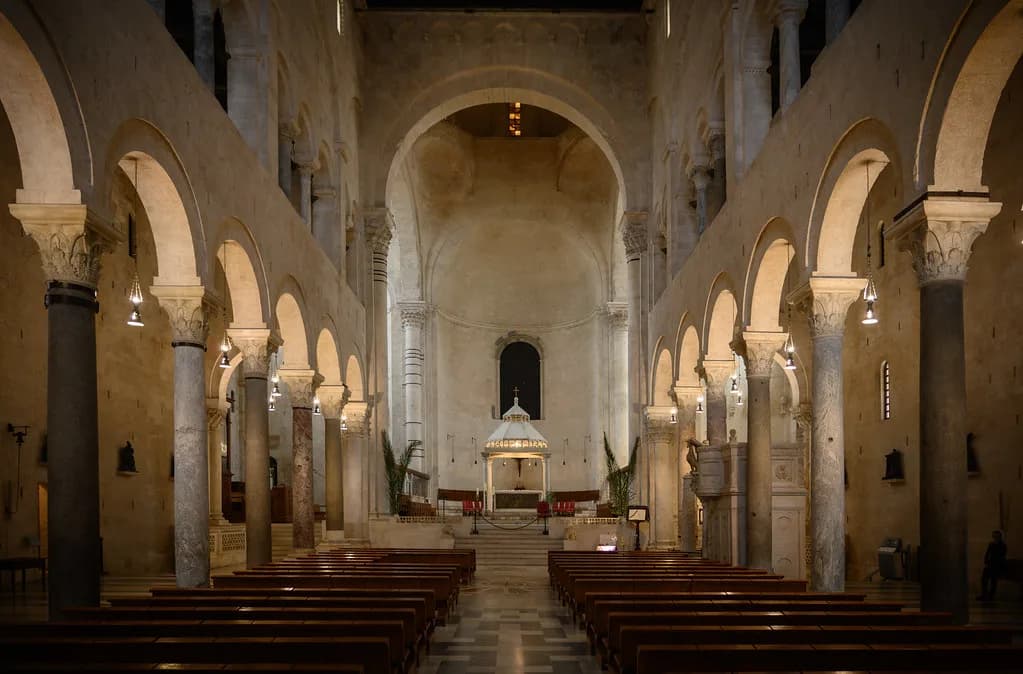
Start at the Basilica di San Nicola, the city's essential stop. Saint Nicholas was a bishop in what is now Turkey, and his remains were brought to Bari in 1087, with the basilica completed in 1197. His tomb sits in the crypt, and the church draws pilgrims from both Catholic and Orthodox traditions. Access to the church has been free; check locally for current entry arrangements and any restrictions on the crypt before you go.
Just behind the basilica is the Museo Nicolaiano, a small collection telling the story of the saint and his link to Bari. It holds relics, paintings, old parchments and bottles once used to hold the Manna of Saint Nicholas, drawn from the basilica's archive. Entry is ticketed, so treat it as a separate paid stop rather than part of the church visit, and confirm the current ticket price and hours at the door or through the city's official site.
The museum is a compact space with a cafe, and it rewards people who are genuinely interested in the history rather than those ticking off sights. If you would rather spend the time walking, skip it and save your legs for the alleys; the basilica alone is the more important visit.
Day one, midday: the alleys of Bari Vecchia
Bari Vecchia is not a museum quarter. It is still inhabited, and residents leave doors open, sit outside and go about daily life while visitors pass through. Walk without a fixed route: the pleasure is in the narrow lanes, the neighbourhood shops and the sound of the place. If you want more structure, a self-guided route helps you cover the main corners without turning the morning into a march.
Two small squares are worth seeking out. Largo Albicocca, known as the Square of Lovers, takes its name from an apricot tree where couples once exchanged fruit, and it is lit up in the evening. Piazza Mercantile has the Column of Justice, a reminder of the city's rougher past, with marks still visible on the stone.
Keep an eye out for less obvious corners as you wander. The old town rewards the curious more than the efficient, and the wider list of understated stops is covered in this guide to hidden gems in Bari.
Day one, afternoon: Castello Svevo and the orecchiette street
The Castello Svevo, or Norman-Swabian Castle, began in the twelfth century under King Roger II and was later rebuilt after destruction. Over the centuries it passed through royal hands, including those of Bona Sforza, before serving as a prison and a barracks. Today it hosts exhibitions, and the interior is ticketed; hours and admission change, so check before building your afternoon around it.
Even if the castle is closed, the surrounding old town fills the time easily. Across from the entrance, an arch leads into Arco Basso, the street known as the orecchiette street, where women traditionally shape fresh pasta by hand and sell it from their doorsteps. Whether stalls are active varies by hour and season, so treat buying pasta as a bonus rather than a guaranteed stop.
Judge what you buy on the day. The street has had its share of attention and controversy over claims about handmade produce, so look at what is actually being made in front of you rather than assuming every packet is shaped on the spot. Taralli, the crunchy fennel-seed rings sold all over Puglia, make an easy purchase either way.
For a cold stop nearby, Gelateria Gentile is directly across from the castle and is described locally as one of the city's oldest ice cream shops. It is a good reset before the evening walk along the water.
Day one, evening: the Lungomare and the old port
Head to the Lungomare, Bari's seafront promenade, as the light softens. The stretch past Teatro Margherita toward Porto Vecchio and Molo San Nicola is the liveliest part, where families set up chairs and stay out late. The theatre itself, now used for art exhibitions, is a useful landmark on the walk.
Food near the old port leans on the sea. Bari is a strong city for fresh seafood, and the fishermen returning to Molo San Nicola set the tone. The fish market itself is a lively place to explore, with raw seafood served in restaurants and street stalls frying polenta and other snacks. For something simpler, El Chiringuito is a no-frills local bar known for cold beer and panzerotti, the fried dough pockets filled with tomato and mozzarella.
Order seafood only from established vendors. Fish and shellfish sold openly by restaurants and the market are the safe choice, and you can ask what is seasonal and local before ordering.
Day two, morning: Murat and Via Sparano
Cross the railway line for a different Bari. Murat is the modern grid of shops, cafes and bars, with Via Sparano as its main artery. The street is where the city's best stores sit alongside fine Art Nouveau facades, making a slow walk as much about architecture as shopping.
This is also the place to take a proper coffee break. Murat has high-end cafes and creative cocktail bars, and it is where locals do their daily business rather than a preserved tourist zone. Wander without a target, then pick a cafe with a full morning crowd.
If you would rather keep the whole two days in the old town, that works too. Murat is a pleasant contrast rather than a must; skip it without regret if the alleys of Bari Vecchia are still calling you.
Day two, midday: the fish market and street food
The fish market is the city's best free spectacle. Go mid-morning to watch the trade, listen to the calls and see what came in that day. From there, build lunch from street food rather than a sit-down meal: focaccia Barese, the thick potato-dough version topped with tomatoes and olives, is a local staple and nothing like the focaccia you may know.
Add panzerotti, sgagliozze and other fried snacks from the old town, and check what is being fried in front of you rather than settling for the first display. For a proper sit-down meal, look for restaurants serving raw seafood, octopus panini or local meat rolls, and ask whether horsemeat is used before ordering braciole, since it is a local tradition.
Bakery and market prices change constantly, so compare a couple of counters before committing. Cash still helps at smaller stalls, and lunch from a bakery is usually the cheapest way to eat well in the centre.
Day two, afternoon: beach or more old town
Decide between the beach and the city rather than trying to do both. Bari has public beaches and private lidos, with Pane e Pomodoro, San Francesco and Spiaggia Torre Quetta among the main options. San Francesco has a lido and a free communal area beside it; the paid section offers showers and bars and a lounger for the day, though prices vary by operator and season, so ask at the entrance.
Be honest about the trade-off. A beach afternoon means less time for the old town or Murat, and the sand can get punishingly hot in summer. If you want both a swim and a city walk, choose the nearer beach and plan a late return rather than a full beach day.
If the weather turns or you would rather stay in the city, spend the afternoon revisiting Bari Vecchia at a slower pace. The alleys, small shops and waterfront benches are a fine alternative, and the density of the old town means you can duck in and out of the heat.
Day two, evening: aperitivo, dinner and staying out
Bari's evening rhythm is the reason to stay two nights. Locals gather in the squares for drinks before dinner, and the streets stay busy well past typical restaurant opening times. Build in an aperitivo rather than an early meal, then eat when the city does.
For dinner, resist over-planning. Choose a restaurant that is full of locals, order what is seasonal and ask for the local pasta with turnip tops or a tomato sauce. Seafood, fried snacks and bakery-style pizza are all strong choices for a two-day trip, and you can always return to a favourite on a third day.
If you only have one evening left, spend it near the water rather than chasing a reservation across town. The walk back through the old town, gelato in hand, is the best closing note.
If you have a third day: easy day trips
Bari is an efficient base for the surrounding region. Polignano a Mare, Monopoli, Alberobello and Locorotondo are all within reach, and Matera in neighbouring Basilicata is a memorable day out for its ancient cave dwellings. Longer trips reach Lecce, sometimes called the Florence of the South, and Ostuni, the white city.
With three days, add one day trip and keep the other two for the city. Polignano and Monopoli are the easiest coastal options, while Alberobello's trulli houses and Matera's cave districts are the most distinctive. The rest of your time can follow a relaxed three-day version of this plan.
Practical notes for a two-day visit
Plan around the heat. Bari is at its most comfortable in spring and early autumn, and July and August can be brutal, with afternoons too hot for comfortable exploring. Summer also brings cruise crowds to the port. An early start, a long midday break and a late afternoon walk is the rhythm that works best in the warmer months.
Treat the basilica, museum and castle as separate visits with separate conditions. The church and the castle are distinct sites, and the museum is its own ticketed collection. Confirm hours and tickets through the official city site or the site itself on the day, especially outside high season.
Walking is the best way to cover the centre, and two days of it is achievable without a car. Keep a small amount of cash for markets and street food, expect larger venues to accept cards, and leave slack in the schedule for the city's late-running evenings.
Plan Your Two Days in Bari
Two days in Bari work best as a slow day in the old town and a broader day across Murat and the waterfront, with the afternoon left flexible. Book accommodation in Bari Vecchia if you want atmosphere and short walks, or in Murat if day trips and station access matter more.
Check current hours and tickets for the castle and museum before you travel, and confirm transport times and fares with the operators rather than relying on older guides. The rest of a good Bari visit needs little planning: walk, eat late and let the city set the pace.
Frequently Asked Questions
How many days should you spend in Bari?
Two to three days is a good fit. One day covers the main sights, while two days let you eat well, enjoy the evening rhythm and still see the old town without rushing. Add a third day if you want a day trip to Polignano a Mare, Alberobello or Matera.
What should you not miss in Bari on a two day trip?
Prioritise the Basilica di San Nicola, the alleys of Bari Vecchia, the Lungomare seafront and a walk along Arco Basso, the orecchiette street. On day two, the fish market and a lunch of focaccia Barese are worth planning around.
Is Bari a better short-break base than Lecce?
They suit different trips. Bari is bigger, busier and more lived-in, with an inhabited old town, a working port and easy transport across Puglia. Lecce is more polished and compact. For a two-day city break with day trips, Bari is the more practical base.
Can you see Bari in two days without a car?
Yes. The centre is walkable, and Bari has the best public transport connections in Puglia, so day trips can be done by train or bus. If you want a rental car, pick it up at the airport when you leave town rather than keeping it in the centre.
Is a beach day realistic within a two day Bari itinerary?
It is, but it replaces old-town or Murat time rather than adding to it. Choose a beach close to the centre, ask about lounger and umbrella prices at the entrance, and return late enough to catch the evening atmosphere. In summer, avoid the hottest hours.
Sources
Continue exploring
More guides you'll find useful





