
Vicenza Cathedral Guide: Duomo di Santa Maria Annunziata
A Vicenza Cathedral guide tracing Roman origins, the Gothic facade, the Civran Parament cycle and Palladio's dome, with practical notes to verify before you go.
On this page
Vicenza Cathedral stands where the Roman cardo crossed today's contrà Lampertico, a short walk from the streets most visitors follow between the Basilica Palladiana and the Teatro Olimpico. It is easy to treat as a passing stop, yet the building repays a slower look because four distinct centuries survive in one interior. What follows traces the sequence a visitor actually sees: the Roman layers, the Gothic shell, Palladio's dome, the chapels and the repairs after 1944.
Practical details are the one thing this guide deliberately leaves open. Opening hours are not published in a stable, citable form in the sources here, and whether you can walk in freely on a given morning should be confirmed with the diocese rather than assumed from a third-party listing. Check the Diocese of Vicenza website before setting out, and treat any old timetable you find as a starting point only.
Where the Cathedral Sits and Why It Rewards a Detour
The cathedral occupies a corner of the old Roman street grid, which means you approach it through the same narrow contrà that thread central Vicenza. The Palladian Routes history of the church notes that the site began as a wealthy Roman domus at the crossing of the cardo and the present contrà Lampertico. That changes how you read the building: it is not a single Renaissance gesture but a palimpsest layered over domestic Roman Vicenza.
Allow roughly half an hour for the interior and longer if you plan to study the apse paintings closely; that is a suggested pace, not an official duration. The compact nave means most principal works are visible from a few standing points, which makes the cathedral a low-effort addition to a walking day. Photography, seating and any restricted areas should be checked on site rather than assumed.
From Roman House to Christian Church
The Palladian Routes account traces a Roman residential complex enlarged in the second century AD with an apsidal hall used as a domus ecclesiae, a meeting place for the first Christians. A cathedral with a semicircular apse and three naves followed at the end of the fourteenth century in the same spot, though the source folds later rebuilding into one narrative. Read the sequence as an outline rather than a precise excavation report.
Destruction is the recurring theme. Attila's forces devastated Vicenza in 425 and damaged the cathedral, which was rebuilt with three naves. The earthquake of 1117 destroyed it again, and this time it rose with five naves. Frederick II's troops sacked the city in 1236 and caused considerable damage. Each episode explains why so little of the earliest fabric is legible today.
The turning point came in 1261, when Bishop Bartolomeo da Breganze brought back a holy thorn from the crown of Jesus, a gift from King Louis IX of France. He began the temple of Santa Corona soon afterwards and in 1265 pushed the reconstruction of the cathedral toward dimensions close to those of the present church. That link between relic, neighbouring church and cathedral rebuilding is worth carrying with you down the street.
The Gothic Facade and What to Look At
The appearance you meet from the street dates to 1444 to 1467, when the Gothic facade was completed. Look for the vertical thrust and tracery typical of that period rather than for classical orders, which arrive later in Vicenza's story. The facade also carries scars: the 1944 bombing seriously damaged it, so what you see includes post-war repair as well as quattrocento design.
Because the cathedral's facade is Gothic, it sits oddly in an itinerary built around Palladio, and that contrast is the point. Vicenza's best-known buildings are sixteenth-century classical essays on the classical past; here you see the medieval city those architects inherited. If you are following a Palladian route through town, plan the cathedral as the medieval counterweight rather than an interruption.
Palladio's Dome and Its Place in a Palladian Itinerary
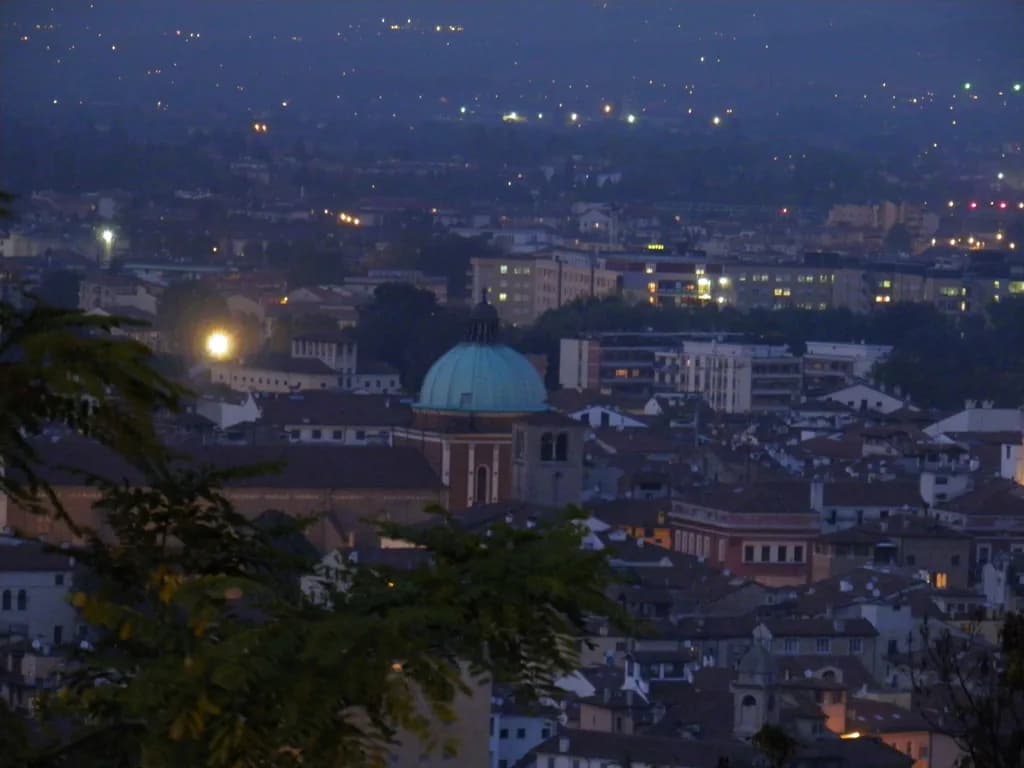
In the second half of the sixteenth century the tambour and the great dome were erected on a design by Andrea Palladio, the cathedral's clearest claim on the architect's legacy. Seeing a dome by Palladio inside a Gothic shell is a useful corrective to the idea that his work only appears in polished classical buildings. It also explains why the cathedral belongs in any serious Palladio walk even though he did not design the church itself.
The dome was destroyed when an Anglo-American bombing struck the cathedral on 15 May 1944, which also destroyed much of the nave and seriously damaged the facade and the southern chapels. What stands overhead today is therefore a reconstruction of a sixteenth-century design, a fact that becomes visible once you know it. Keep that in mind when comparing this dome with the architect's better-known villas and palaces.
Inside: Nave, Presbytery and the Holy Cross Fragment
The interior is Gothic in style, with a single nave under a cross vault and an elevated presbytery at its centre. There stands the altar commissioned in 1535 by Aurelio Dall'Acqua from the master stonemasons of Pedemuro, which preserves a fragment of the Holy Cross. Approach the presbytery as a focal point of the visit rather than as background to the paintings.
Behind and to the side of the altar, along the apse, runs the Civran Parament, a setting of twelve large paintings on the story of the True Cross. The ensemble is crowned and framed by a balustrade carrying ten wooden angels, some attributed to Orazio Marinali. Change your position along the apse to read the cycle in order instead of viewing it from a single spot.
The Civran Parament Cycle Explained
Bishop Giuseppe Civran commissioned the cycle in 1679, and it was executed by seven artists of the Venetian school working to one narrative programme. That combination of a single theme, twelve canvases and multiple hands is what distinguishes it from the scattered altarpieces elsewhere in the church. It is also the reason the apse repays slow, sequential looking rather than a glance.
The theme is the True Cross, which ties the paintings back to the relic in the altar and to the city's relic history at Santa Corona. If you have already visited that church, the cycle reads as a continuation of the same devotional story. If you have not, consider pairing the two so that the thorn, the cross fragment and the painted narrative connect.
Side Chapels, Sculpture and Paintings to Find
The large nave opens into side chapels, including those of the Thiene and Loschi families, and holds important funeral monuments and sculpture by Giulio Romano, Alessandro Vittoria and others. Works by Alessandro Maganza, Giulio Carpioni, Bartolomeo Montagna, Francesco Maffei, Gianbattista Pittoni and further artists are also recorded in the church. Treat these as names to hunt for, since exact placements can shift with restoration and rehanging.
The 2009 furnishings give the interior a contemporary layer. The Vicenza-born sculptor Pino Castagna, a native of Castelgomberto, created the bronze altar, the ambo and the episcopal chair, along with the Easter candle holder, a processional cross and candelabra. Look for how the bronze sits against the Gothic stone; the contrast is part of the experience of the building today.
How the Cathedral Fits a Broader Vicenza Walk
A logical route leaves the cathedral for the Basilica Palladiana and Piazza dei Signori, then continues to the Teatro Olimpico and Palazzo Chiericati. All three are on the standard Palladian circuit, and the Teatro Olimpico in particular benefits from a planned slot rather than a quick look. Our Teatro Olimpico Vicenza visitor guide explains what the theatre asks of your time.
Museum cards sold in Vicenza cover a defined network of civic sites rather than every church in town. The tourist consortium lists the Vicenza Gold Card as covering eleven sights and the Silver Card as covering four chosen from the same network, with civic museums closed on Mondays. The cathedral does not appear among the listed sites, so plan it as a separate stop and confirm current card terms before buying.
For a wider set of alternatives beyond the obvious circuit, our guide to hidden gems in Vicenza covers quieter corners and overlooked details in the same streets. It works well as an afternoon companion to a cathedral morning, when the main squares fill and you want somewhere calmer to walk.
If you want the cathedral placed alongside other city sights with their own guides, start from Vicenza Attractions and build the day from there. The hub keeps individual entries separate, which matters because each church, palace and museum has its own access rules.
Nearby Churches and the Hill Above Town
Santa Corona is the natural companion church, both because of the relic connection and because it sits on the same museum network path through the centre. Our Chiesa di Santa Corona, Vicenza guide sets out what to see there, including its own Palladian associations. Walking between the two takes you through the contrà that most visitors skip.
Monte Berico offers a different register entirely, a hilltop sanctuary reached on foot from the centre and known for its views back over the city and its villas. The sanctuary publishes its own liturgical and cultural calendar, which is the place to check before climbing. Combine it with the cathedral only if you have a full day and are comfortable with inclines.
Practical Notes Before You Go
Confirm the current opening arrangements directly with the diocese, since a church in active liturgical use can close for services or works without notice in third-party listings. Do not rely on a remembered timetable or a map app for a place of worship. If the doors are shut, the surrounding streets and the nearby civic sites still make the detour worthwhile.
For a broader view of how Vicenza's monuments, palaces and museums are organised, including which are ticketed and which are civic, consult the city's official civic museums site. It lists the individual venues and their current information rather than bundling everything into one admission. That distinction matters when you are deciding where to spend a limited budget.
Plan Your Visit
Vicenza Cathedral is best approached as a layered building rather than a single monument: Roman house, medieval shell, Palladian dome, seventeenth-century painting cycle and twentieth-century reconstruction all occupy the same small interior. Give it a focused half hour, then let the rest of the centre do the work. Check the diocese for current access before you go and keep the cathedral separate from any museum card purchase.
Frequently Asked Questions
Is Vicenza Cathedral free to visit?
The available sources do not confirm current entry terms, so the honest answer is to check with the Diocese of Vicenza before you go. Churches in active use often differ from museums in how they handle visitors, and conditions can change with restoration or services. Look at the diocesan website rather than relying on a third-party listing.
Did Palladio design Vicenza Cathedral?
No. Palladio designed the sixteenth-century tambour and dome, which were added to a church that already existed in Gothic form. The facade was completed between 1444 and 1467, well before his contribution, and the building has been rebuilt and repaired several times since.
What is the Civran Parament cycle?
It is a set of twelve large paintings telling the story of the True Cross, commissioned in 1679 by Bishop Giuseppe Civran and executed by seven artists of the Venetian school. It runs along the apse behind the presbytery and is framed by a balustrade with ten wooden angels, some attributed to Orazio Marinali.
What happened to the cathedral in 1944?
An Anglo-American bombing on 15 May 1944 destroyed the dome and much of the nave, and seriously damaged the facade and the southern chapels. The dome you see today reflects Palladio's sixteenth-century design but is a reconstruction rather than the original fabric.
How long should a visit take?
A suggested half hour covers the nave, presbytery, apse cycle and the main chapels at an unhurried pace, and longer if you want to study the paintings. This is a recommendation, not an official figure. Confirm opening arrangements first, since a closed door changes the plan entirely.
Is the cathedral included in the Vicenza museum cards?
The cathedral does not appear among the sites listed for the Vicenza Gold and Silver cards, which cover a network of civic museums and monuments. Check current card details and opening days before buying, and note that the civic museums close on Mondays.
What else should I see near the cathedral?
Santa Corona is the closest companion church and shares the relic history of the True Cross. In the other direction, the Basilica Palladiana, Teatro Olimpico and Palazzo Chiericati form the core of a Palladian day, while Monte Berico offers a hilltop walk and city views.
Sources
Continue exploring
More guides you'll find useful





