
San Rufino Cathedral Assisi: Facade, Baptismal Font & Crypt Guide
Plan a visit to Assisi's cathedral: how the Romanesque facade reveals itself on the descent, what the baptismal font tradition says, and what the crypt adds.
On this page
Most travellers treat San Rufino as a landmark to photograph on the way between Piazza del Comune and the basilicas downhill. That is a mistake, because Assisi's cathedral carries the city's oldest patron saint, a facade of pale local limestone, and a marble baptismal font that tradition links to Francis, Clare and Frederick II. Allow a little more than a glance and the building becomes a compact history of the town rather than a backdrop.
The cathedral sits on its own square upslope from the main civic square, so the building is encountered on foot, usually while descending from the upper streets. This guide separates what can be seen without a ticket from the adjacent Diocesan Museum and crypt, and it flags clearly where current hours and admission rules must be checked rather than guessed.
Orientation: the approach from Piazza Matteotti
The facade is one of the great staged views of Assisi, and the staging depends on your approach. Coming down from Piazza Matteotti, the cathedral begins partly hidden behind the surrounding houses, then appears more fully as the slope descends toward its square, according to the Exploring Umbria description. If you arrive from below, the effect is reversed and the facade arrives all at once, so plan to descend at least once.
Piazza San Rufino is also the address given for guided tours of the city highlights, with meeting instructions often tied to the square rather than the church door. If you join a group, the cathedral appears in the itinerary as a passing stop rather than an interior visit, so budget separate time afterwards if the building interests you. Check the meeting point on your booking confirmation rather than assuming the steps of the facade.
The facade: Romanesque geometry in ivory limestone
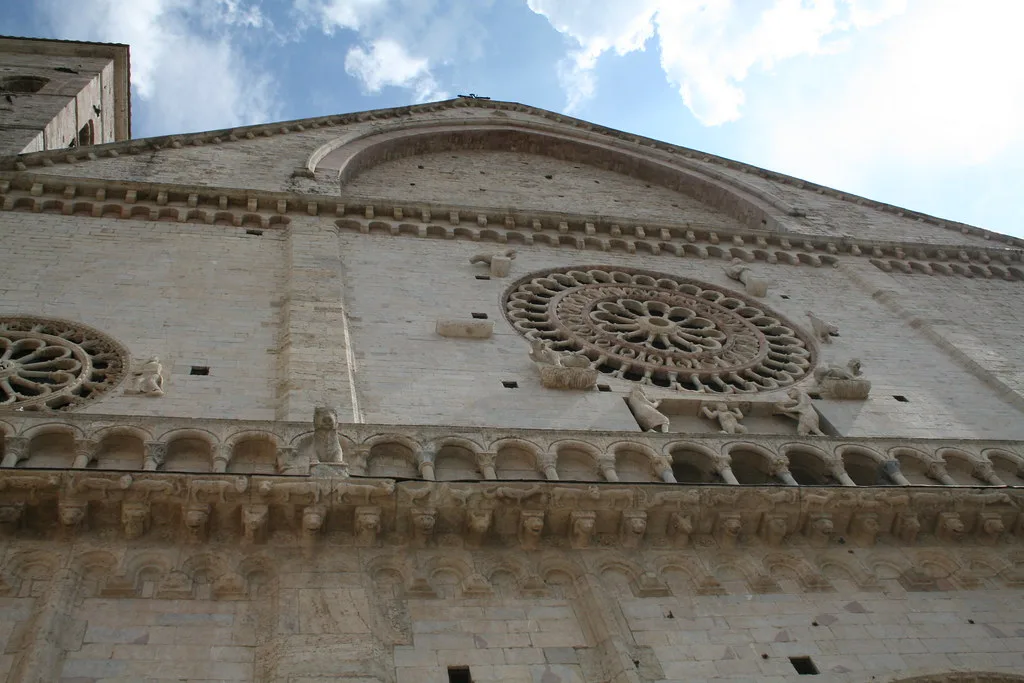
The cathedral's front is widely praised for its period, and the reason is visible without any art-history training: layered arches and repeating geometries cut into pale limestone, with the composition changing as you move. The stone catches late-afternoon light, when the ivory surface warms toward orange before dusk, making that hour especially worthwhile for a slow look rather than a quick snapshot.
Stand back on the square to read the lower portal zone and the upper tiers separately; details that disappear up close become legible from the far side. The surrounding buildings crowd the church on several sides, so the best full view is a few steps back along the street you arrived by. Photography is straightforward outdoors, but keep sightlines clear for worshippers entering.
Who San Rufino was, and why Assisi claims him
Rufino is presented as Assisi's first bishop and patron, martyred in the 3rd century under Roman rule. The hagiography tells of a long journey from the eastern Mediterranean to Italy, then a bishopric in Assisi, pursuit by the consul Aspasius, and execution by drowning in the Chiascio with a millstone attached. The body is said to have been recovered downstream where Costano, in the municipality of Bastia Umbra, now stands; treat these as the city's founding Christian stories rather than documented biography. Further visitor details appear in Assisi Cathedral (San Rufino) - Exploring Umbria.
That legend explains the layout of the site you are visiting: an earlier church, then a rebuilding, and finally the present structure begun in 1100 under the architect Giovanni da Gubbio. The bishop's seat was moved here in 1035, which is why San Rufino, not the older Santa Maria Maggiore, is Assisi's cathedral. Knowing the sequence helps you read the crypt, which preserves the older layer of the story.
Interior: three naves and Galeazzo Alessi's design
Inside, the plan is a three-aisled basilica divided by substantial arches on square-based columns, with the present interior design credited to the Umbrian architect Galeazzo Alessi in the 1500s. The result is orderly and relatively austere, so attention moves to individual works rather than overall decoration. Walk the full length of the right nave and then the left before choosing where to linger. Further visitor details appear in Assisi Cathedral (San Rufino) - Exploring Umbria.
The right side holds the very old marble baptismal font, while the Cappella del Santissimo Sacramento near the third bay is described as the finest specimen of Baroque art in the city. The left nave reveals older fabric, including the base of a Roman cistern inscribed with the names of local magistrates, the Marones. That single object connects the Christian church to the Roman town of Asisium beneath it.
The baptismal font: what the tradition actually says
The marble font in the right nave is the building's most quoted object. Tradition holds that Francis, Clare and the emperor Frederick II were baptised in it, but that is a traditional attribution rather than a documented record, and it is worth saying so when you explain the church to companions. The font itself is genuinely ancient, which is what gives the claim its long life. Further visitor details appear in Assisi Cathedral (San Rufino) - Exploring Umbria.
For visitors, the practical point is that the font is inside the cathedral, not in a separate museum space, so it can be seen during an ordinary church visit subject to the church being open for worship. Do not treat the baptism as a verified historical event when you read interpretation panels or guidebooks that repeat it. The honest framing — tradition links the font to these figures — matters in a city where Franciscan history and legend are closely interwoven.
The crypt, Bishop Ugo and Francis's prayer places
The crypt takes you back to the church of around the year 1000 and to a dispute between Bishop Ugo and the people of Assisi. The legend says the bishop wanted to move Rufino's sarcophagus to Santa Maria Maggiore, the crowd resisted, and the marble casket could not be shifted by sixty men but was lifted by seven ordinary ones; the bishop then embellished and enlarged the cathedral instead. The sarcophagus in the crypt is presented as the same one from that story. Further visitor details appear in Assisi Cathedral (San Rufino) - Exploring Umbria.
The crypt also preserves Francis's connection to this church: it was one of his chosen places for solitary prayer, and a small subterranean space under the sacristy is known as the oratory of Saint Francis. Visiting the crypt is not simply a detour into archaeology; it is part of the devotional geography of Assisi. Treat it quietly, as you would any active place of prayer, and check locally whether it is open on the day you visit.
The Diocesan Museum: a separate itinerary
The crypt belongs to the Diocesan Museum's itinerary, inaugurated in 1941, which also includes the exhibitions in Palazzo dei Canonici, its cellar and the cathedral cloister. That wording matters: the museum is described as a distinct route through the complex, so do not assume one entry covers everything or that the crypt is simply an open corner of the church. Confirm the current ticket scope at the site or through the diocese before planning around it. Further visitor details appear in Assisi Cathedral (San Rufino) - Exploring Umbria.
If time is short, prioritise the medieval paintings, which the source describes as rare surviving specimens left in the city, and the Roman and pre-Roman finds that complement the Roman Forum collection. A highlight is Niccolò Liberatore's Saint Rufinus Altarpiece, which narrates the patron's martyrdom and ties the museum collection back to the building you just walked through. The museum is thus the best place to fill in the gaps that the church interior alone leaves.
Practical notes: dress, quiet and what is ticketed
Assisi tour operators report a dress code for places of worship and selected museums: knees and shoulders covered, no shorts or sleeveless tops, for men and women alike, with entry refused to those who do not comply. Treat this as the requirement reported for worship sites in the city rather than a formally published cathedral policy, and dress accordingly in warm months. A light scarf or long-sleeved layer solves the problem for most visitors.
The church is an active place of worship, so keep voices low, avoid flash and do not wander into roped areas during services. Because the source material does not establish which parts are free and which require a ticket, the safe approach is to ask at the cathedral or museum entrance on arrival rather than budgeting from a fixed assumption. The diocese, the parish or the tourist information service in Piazza del Comune can confirm current access rules.
How long to allow at San Rufino
As a suggestion rather than an official figure, allow around 30 to 45 minutes for the cathedral alone: the facade from the square, the two side naves, the font and a few minutes in quiet. If you add the crypt and the Diocesan Museum, plan a half day rather than squeezing them into a lunch break, because the museum route runs through several spaces in the complex. These timings are your own planning tool, not a published visiting time.
The cathedral works well as a slow stop between other sights because it sits on a natural walking route through the upper town. Arriving in the late afternoon gives you the facade light described above and usually a calmer interior than the middle of the day. Check the day's opening arrangements before making it the anchor of your afternoon.
Pairing San Rufino with nearby sights
From Piazza San Rufino, the walk down to Piazza del Comune brings you to the Temple of Minerva, a Roman building reused as the church of Santa Maria sopra Minerva, and to the civic palaces around the square. Continue to the Basilica di Santa Chiara, built of pink stone from Monte Subasio and holding the crucifix that tradition says spoke to Francis at San Damiano. These three stops form a compact half-day on foot when combined with the cathedral.
The Chiesa Nuova, built in 1615 on the reputed birthplace of Francis, is close to the civic square and appears on standard city walking tours alongside Santa Chiara and the Temple of Minerva. If you want to go beyond the headline sights, our guide to hidden gems in Assisi points to the quieter corners that reward an unhurried afternoon. Keep the cathedral as the start of that walk rather than the end.
What to verify before you go
Current opening hours for the cathedral and the Diocesan Museum, ticket prices, closure days and seasonal changes are not fixed in this guide because the available sources do not publish them. The right places to check are the parish or diocesan channels and the tourist information service in Piazza del Comune, where the city's event and visitor information is coordinated. Verify the week you travel, since worship schedules can alter access at short notice.
If you plan to combine the cathedral with the Basilica of San Francesco, note that sources describe past suspensions of guided tours inside the basilica during periods when the saint's remains were on display. Any such restriction should be checked against the basilica's own announcements for your dates rather than assumed. The cathedral visit itself can be planned independently of those arrangements.
Plan Your Cathedral Visit
San Rufino rewards a deliberate visit: descend from Piazza Matteotti for the facade, read the interior as a 1500s design wrapped around Roman and medieval fabric, and treat the font and crypt stories as tradition honestly told. Keep the church and the museum route separate in your planning, and confirm hours, tickets and the crypt's accessibility on the day.
For the wider context of Assisi's sights and how this cathedral fits among them, start with our Assisi attractions guide and then build a walking day around Piazza del Comune, Santa Chiara and the basilicas.
Frequently Asked Questions
Why is the facade of San Rufino Cathedral considered notable?
The front is admired for its layered Romanesque geometry in pale limestone and for the way it reveals itself as you descend toward Piazza San Rufino from Piazza Matteotti. The composition changes with your angle and warms in late-afternoon light, so the approach matters as much as the facade itself.
Were Francis and Clare really baptised in this cathedral?
Tradition holds that Francis, Clare and Frederick II were baptised in the ancient marble font in the right nave. That attribution is traditional rather than documented, so it is best described as the city's received story rather than a verified record of the baptisms.
Is the crypt included with the cathedral visit?
The crypt is described as part of the Diocesan Museum itinerary, which also includes spaces in Palazzo dei Canonici, a cellar and the cloister. Because the sources do not set out ticket scope, confirm at the entrance whether the crypt requires the museum ticket on the day you visit.
What is there to see in the Diocesan Museum?
The museum holds rare medieval paintings, Roman and pre-Roman finds, and Renaissance works including Niccolò Liberatore's Saint Rufinus Altarpiece, which depicts the patron's martyrdom. Its rooms also help explain the Roman town beneath the Christian church.
What should I wear when visiting Assisi churches?
Assisi tour operators report a worship-site dress code requiring knees and shoulders to be covered and excluding shorts and sleeveless tops, with entry refused for non-compliance. Carry a light layer or scarf in summer, and treat it as a courtesy requirement even where it is not formally posted.
Is San Rufino Cathedral free to enter?
The available sources do not establish whether the cathedral is free or which parts require a ticket, and no admission prices are verified here. Ask at the church or the tourist information service in Piazza del Comune before planning your budget around a particular assumption.
Sources
Continue exploring
More guides you'll find useful





