
Basilica di Santa Chiara Assisi: Visitor Guide to St Clare's Church
Plan a visit to the Basilica di Santa Chiara in Assisi: the Crucifix of San Damiano, Clare's relics, free entry, dress code and a simple walk from Piazza del Comune.
On this page
The Basilica di Santa Chiara anchors the lower eastern edge of Assisi's historic centre, a short walk from Piazza del Comune and a natural companion to the town's better-known Franciscan sites. For visitors tracing the story of St Clare and St Francis, it holds a piece of the tale that exists nowhere else: the original Crucifix of San Damiano, the cross that tradition says spoke to Francis. One independent walking guide puts the church about five minutes from the Lion Fountain and less than a kilometre from the square, a useful estimate rather than official guidance.
Unlike some of Assisi's ticketed museums and cloisters, the basilica itself has no admission fee according to a detailed visitor account, and the same source reports roughly an hour to scratch the surface. Those two facts make it an easy, low-commitment stop to slot into a day that also includes San Rufino, Chiesa Nuova and the Temple of Minerva. The main thing to plan around is timing: sources disagree on the exact daily opening schedule, so treat any printed timetable as approximate and confirm before you travel. Further visitor details appear in ✔ 11: The Basilica of Santa Chiara – Discovering Assisi.
Where the Basilica Sits and How to Reach It on Foot
Santa Chiara stands at Piazza Santa Chiara, just outside the busiest core of the old town, below the level of Piazza del Comune. The simplest approach on foot is to leave the square past the Lion Fountain and follow Corso Mazzini, the lower of the two roads leading away, then continue straight through an arch until the church appears on your right. The blogger behind Discovering Assisi estimates this walk at about five minutes from the fountain and under a kilometre, which matches the compact scale of central Assisi.
Because the church sits toward the edge of the historic centre, many visitors combine it with a broader loop rather than treating it as a standalone trip. The Assisi tourism portal publishes general information on parking, traffic limits and local buses, which is the right place to check how you will enter the town by car. If you are arriving without a vehicle, the same portal gathers the practical transport links for trains and buses into Assisi.
A Short History: 1265, Pink Stone and Heavy Buttresses
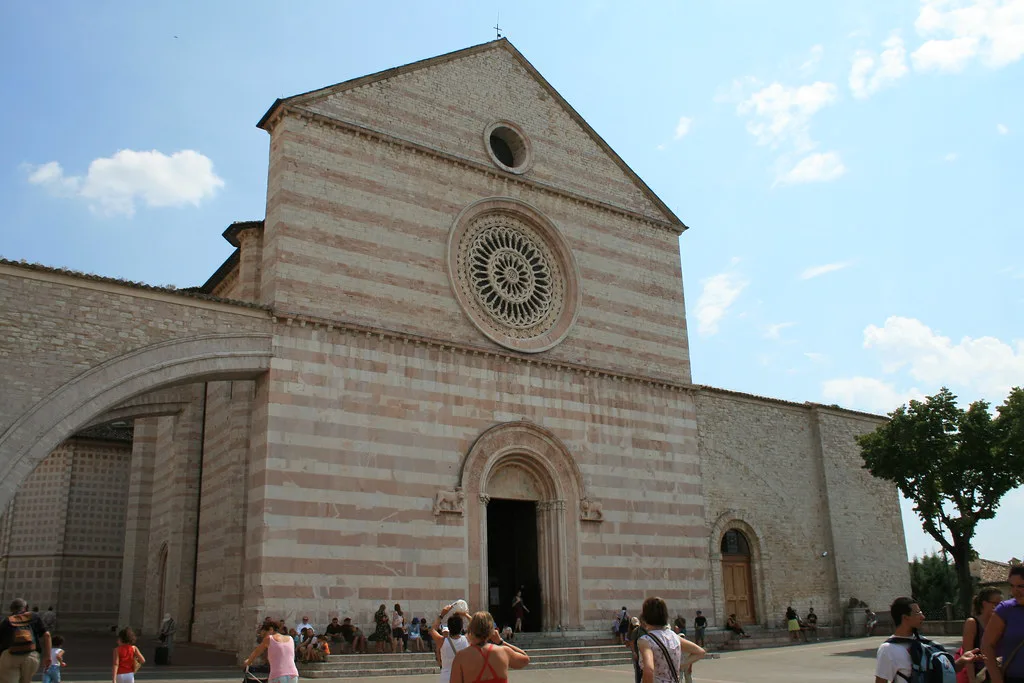
The basilica was completed in 1265, built in the pale pink stone quarried from Monte Subasio, the mountain that frames Assisi and separates it from Spello and Nocera Umbra. The enormous buttresses that give the exterior its distinctive profile were added late in the same century, a structural solution that makes the facade read more fortress than chapel at first glance. The church's association with Clare, who founded the Poor Clares and died in 1253, made it a pilgrimage destination from the start.
Architectural labels vary between sources, with one commercial attraction listing describing the building as Romanesque while the church's soaring interior and later additions give it a more hybrid character. Rather than fixating on style, look for the contrast with the Basilica of San Francesco higher up the hill, which followed a different Gothic trajectory under French influence. That contrast is one of the more rewarding things to notice when you see both churches on the same day.
The Crucifix of San Damiano: Why the Original Is Here
The most significant object in Santa Chiara is the original Crucifix of San Damiano, the painted cross before which, according to tradition, Francis heard a voice urging him to repair the church. The version now displayed at the San Damiano sanctuary itself is a replica, so visitors who skip Santa Chiara miss the authentic object. The cross is a 13th-century work and one of the reasons a visit here rewards even travellers who have already seen the town's headline Franciscan sights.
Guided city tours routinely include the basilica as one of four or five principal stops, alongside San Rufino, Chiesa Nuova, the Temple of Minerva and the Basilica of San Francesco. A typical itinerary allots about fifteen minutes inside Santa Chiara, which is realistic if your aim is the crucifix and a quick look at the nave. If you want to read the interpretation panels and sit with the atmosphere, allow longer and treat the tour as an orientation rather than a full visit.
Clare's Relics and the Connection to Agnes
Beyond the crucifix, the basilica preserves a cluster of personal relics that make Clare and her community tangible: her tunic and mantle, a hat containing her hair, and items linked to Francis including a habit, a sandal and a stocking he made for her. The skull of Agnes, Clare's sister, is also displayed. These objects, rather than grand frescoes, are what pull most visitors through the door, and they sit in a church whose paintings postdate those of the Basilica of San Francesco.
Clare's bodily remains are kept separately, and the same visitor account warns that a long queue can form to view the place where they are preserved. That is a planning detail rather than a deterrent: if the line is long when you arrive, see the relics and the crucifix first and return to the queue before you leave. No source confirms a ticket requirement for this viewing, so do not assume one and do not assume the tomb is always open either; ask at the church if access matters to you.
Practical Planning: Free Entry, Approximate Hours and the Dress Code
A detailed independent account states plainly that there is no admission fee at Santa Chiara, which separates it from paid interiors you may encounter elsewhere in Assisi. Commercial listings that advertise tickets and promotions for the basilica should be read with care, since the church itself is free to enter. If a paid experience appears in your search results, check what it actually includes before booking, because it is likely a guided tour rather than an entry ticket.
Opening times are the least reliable fact in any online guide to Santa Chiara. One commercial listing shows overlapping summer and winter windows that include 08:30 to 12:30 and 14:00 to 18:45 in summer, alongside a separate early-morning schedule, which is too contradictory to print as gospel. The independent walkthrough gives 9:00 to 12:00 and 14:00 to 18:00 with a note that closing can run later, and flags that the church is open for prayer outside visitor hours. Treat all of these as approximate and confirm the current schedule locally or through the Assisi tourism office before making a special trip.
A dress code applies inside places of worship, and guided-tour operators are explicit that knees and shoulders must be covered for both men and women, with shorts and sleeveless tops disallowed and entry potentially refused. This is standard across Assisi's churches, not a quirk of Santa Chiara, so pack a light layer or scarf even in warm months. The same operators note that mobile or paper tickets are accepted for their tours, a reminder that the ticketed element is the guiding, not the church.
Pairing Santa Chiara With Nearby Stops
Santa Chiara works best as one link in a walking chain through the lower town. From the basilica you can retrace your route and branch toward San Rufino, Assisi's cathedral, or continue to Chiesa Nuova, built in 1615 on the site traditionally identified as Francis's birthplace. The Temple of Minerva, one of Italy's best-preserved Roman temples and now a church, sits on Piazza del Comune and makes a natural pause between stops.
If you have time for only one more major church, the Basilica of San Francesco is the obvious counterpart, and our guide to the hidden gems in Assisi helps you find quieter corners between the headline sights. Be aware that guided tours of San Francesco's basilica were suspended from 15 February to 6 April 2026 because of the exposition of the saint's remains, with guides explaining from outside while visitors entered independently. That suspension applied to San Francesco, not Santa Chiara, and it belongs to the past; check current arrangements before booking any tour.
How Long to Allow and How to Pace the Visit
The independent account suggests about an hour to get beyond a surface impression, while a guided tour spends roughly fifteen minutes inside. Those figures bracket a realistic range: forty-five to sixty minutes lets you see the crucifix, read the relic displays and queue for Clare's remains without rushing. If you are short on time, prioritise the San Damiano Crucifix and the relics, which are the elements you cannot see elsewhere in the same form.
Because the church is free, a brief stop costs nothing but time, which makes it a sensible anchor for a slower day rather than a box to tick. Pair it with the walk back up through the back streets below Piazza del Comune, which the independent guide recommends for variety, and finish at the square as the light changes. Assisi's tourism portal also lists current events and celebrations, useful if your dates coincide with a major feast or civic festival.
Plan Your Visit
Santa Chiara rewards a modest investment of time: no admission fee, a short walk from the centre, and the original Crucifix of San Damiano as its centrepiece. Go early or late to reduce the chance of a long queue for Clare's relics, cover your shoulders and knees, and accept that printed opening hours are approximate. Confirming the day's schedule before you set out is the single most useful preparation you can make.
Use our Assisi Attractions hub to see how Santa Chiara fits alongside the town's other churches, Roman remains and viewpoints. A calm half-day that links Santa Chiara, Piazza del Comune and one or two smaller churches will leave a stronger impression than racing between every site on a list. For related planning, see Self-Guided Walking Route in Assisi: A Step-by-Step Loop.
Frequently Asked Questions
Is there an admission fee for the Basilica di Santa Chiara?
An independent visitor account states that there is no admission fee to enter the basilica, and guided city tours treat it as a free stop within their itineraries. Paid products you may see online are generally guided experiences rather than entry tickets, so check what is included before booking. Confirm locally if you want certainty on the day.
How long should I allow for a visit to Santa Chiara?
Allow around forty-five to sixty minutes if you want to see the Crucifix of San Damiano, look at Clare's relics and join any queue to view where her remains are kept. A guided tour typically spends only about fifteen minutes inside, which suits travellers who mainly want the highlights. The independent walking guide suggests roughly an hour to move beyond a surface impression.
What is the original Crucifix of San Damiano and where is it kept?
It is the painted cross before which, by tradition, Francis heard a call to repair the church. The original is displayed in the Basilica di Santa Chiara, while the cross now at the San Damiano sanctuary is a replica, so the basilica is the place to see the authentic object.
Do I need to dress modestly to enter the basilica?
Yes. Places of worship in Assisi ask visitors to cover knees and shoulders, and tour operators warn that shorts and sleeveless tops may lead to refused entry for men and women alike. Carrying a light scarf or long-sleeved layer is the simplest way to stay compliant across several churches in one day.
How far is Santa Chiara from Piazza del Comune?
An independent walking guide estimates about five minutes from the Lion Fountain and less than a kilometre, following Corso Mazzini, the lower of the two roads leaving the square, and continuing through an arch. That is a blogger's estimate rather than official guidance, but it matches the compact scale of central Assisi.
Are opening hours reliable and should I check before going?
Available sources disagree, with one listing showing overlapping summer and winter windows and the independent guide giving slightly different morning and afternoon times. Because these conflict, treat any printed schedule as approximate and confirm the current hours locally or through the Assisi tourism office before making a special journey.
Sources
Continue exploring
More guides you'll find useful





