
Neonian Baptistery Ravenna: Visitor Guide to the Dome Mosaic
Plan a visit to Ravenna's Neonian Baptistery: read the dome mosaic of Christ's baptism, trace its history, and check ticket and opening details with the operator.
On this page
The Battistero Neoniano, also called the Orthodox Baptistery, is easy to misjudge from the pavement. It is a modest brick octagon in Piazza del Duomo, and the reason to go inside is almost entirely above your head: a dome mosaic laid out in concentric rings around the baptism of Christ.
It belongs to the Opera di Religione della Diocesi di Ravenna, the body that manages the city's diocesan monuments, and it is described there as one of five UNESCO-listed sites reachable on foot in the historic centre. Treat ticket scope, opening hours and any interruption for liturgical use as things to confirm with the operator rather than fixed rules.
Where the Baptistery Sits Beside Piazza del Duomo
The baptistery stands in the monumental quarter of central Ravenna, next to the cathedral and its round Romanesque campanile, which one reference describes as dating from the 10th century. Because it is a working sacred building rather than a museum room, you may find the doors closed to visitors during a baptism or liturgy; the operator posts notices, so scan them before setting out.
An hour here is enough for a careful look at the ceiling, though you will want to sit or stand quietly rather than walk through. The building is small and the floor plan is octagonal, so there is no route to follow: you enter, look up, and circle slowly.
Why the Baptistery Matters Among Ravenna's UNESCO Monuments
Ravenna holds eight UNESCO World Heritage monuments in total, and most visitors concentrate on the mosaic interiors. The diocesan group of five is the cluster you can cover on foot in the centre: the Mausoleum of Galla Placidia, the Basilica of San Vitale, the Basilica of Sant'Apollinare Nuovo, the Neonian Baptistery, and the Chapel of Sant'Andrea with the Archiepiscopal Museum. Further visitor details appear in Ravenna Mosaici – Opera di Religione della Diocesi di Ravenna.
Not every mosaic site sits inside that group. The Arian Baptistery, the Mausoleum of Theodoric and the Basilica of Sant'Apollinare in Classe lie outside the diocesan cluster and may be ticketed separately, so do not assume one ticket opens every door.
A Short History: From Roman Bath-House to Bishop Neone
The building began as a Roman bath-house and was converted under Bishop Ursus around 400 AD, according to Sacred Destinations, then completed by Bishop Neone in the second half of the 5th century, when the dome mosaics were added. That chronology explains why the lower walls still carry inlaid marble designs, including porphyry discs and green marble panels, preserved from the baths.
The same source calls it the oldest monument in Ravenna, a claim worth repeating as a description rather than a certainty, since dating early Christian buildings involves interpretation. What is not in dispute is the date range of the mosaic programme, generally given as the later 5th century.
Reading the Dome From the Centre Outward
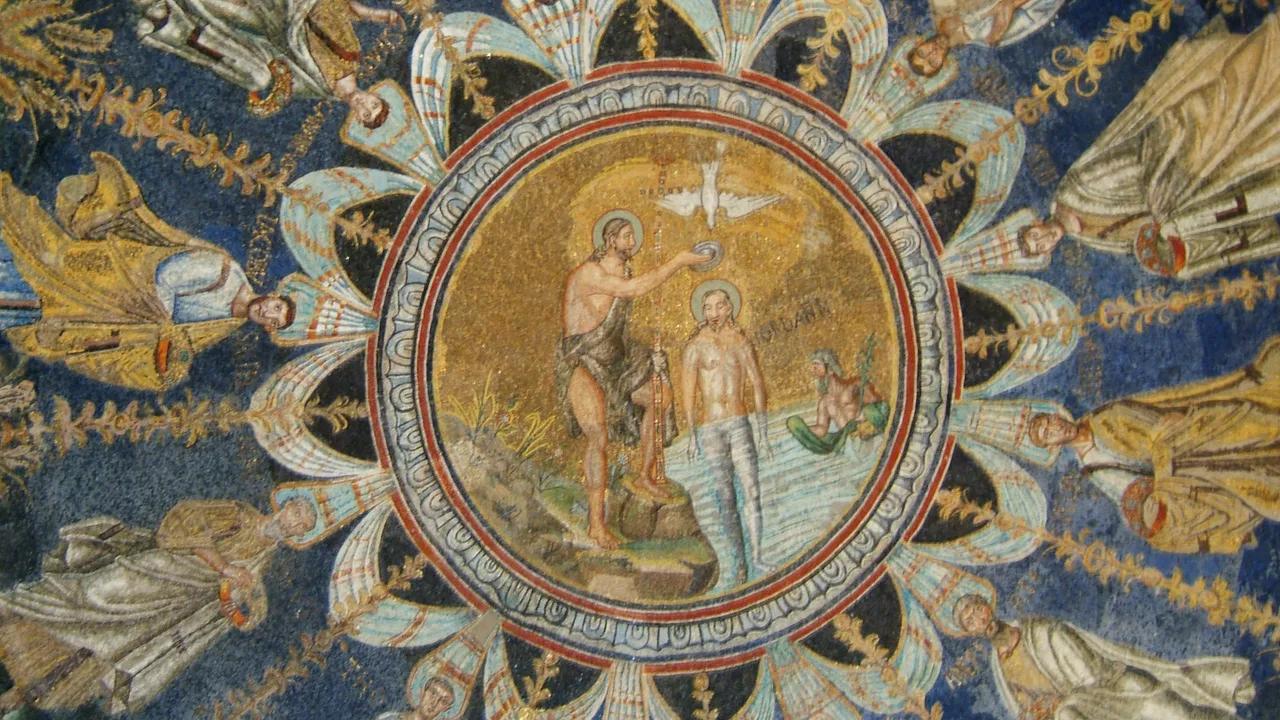
Start with the small medallion at the apex, which shows John the Baptist pouring water over Christ in the River Jordan. Ringing that scene is a band of the Twelve Apostles, each named in the mosaic and carrying a crown in veiled hands as they process slowly through deep blue and gold.
The outermost ring is divided into eight sections that alternate empty thrones, standing for Christ's divinity, with altars holding open gospel books. The thrones are flanked by depictions of celestial gardens and the altars by empty chairs, a visual shorthand for the places reserved in heaven.
Details Worth Spotting, Including Later Restorations
In the lower right of the central scene, the River Jordan is personified as an old man rising from the water, holding a reed in one hand and offering a garment to Christ with the other. Look for him before you move outward; he is the easiest figure to miss because he sits low in a busy composition.
Some elements are not original. The right arm of John the Baptist, the dove and Christ's head were restored in the 18th century, and a 19th-century Roman artisan named Felice Kibel added the dish used to pour the water, exercising more creative licence than conservation required. Knowing this keeps you from mistaking every tessera for a 5th-century hand.
Below the Dome: Stucco, Marble and the Font
The arches supporting the dome carry mosaics of golden acanthus on blue and red grounds alongside stucco reliefs of prophets and biblical scenes from the same period as the dome. In the spandrels below, gold vines and prophets sit against deep blue.
At floor level, the large octagonal baptismal font dates from the 12th or 13th century, a reminder that the room kept being used and adapted long after late antiquity. A Byzantine altar and a Roman marble vase occupy the side niches.
Why the Floor Looks Sunken
The baptistery gives the impression of having sunk into the ground, and the usual reading is that street level rose by roughly ten feet around it over the centuries rather than the building descending. That also explains why you step down into a space whose windows now sit awkwardly relative to the pavement outside.
Keep the effect in mind as you look at the light: it enters from higher openings than you might expect, which is part of why the gold tesserae shift in brightness as you move around the room.
Tickets: Confirm Scope and Price With the Operator
The Opera di Religione site publishes dedicated pages for opening times and prices and sells tickets through its own booking service, which is the page to trust for current scope. Diocesan monuments are paid interiors, so budget for entry rather than assuming free access, and check whether the bundle you want still covers the sites on your list.
Third-party figures circulate, including a roughly three-euro single admission and a combined pass near eleven-fifty, both labelled indicative and dated to March 2026 by one site. Treat such numbers as historical context, not current prices, and verify against the operator before you rely on them.
Opening Hours and Liturgical Closures
Hours change with the season, and one guide states plainly that times shift and should be checked on the official Ravenna mosaic website before travelling. Third-party listings give summer and winter variants, but these are not a substitute for the operator's own notice.
Baptisms still take place in the baptistery, and the operator posts advance notices when celebrations will suspend visits, including a scheduled change to the celebration calendar from October 2026. Read the notices page on the day you plan to go, since a short suspension can otherwise cost you the whole visit.
Neonian Versus Arian Baptistery
Both baptisteries put a baptism scene in the dome, which makes the comparison unusually direct. The Arian Baptistery, built in the 5th century for the community that worshipped under Theodoric, shows the same subject in a smaller, quieter building with a different theological accent.
If your time is limited, the Neonian is the denser experience and the one beside the Duomo; the Arian is the better choice if you want to see how the same iconography could be reworked for a rival Christian community. Visiting both turns a single sight into a lesson in how imagery carried doctrinal argument.
Etiquette Inside a Working Sacred Space
These are consecrated buildings, so dress as you would for a church: cover shoulders if asked, and skip beachwear. Photography rules vary by site, so follow the signage and staff rather than assuming flash or tripods are acceptable anywhere.
Keep voices low and do not touch the mosaics, which conservation work has left delicate. A pocket magnifier or a phone set to no flash helps you examine tesserae closely without getting nearer than the rope allows. Further visitor details appear in Ravenna's Mosaic Baptisteries: Orthodox & Catholic Secrets.
Pacing Your Day Around the Mosaics
Allow roughly two to three hours for the four main central sites, San Vitale, Galla Placidia, the Neonian Baptistery and Sant'Apollinare Nuovo, and add an hour or two if you also want Theodoric's Mausoleum and Sant'Apollinare in Classe. This is a suggested pace, not an official figure.
A sensible order starts at San Vitale, slips into Galla Placidia while your eyes are still tuned to gold, then continues to the baptistery and Sant'Apollinare Nuovo, which sit close together. Comfortable shoes matter, because the stone floors are old and uneven.
Mosaic interiors are indoors, so bad weather does not ruin the day; spring and autumn bring milder walking weather and generally thinner crowds. Outside the mosaic circuit, Ravenna has quieter corners worth a detour, including the flooded crypt of the Basilica of San Francesco, and you can plan more of them with our hidden gems in Ravenna guide.
Accessibility and Things to Check Ahead
Accessibility varies between Ravenna's monuments, with steps and thresholds at some entrances, so ask at the door or contact the operator's information office rather than assuming step-free entry. The operator also runs a dedicated accessibility project covering tactile maps and panels for its monuments.
One constraint to check rather than guess is capacity: at least one small diocesan monument limits how many people enter at once, though nothing in the available material confirms a cap for the baptistery itself. If you are bringing a group, ask the operator's booking office in advance.
Where to Go Next in Ravenna
Once you have read the baptistery ceiling, Ravenna's other mosaic interiors will look familiar in technique and different in scale. San Vitale and Sant'Apollinare Nuovo make the natural next stops, and our Ravenna Attractions hub bundles the individual visitor guides so you can plan the sequence site by site.
Plan Your Visit
The Neonian Baptistery rewards a slow, upward-looking visit of about an hour, and it fits naturally into a walking day that also takes in San Vitale, Galla Placidia and Sant'Apollinare Nuovo. Book nothing on assumption: confirm ticket scope, hours and any liturgical interruption with the Opera di Religione shortly before you go.
Set your expectations accordingly and the reward is a compact, readable mosaic programme where apostles, thrones and a personified river all carry meaning. Between the baptistery and the rest of Ravenna's mosaics, plan for the ceiling to take longer than the floor.
Frequently Asked Questions
What can you see on the dome of the Neonian Baptistery?
The apex medallion shows John the Baptist baptising Christ in the River Jordan. Around it runs a ring of the Twelve Apostles, each named and carrying a crown, and an outer ring alternating empty thrones with altars holding open gospel books. Some details, including John's right arm, the dove, Christ's head and the water dish, are 18th- or 19th-century restorations rather than original work.
Is the Neonian Baptistery included in the Ravenna mosaic ticket?
The baptistery is one of the five diocesan monuments in central Ravenna, alongside San Vitale, Galla Placidia, Sant'Apollinare Nuovo and the Chapel of Sant'Andrea with the Archiepiscopal Museum. Bundle scope and price change, so check the current ticket pages on the Opera di Religione della Diocesi di Ravenna site before buying. Do not assume one ticket covers non-diocesan sites such as the Arian Baptistery.
How old is the Battistero Neoniano and who built it?
The building began as a Roman bath-house converted under Bishop Ursus around 400 AD and was completed under Bishop Neone in the second half of the 5th century, when the dome mosaics were added. One reference calls it the oldest monument in Ravenna, though that is a source description rather than an uncontested fact.
Should you visit the Neonian Baptistery or the Arian Baptistery?
Both set a baptism scene in the dome, which makes comparing them worthwhile. The Neonian is more ambitious visually and sits beside the Duomo; the Arian, built in the 5th century for Theodoric's community, is smaller and quieter and shows the same subject with a different emphasis. Choose the Neonian if you visit only one, and see both if you want the theological contrast.
How long does a visit to the baptistery take?
The room is small and octagonal, so most of the time goes into looking up rather than walking around. An hour is a reasonable allowance for a careful read of the dome, and the four main central mosaic sites together can be covered in about two to three hours at a steady pace.
Can you take photos inside the baptistery?
Rules vary between Ravenna's sacred sites, so follow the on-site signage and staff instructions. As a general habit, avoid flash and tripods, and never touch the mosaics. A wide-angle lens or a raised phone helps capture a dome that is difficult to frame from directly below.
Why does the baptistery look like it is below street level?
The usual explanation is that the street level around the building rose by roughly ten feet over the centuries, so the baptistery now appears sunken when it has stayed in place. That is why you seem to step down into it and why light enters from openings higher than the modern pavement suggests.
Sources
Continue exploring
More guides you'll find useful





