
Orvieto Underground Caves Tour: What to Expect and How to Book
Plan the guided Orvieto Underground caves tour: the Piazza Duomo 23 meeting point, published departure times, what you see in the tufa caves and how booking works.
On this page
Orvieto sits on a block of volcanic tuff, and its inhabitants spent roughly 2,500 years cutting into it. The result is a dense layer of cellars, wells, kilns and passages beneath the streets, and a guided tour called Orvieto Underground opens a section of that layer to visitors.
The operator advertises the route as an easy one-hour walk with a guide, starting from Piazza Duomo 23, the address to copy into your map before you set out. It is one named attraction with its own admission, not a single pass covering every cave in town.
What the Orvieto Underground Tour Actually Is
The tour company presents the visit as a journey into a subterranean city formed by continuous excavation, with chambers and passages layered under the modern town. Guides link what you see underground to the Etruscan settlement of Velzna and to the medieval and Renaissance city above.
A useful mental model is a city that used its rock instead of hauling materials across the plateau. The same soft tuff that was easy to cut also needed channels below for water and storage.
The official Italian tourism page describes these passages as a historical and archaeological archive examined systematically only in recent decades. That explains why the interpretation matters as much as the spaces.
Orvieto Underground is separate from the Sotterranei below Orvieto Cathedral, which the cathedral authority describes as its own underground area tied to the cathedral's building history. Buying one does not buy the other.
Meeting Point and Getting to Piazza Duomo 23
Visits start from Piazza Duomo 23, on the square beside the cathedral, according to the operator's own page. Use that exact address and plan to reach the meeting point a little before your chosen departure time, because the schedule runs to fixed slots rather than rolling starts.
Official tourism information repeats the same address and lists the contact number for the site. If you are arriving by train, note that the station sits below the historic centre, so build in time to get up to the piazza before your slot.
Once on Piazza Duomo, the cathedral facade is the obvious landmark. The entrance point is close to it, so the tour stacks easily onto a cathedral visit provided you leave a gap between the two bookings.
Published Departure Times and the Visit Schedule
The operator publishes four daily departures, at 11:00, 12:15, 16:00 and 17:15, every day. Because a timetable can change with seasons and staffing, treat these as the published schedule to reconfirm by phone or email rather than a fixed promise for your date.
Booking by phone or email is explicitly advised at weekends and in high season, so this is the safest route if your dates are fixed. Confirm once by email, keep the reply, and you can plan the rest of the day around a slot.
Booking Decision: Reserve Ahead or Risk the Slot
There are two honest choices. Reserve by phone or email and accept a fixed anchor in your day, or arrive and hope a published departure still has room, which is the riskier option on weekends and in the peak months.
Travelers comparing options often ask which underground site is the better booking, and experienced visitors typically suggest matching the site to your interest, because they are different experiences rather than substitutes.
Do not assume that a paid walking tour offered elsewhere automatically includes this operator's entrance. At least one commercial tour listing describes a different cave, Pozzo della Cava, under a headline about the cathedral and underground caves.
Read the inclusions list before you pay. If the itinerary names the venue you want, the wording will say so.
What the One-Hour Route Covers
The route is described as an easy, roughly one-hour guided walk. Within that hour, the sequence of spaces explains how the same cave can have successive uses rather than a single function.
The first space on the itinerary is the medieval olive press known as the Mill of Santa Chiara, where millstones and a reconstructed press still speak to oil production for the whole city.
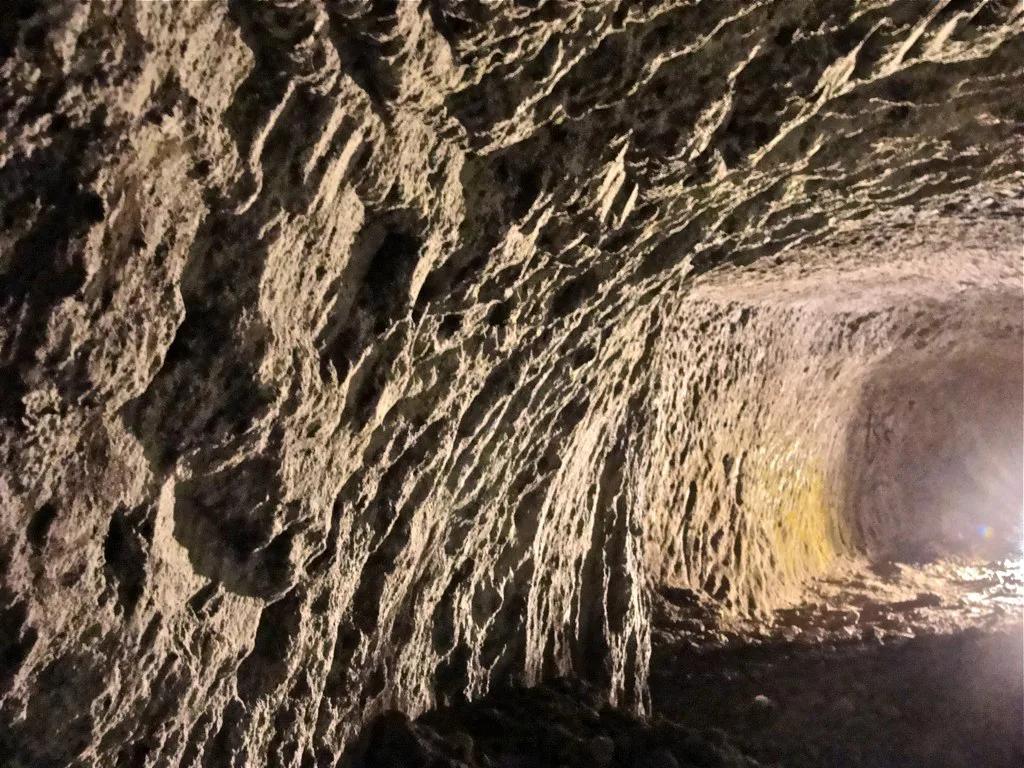
The route then enters a pozzolana quarry, where the marks of small hand tools remain visible on the walls. Pozzolana was used to make mortar, which ties the cave into the construction history of the buildings above.
A vertical shaft reaches down to the groundwater. The Etruscans dug it in the sixth century BC and cut small footholds, called pedarole, along the walls so people could climb without ropes or ladders.
Dovecotes are also part of the visit. Each small niche was nesting space for a pair of birds, and basins of water nearby helped the birds drink and get rid of parasites. A rear tunnel once connected these spaces to the city above.
One of the eastern chambers holds a bench along three walls and at least two connecting tunnels, which identify it as a Second World War air-raid shelter with separate entrances and exits.
How to Read the Caves as You Walk
Look for the physical evidence instead of just the shapes of the chambers. Hand-cut tool marks in the pozzolana quarry show that cubic metres of rock were removed by hand, and the marks are still visible on the walls.
At the well shaft, the pedarole niches are the best clue to how the Etruscans solved a practical problem with a low, simple solution rather than engineering.
The rock itself is the reason all of this was possible. Tuff and pozzolana form the plateau Orvieto is built on, and the softness that made excavation easy is the same quality you see in the tooled wall faces.
Who the Tour Suits and What to Wear
This is a guided walk rather than a crawl or a self-guided cave visit, so the hour passes with explanations. The operator calls the route easy, which suits travellers who want context more than exploration.
Wear closed shoes with grip, because tuff floors can be uneven. Underground air tends to feel cooler than the sunny piazza, so a light layer helps even on a hot day.
If you want a shorter or self-guided cave visit instead, plan it early rather than deciding on the spot with a fixed departure slot. Places fill, and in summer the piazza is not a good place to wait for a place to open up.
Orvieto Underground vs Pozzo della Cava vs St Patrick's Well
Orvieto has several separate underground attractions, and mixing them up is the most common planning mistake. The tour described here ends at Piazza Duomo 23, and it is not the same attraction as Pozzo della Cava or St Patrick's Well.
Pozzo della Cava is an archaeological complex in the historic centre, and some commercial tours enter it instead. Check the tour name and the inclusions before you buy, particularly if you are booking through an agency.
St Patrick's Well is a Renaissance piece of engineering commissioned after Pope Clement VII fled the Sack of Rome. Its separate double-helix staircases were designed to keep people carrying water from meeting on the stairs.
Sources give different figures for the well's depth and step count, so rely on what the official ticket office publishes for the day rather than a figure from a blog.
Orvieto also rewards slower wandering beyond the caves, and the hidden gems in Orvieto are worth an hour of aimless walking between bookings.
Pairing the Tour With the Duomo and the Cliff Walk
The cathedral is a separate ticketed visit a few steps from the meeting point, and the cathedral authority publishes its own closures and access changes. It is best to plan the cathedral visit as a separate slot, not as part of the cave ticket.
Inside, the Cappella di San Brizio holds Luca Signorelli's Last Judgment cycle, completed between 1499 and 1504. Allow time after the caves to sit with that cycle, rather than trying to rush it before a departure.
The cathedral itself is a Gothic building whose facade mixes marble, sculpture and mosaics, and its construction began at the end of the thirteenth century. Seen after the underground route, its stone makes more sense.
In the late afternoon, walk to the edge of the tuff plateau for the view over the valley. The cliff edge and the views are free, and they make a good close to a day that started underground.
Practical Tips for the Day
Bring a torch, but rely on the guide for lighting. Flash is best avoided in enclosed spaces with other visitors.
Allow extra time at weekends even if you have booked, because the piazza around the cathedral fills with day-trippers. If you booked a fixed slot, arrive early rather than counting on the clock.
Children and older visitors can enjoy the route, but the temptation to walk quickly should be resisted. The most memorable details are small: a tool mark, a foothold, a nesting niche.
Combine the cave tour with the Orvieto Attractions hub if you plan to see several paid sites, because each has its own ticket and its own opening calendar.
Plan Your Visit
Orvieto Underground is not a substitute for the cathedral's subterranean spaces, the Pozzo della Cava complex or St Patrick's Well. It is a distinct guided hour that explains how people used the tuff and how that shaped the city above.
Book by phone or email for weekends and the high season, treat the published departure times as something to reconfirm, and build the rest of the day around the cathedral and the views along the cliff edge. For related planning, see Orvieto with Kids: Underground Caves, Wells and Family Walks.
Frequently Asked Questions
Do you need to book the Orvieto Underground tour in advance?
The operator says booking by phone or email is strongly advised at weekends and in the high season. Outside those busy periods you can try for a place, but a fixed reservation protects your day around the published departures.
How long does the Orvieto Underground tour last?
The operator describes the guided route as an easy walk of about one hour. Allow extra time for arrival and for gathering before the departure, and check the current timings when you book.
What time do Orvieto Underground tours depart?
The published departures are at 11:00, 12:15, 16:00 and 17:15 daily. Timetables can change with seasons, so confirm the times with the operator before you travel.
Where does the Orvieto Underground tour start?
Visits start from Piazza Duomo 23, beside the cathedral. Arrive a little before your slot so you are not rushing through the square when the group is gathering.
Is Orvieto Underground the same as Pozzo della Cava?
No. They are separate sites with separate tickets. Some commercial tours enter Pozzo della Cava rather than the Orvieto Underground route, so check the inclusions before booking.
Is the Orvieto Underground tour suitable for children or older visitors?
The operator describes the route as easy, which usually suits most ages. The site has not published detailed accessibility information, so ask directly about mobility needs before you book.
What should I wear for the Orvieto Underground caves tour?
Wear closed shoes with grip and bring a light layer, since underground spaces feel cooler than the sunny square. Leave your flash off inside.
Can I visit Orvieto Underground and the Duomo on the same day?
Yes, but treat them as two separate bookings. The cathedral has its own tickets and its own closure calendar, so space them out and confirm the cathedral's access before you go.
Sources
Continue exploring
More guides you'll find useful





