
Palazzo Schifanoia Frescoes: A Guide to the Hall of the Months
A practical guide to the Hall of the Months at Palazzo Schifanoia in Ferrara: how the cycle is read, the seven surviving months and what else the museum holds.
On this page
Palazzo Schifanoia is the reason many travellers add a day to Ferrara: its main hall holds one of the great secular fresco cycles of the Italian Renaissance, painted for the Este court. The building's name comes from the old Italian idea of shirking boredom, and the museum has been rearranged since the 2012 earthquake to tell that story across sculpture, painting, miniature and ceramics. This guide explains what survives in the Hall of the Months, how to read its three registers in order, and what to check before you buy a ticket.
Treat the frescoes as a document rather than wallpaper: each surviving month combines court life, an astrological patron and a planetary triumph, so a slow circuit of the room rewards attention. The standard schedule and fares published by the city's tourism portal are summarised below, but confirm them on the museum's own pages before a visit.
The Name and the Palace: An Este Retreat That Outgrew Its Purpose
Alberto d'Este built the palace outside the older city walls in 1385, and the tourist board for the province of Ferrara describes it in its own itinerary notes as a suburban residence later transformed and enlarged, especially under Borso d'Este. The site's stated purpose was leisure, which explains why the interiors were designed to entertain rather than intimidate.
Under Borso, lord of the city between 1450 and 1471, the palace was extended and redecorated in the taste of the day, and the great hall received its painted scheme. Ferrara's tourism portal links the building to the political and cultural ambitions of Leonello and Borso d'Este, who between them reshaped the city's image as a Renaissance capital.
The palace did not stay glamorous. Between the eighteenth and nineteenth centuries it declined and was used as a tobacco factory, the frescoes were covered and partly destroyed, and the civic museum was only founded in 1898. Keep those centuries in mind when you enter the hall: what you see is a rescued fragment of a much larger decorative programme.
What the Fresco Cycle Is: A Calendar of Power
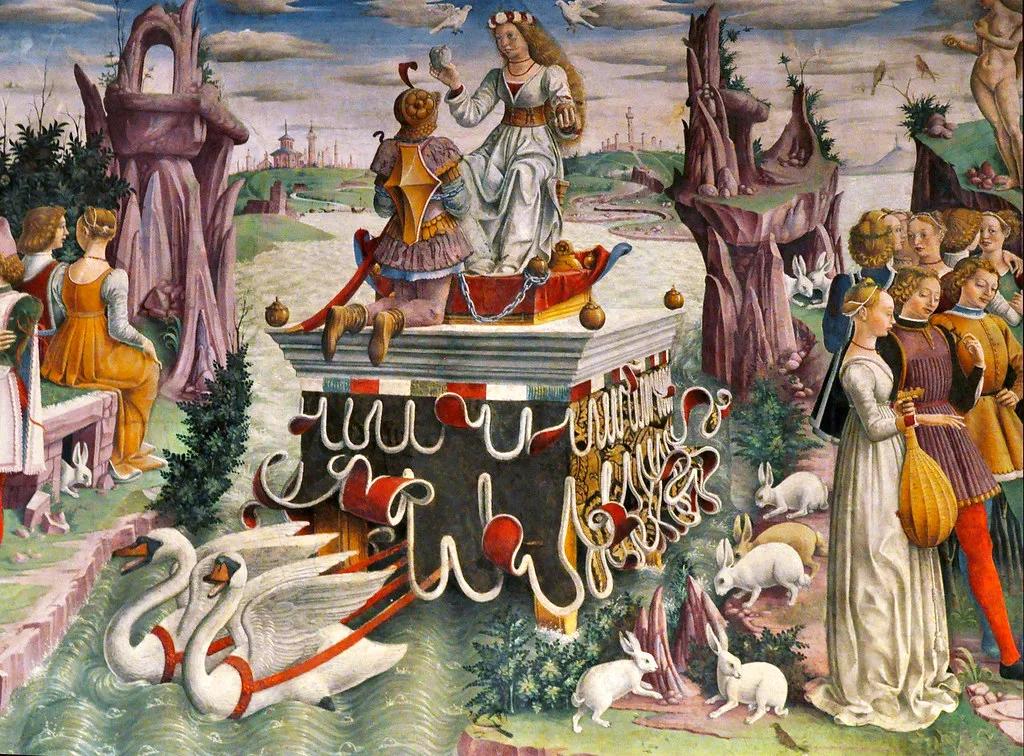
The Hall of the Months, or Salone dei Mesi, is a secular astrological calendar that sets the court's activities against the movement of the solar year, with astrological and mythological references threaded through the scenes. It was painted for Borso d'Este and reads as propaganda as much as decoration, tying the duke's rule to cosmic order.
The key to the cycle stayed obscure for a century. Interpreters proposed allegories of the virtues, but the convincing reading came from the art historian Aby Warburg in 1912, who identified a genuine astrological calendar linking court life with the celestial sphere. The astrological deities of the middle band were taken by the court astrologer Pellegrino Prisciani from the writings of Abu-Ma'Shar, which is why the room reads as a system rather than a set of separate pictures.
Painted surface once reached roughly 525 square metres, according to the Ferrara tourism portal, which gives a sense of how much has been lost as well as how much survives. Seven of the twelve original sections can still be admired, so expect an incomplete calendar and plan to look at what remains rather than hunt for missing months.
If you have limited time in the city, slot Schifanoia alongside Ferrara's other Este residences and churches rather than treating it as a quick photo stop. A broader list of city sights and opening conventions is gathered in the Ferrara Attractions guides, which help you sequence a day around timed museum entries.
Ferrara's historic centre is the UNESCO World Heritage listing that frames all of this, and the Este patronage visible at Schifanoia is part of the same urban story told across the city's palaces and painted rooms.
How to Read the Three Tiers, Bottom to Top
The cycle is organised in three horizontal levels, and reading them in order is the single most useful thing you can do in the room. At the bottom are representations of court life for each month; in the middle are the astrological deities governing that month; and at the top is the celestial sphere with the triumphs of the relevant planetary deities.
Start with the lower band to identify the month's seasonal activity and the duke's presence, then move up to the middle figure and finally to the triumph. This order turns a dense wall into a legible sequence and lets you compare how the painters varied the same formula from bay to bay. The hall is the climax of the visit, and it is worth circling the room at least twice, once for the narrative and once for the details of costume, animals and landscape.
Expect the surviving months to be separated by damaged areas, which can make the calendar feel discontinuous. Use the middle register as your guide to which month you are standing in front of, since the astrological figure usually survives well enough to anchor the identification.
The Painters Behind the Cycle: The Officina Ferrarese
Work on the hall was directed by Pellegrino Prisciani and involved the leading painters of the Officina Ferrarese: Cosmè Tura, Francesco del Cossa, Ercole de' Roberti, Gherardo di Andrea Fiorini da Vicenza and a figure historians call the Master with wide eyes. Seeing several hands in one room is part of the pleasure, because the differences in modelling and colour reveal how a large workshop divided a single commission.
The provincial tourist board also credits the cycle to painters of the school of Cosmè Tura, naming Francesco del Cossa and Ercole de' Roberti among the collaborators, which matches the portal's account. Look for the harder, more angular facial types associated with this workshop and compare them with the softer, more lyrical passages elsewhere in the same room.
If your interest is primarily in painting technique, allow more time here and less in the later rooms, where the displays shift towards objects. The museum route deliberately mixes miniature, sculpture, painting and Este ceramics, so the frescoes are one chapter of a wider collection rather than the whole visit.
Loss and Rediscovery: From Tobacco Factory to Civic Museum
The frescoes were covered and partly destroyed during the palace's industrial phase, then brought back to light between 1821 and 1840. The portal credits the restorer and painter Giuseppe Saroli with the 1821 rediscovery, working alongside Luigi Caroli and Francesco Avventi, with later restoration entrusted to the Bolognese Alessandro Compagnoni. That sequence helps explain why some figures are crisp and others are fragments. Further visitor details appear in Museo Schifanoia - InFerrara.
The building's modern chapter is more recent. The current exhibition route was inaugurated in stages after restoration following the 2012 earthquake: the Salone dei Mesi reopened in June 2020 with new lighting, and the Borsiana and Albertiana wings reopened in May and October 2021 respectively. Because opening arrangements have changed in stages before, check the museum's own announcements for any room closures on the day you plan to visit.
For a wider set of low-key corners, courtyards and lesser-known churches to pair with the museum, the hidden gems in Ferrara guide is a sensible companion for the rest of the afternoon.
The Missing Justice in the Hall of Virtues
In the Hall of Virtues, where Borso held audiences, Justice is not represented. For decades it was assumed that Borso himself stood in for the virtue, but the portal notes it is more likely that the figure, evidently pre-eminent over the others, was destroyed. Treat this as an open question rather than a settled fact, and read the surviving figures as a group from which the keystone has gone.
The same caution applies to the interpretation of the middle band of the great hall, which resisted explanation until Warburg's reading took hold. Museums change labels and research moves on, so the wall text in front of you should be treated as the most current account available on site.
Practical Visiting Basics: Hours, Fares and Free Entry
The standard schedule published for the museum is Tuesday to Sunday, 10am to 7pm, with the ticket office closing at 6pm; the portal describes these as standard hours and points readers to updates for any changes. Standard full admission is listed at 12 euros, with a reduced 9-euro rate for visitors aged 18 to 30, over-65s, YougER cardholders, first-year University of Ferrara students showing an admission ticket, and other affiliated categories. These figures come from the Ferrara tourism portal and should be confirmed before purchase, since the operator's own site is the place to check current terms.
Free admission categories listed include school groups with accompanying teachers, children under 18, disabled visitors with an accompanying person, licensed tour guides, journalists and publicists with a card, MyFE Card holders, anyone celebrating a birthday on the day of the visit, and 18 App users. Bring documentation for whichever category applies, and note that the portal provides a link for online reservation.
The Ferrara tourism portal does not publish a combined ticket or pass covering Palazzo Schifanoia together with other civic museums, so do not assume one exists. Ask at the ticket desk or check the operator's site if you are planning several museum visits, and compare the cost of individual tickets before committing to any bundle.
Access and Tools: Step-Free Entry and the Museum-MIX App
The museum is described as wheelchair accessible, and the address is Via Scandiana 23 in Ferrara, with a telephone contact listed for enquiries. If you have specific access needs, call ahead to confirm the route through the building and the availability of any lift or alternative entrance on the day.
The Museum-MIX App turns the visit into an interactive experience, offering extra content and augmented reality that overlays the atmosphere of the Ferrara Renaissance on what you see. It is optional, but it is useful if you want background on individual scenes without crowding around a single information panel.
Photography rules, cloakroom arrangements and group policies are not covered by the sources summarised here; ask at reception or check the official pages before you travel if these matter to your plans.
Fitting Schifanoia Into a Ferrara Day
Schifanoia sits in a group of Este-era monuments that reward a slower walking day rather than a checklist. Pair the frescoes with the city's cathedral, the church of San Francesco, Casa Romei, the Monastery of Corpus Domini, Santa Maria in Vado and the Palazzina Marfisa d'Este, all listed as stops on a Renaissance residences and churches itinerary.
Because the museum's standard day ends in the early evening and the ticket office closes an hour before, place Schifanoia earlier in the day and keep churches and squares for the late afternoon. The tourist information office in the inner courtyard of the Castello Estense is open Monday to Saturday from 9am to 6pm, and on Sundays and holidays from 9.30am to 5.30pm, according to the same portal; it can supply maps, leaflets and MyFE Card details.
If you would rather build the day around smaller, less formal stops between the major palaces, the hidden gems in Ferrara selection offers alternatives that fit the same walking radius in the historic centre.
Before You Go
The Hall of the Months rewards preparation more than most museum rooms: know that seven months survive, read the three registers from the bottom up, and look for the different hands of the Ferrara workshop. Check the museum's own pages for the day you plan to visit, since the standard hours and fares published by the tourism portal are a starting point rather than a guarantee.
Use the booking channel the museum publishes, ask about combined options only if the desk confirms them, and leave space in your day for the other Este residences nearby. That way the frescoes become part of a coherent picture of Renaissance Ferrara rather than an isolated stop. For related planning, see Palazzo Ducale Estense Ferrara Guide: Piazza Municipio.
Frequently Asked Questions
What does the name Schifanoia mean?
It comes from an old Italian phrase meaning to shirk or avoid boredom, which was the stated purpose of the suburban palace Alberto d'Este conceived in the fourteenth century. The name is a reminder that the interiors were designed as pleasure and entertainment for the Este court.
How many months of the fresco cycle survive?
Seven of the twelve original sections can be seen, according to the Ferrara tourism portal. The painted surface once reached roughly 525 square metres, so expect gaps where sections were lost or damaged.
Who painted the Hall of the Months?
Work was directed by Pellegrino Prisciani and involved the Officina Ferrarese, including Cosmè Tura, Francesco del Cossa, Ercole de' Roberti, Gherardo di Andrea Fiorini da Vicenza and a painter known as the Master with wide eyes.
How is the fresco cycle structured?
It has three levels: court life for each month at the bottom, the astrological deity governing that month in the middle, and the celestial sphere with planetary triumphs at the top. Reading from the bottom up makes the room legible.
Is Palazzo Schifanoia wheelchair accessible?
The museum is described as wheelchair accessible by the Ferrara tourism portal. For specific needs, telephone the museum in advance to confirm the route and any assistance available on your visit day.
Can I buy one ticket covering Schifanoia and other civic museums?
The Ferrara tourism portal does not publish a combined ticket or pass linking Palazzo Schifanoia with other civic museums. Ask at the ticket desk or check the operator's site before planning several museum visits on one ticket.
Sources
Continue exploring
More guides you'll find useful





