Bastione di Saint Remy Cagliari: Visitor Guide to the Terrace
Plan a visit to the Bastione di Saint Remy in Cagliari: its 1896 to 1902 rebuild, the grand staircase, the covered promenade and terrace views over the city.
On this page
The Bastione di Saint Remy is where Cagliari's historic centre steps down toward the modern city, a neo-classical composition wrapped around older defensive walls. It is not a church or a conventional museum, but a public architectural set-piece of stairways, terraces and painted rooms. This guide separates what the heritage record documents from what you should check on the day.
One anchored detail for planning: the monument was built between 1896 and 1902 to designs by the municipal engineers Fulgenzio Setti and Giuseppe Costa, working from an idea first proposed in the mid-nineteenth century by the architect Gaetano Cima. For the wider picture, browse the Cagliari Attractions hub before choosing which sights share your day.
Why the Bastione di Saint Remy Is Worth a Stop
Most visitors meet the Bastione while moving between Piazza Costituzione and the Castello quarter, and that is part of its appeal. As a piece of urban connective tissue rather than an enclosed attraction, it fits naturally into a walking route instead of demanding a dedicated excursion. The reward is a layered view across rooftops toward the sea, framed by arches and stonework.
It also works as an architectural pause between heavier sights such as museums and archaeological zones. Do not assume the covered spaces are always open: the heritage record documents the architecture and location but does not publish access rules, so check locally if an interior visit matters to you. For surroundings beyond the obvious stops, our guide to hidden gems in Cagliari pairs well with a morning here.
Layers of History: Spanish Bastions, Then the 1896 to 1902 Rebuild
What you see today sits on far older foundations. The site reuses the levelled bastions of the Sperone and the Mint, originally built by the Spanish in the second half of the sixteenth century, so Spanish military engineering underlies the nineteenth-century composition. Keeping that sequence in mind makes the monument easier to read as a palimpsest rather than a single-period piece.
The present structure was raised in 1896 to 1902 under Setti and Costa, following a nineteenth-century proposal by Gaetano Cima. The result is an urban re-facing rather than a fortress: the old walls were trimmed and dressed in a new architectural language. For a broader sense of how this fits among the city's sights, see the Cagliari Attractions collection.
The Grand Staircase from Piazza Costituzione
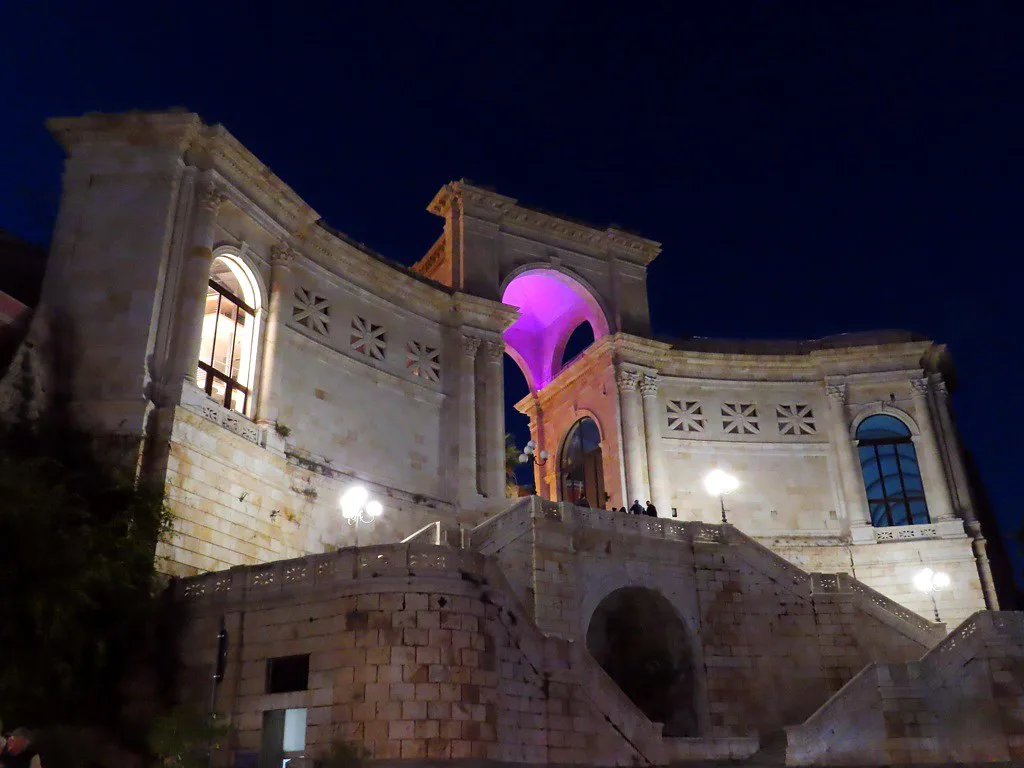
The main approach begins at Piazza Costituzione, where a long staircase climbs in several ramps and meets at a mid-height landing that opens into the covered promenade. This is the section most photographs feature, and it is also the easiest part to navigate spontaneously. Use the landing as your orientation point: from there the route divides between interior and open-air levels.
Because the stairways are exterior and unmistakable, they suit travellers who prefer to arrive without booking anything in advance. Sensible shoes matter more than timing here, and the climb is worth pacing if you plan to continue uphill into Castello afterwards.
The Passeggiata Coperta along Viale Regina Elena
Halfway up, the covered promenade runs along Viale Regina Elena as a long, bright interior lined with large arches and painted rooms. The heritage record notes that fixtures were installed only in 1985, which explains the space's hybrid character between open loggia and enclosed hall. Do not assume it is always open: its access is worth checking on arrival rather than treating it as a guaranteed stop.
If the interior is closed when you visit, the exterior route still delivers the architecture and the views, so keep the promenade as a bonus rather than the main event. Event programming in Cagliari changes, and the city's tourism pages are the place to confirm what is currently running.
The Umberto I Terrace and the Views
Above the great arch, a second staircase with two circular ramps leads to the Umberto I terrace, which the heritage record describes as offering a wide view over the city and toward the sea. This is the classic vantage point, and the reason many visitors treat the Bastione as a viewpoint first and a monument second. Evening light makes the rooftops and water read clearly, though weather off the sea can change quickly.
From this level, two further ramps continue toward the adjacent Santa Caterina bastion and its elementary school, so the terrace is a stage on a longer route rather than a summit. Let the walk unfold rather than racing to one viewpoint; the changing angles across Castello are the real reward.
The Two Circular Ramps beneath the Arch
The double circular ramp is a small piece of engineering theatre: two curving flights tucked under the dominant arch, carrying you upward in a helix. It is easy to miss if you take the obvious straight route, so watch for the arch as a waypoint. The geometry also gives photographers a natural frame looking back down over the city.
Walkers with luggage or limited tolerance for stairs should plan for several flights across the complex rather than a single climb. The heritage record does not describe lifts or step-free alternatives, so if mobility is a concern, confirm practical routes before committing to the upper levels.
After the Second World War: Bombing and Restoration
The Bastione was a lively meeting place until the Second World War, when bombing badly damaged it. It was later restored following the original design, which is why the structure reads as a coherent nineteenth-century composition rather than a ruin. That restoration history sits alongside the festive chapter when the covered promenade hosted the first edition of Sardinia's international trade fair in 1949.
Recognising both episodes keeps the monument from being reduced to a pretty staircase. It has been a civic stage for commerce and celebration as well as a defensive line, and each layer left a physical trace on the site.
Best Times and Conditions to Visit, as Suggestions
These are our suggestions, not published guidance. Early morning and late afternoon usually give softer light and cooler stone underfoot, which matters on an exposed staircase in summer. Midday in high season is best avoided if you dislike glare, while a brisk wind off the sea can make the upper terrace uncomfortable even on a sunny day.
Check the weather before setting out: the city's institutional homepage carries alert notices, and such warnings can affect outdoor plans. The Sardinian tourism portal is also useful for island-wide events that may coincide with your trip.
How Long You Will Want to Spend: A Suggestion
As a rough personal suggestion rather than an official figure, budget around thirty to forty-five minutes for the staircase, terrace and a look at the covered promenade if it is open. Photographers and anyone continuing to Santa Caterina will need longer. If the interior is closed, the outdoor route compresses to a shorter stop of roughly fifteen to twenty minutes.
Those times assume you are already in the centre, since the Bastione sits between the lower city and Castello and needs no separate journey. Build it into a walking day rather than a standalone outing.
What to Verify on the Day: Access, Events and Closures
The heritage record documents the architecture and location, including the address at Piazza Costituzione in the 09124 postal area, but it does not publish opening hours, ticket arrangements or closure notices. Access to the outdoor stairways should be confirmed locally rather than assumed, and the covered promenade in particular may have restricted hours.
Before climbing, check the Comune di Cagliari site for notices affecting the centre, and ask at a tourist information point about any event set-up on the terrace. Temporary installations can close sections without much warning. Verify rather than guess: the monument is free-standing, but its interior spaces are managed and can change.
Visiting with a Slow, Unhurried Mindset
The Bastione rewards a slower pace than its photo reputation suggests. Sit on the terrace, trace the ramps back down, and notice how the structure pivots between the dense medieval street pattern of Castello and the broader modern streets below. That contrast is the real content of the visit.
Slow travel here means resisting the urge to tick off one viewpoint and leave. Combine the Bastione with quieter parts of the historic centre and archaeology such as the Tuvixeddu necropolis when you want a less crowded counterpoint.
Practical Planning with the City and Nearby Attractions
The Bastione works best as the hinge of a city walk, linking Piazza Costituzione below with the Castello lanes above, so plan it between other stops rather than as a destination in itself. Practical details such as current tourism information and island events are available from the regional tourism board.
The monument's street address is listed as Piazza Costituzione in Cagliari, with a 09124 postcode, according to an Italy Magazine listing; useful if you need to point a taxi or map app at it.
Plan Your Visit
The Bastione di Saint Remy is best understood as a piece of urban theatre: Spanish foundations, a nineteenth-century rebuild, a staircase that draws you up, and a covered promenade and terrace that vary in availability. Go for the architecture and the view, and treat the interior as a bonus to confirm on the day.
Pair it with a wander into Castello and, if you want to go beyond the obvious stops, with the quieter places in our hidden gems in Cagliari guide. Check weather notices and tourism pages before you set out, and let the climb take longer than you planned. For related planning, see Orto Botanico di Cagliari: A Practical Visitor Guide.
Frequently Asked Questions
Is the Bastione di Saint Remy free to visit?
The outdoor stairways and terraces are generally treated as public spaces, but the heritage record does not publish a formal free-entry policy, and the covered interior may be managed separately. Check with local information services or the Comune di Cagliari before you rely on free access.
How long should you spend at the Bastione di Saint Remy?
As a personal suggestion rather than an official figure, allow roughly thirty to forty-five minutes to climb the staircase, reach the Umberto I terrace and look into the covered promenade if it is open. If the interior is closed, the outdoor route takes around fifteen to twenty minutes.
What can you see from the Umberto I terrace?
The heritage record describes the terrace as offering a wide view over Cagliari and toward the sea, reached by a second staircase with two circular ramps beneath the great arch. The view takes in the change from the dense Castello heights to the lower city.
Is the Bastione di Saint Remy accessible for wheelchair users?
The heritage record does not describe lifts, step-free routes or mobility arrangements at the Bastione, and the site is built around multiple staircases and ramps. Confirm practical access directly with local tourism information before relying on it.
When was the Bastione di Saint Remy built?
The present structure was built between 1896 and 1902 by municipal engineers Fulgenzio Setti and Giuseppe Costa, working from an earlier idea by Gaetano Cima. It reuses older Spanish bastions of the Sperone and the Mint from the second half of the sixteenth century.
Is the Bastione di Saint Remy worth visiting?
Yes if you enjoy architecture and city views: it links Cagliari's lower streets with Castello and shows how the two levels of the city meet. It is a short stop rather than a full attraction, so combine it with nearby sights.
Sources
Continue exploring
More guides you'll find useful