
Torre dell'Esperò Reale, Alghero: Bastioni Walk Guide
Use Torre dell'Esperò Reale as a landmark on Alghero's bastioni walk: what the sea-facing towers are, what you see from outside, and how to plan the circuit.
On this page
Torre dell'Esperò Reale belongs to the ring of defences that still wraps Alghero's old town, and the most useful way to approach it is on foot along the bastioni rather than as a single ticketed stop. The city's sea walls and towers survive in unusually good condition for an Italian town, which is why locals and visitors treat the circuit as everyday public ground rather than a museum. Plan on lacing the tower into a longer walk and you will get far more out of it than by hunting for an entrance.
Why the Tower Works Best as Part of the Wall Circuit
Torre dell'Esperò Reale sits among the defensive towers that once guarded the harbour approach, and it reads most clearly when you see it in that chain rather than in isolation. The historic centre is compact and pedestrian-only, roughly fifteen minutes end to end on foot, so a tower-to-tower stroll costs you very little time in a short visit. Treat the circuit as the attraction and the individual towers as markers along it.
One practical benefit of that framing is that you never need to commit to a single viewpoint or a single time slot. If one stretch feels exposed to sun or wind, you keep moving and pick up the next tower a few minutes later. The trade-off is that you will not find a distinct visitor experience attached to each tower, so budget your interest for the walk as a whole.
What the Bastioni Actually Are
Alghero was founded in the early twelfth century by the Doria family, and the defensive walls went up a few decades later before being substantially rebuilt through the medieval and sixteenth-century periods. That layered construction explains why the circuit mixes bastions, stretches of plain wall and towers of different shapes. The Catalan period left the deepest imprint, which is why street signs, language and architecture across the centre still feel more Barcelona than Cagliari.
Today you can see several towers inside the walls and additional ones placed outside along the coastline, and the sea-facing ones are the easiest to appreciate because the water gives you a clean sightline. Walkers commonly describe the bastioni as the highlight of a wandering afternoon rather than a checklist. Keep that in mind when you are deciding how much of the day to give it.
Reading a Sea-Facing Tower from Outside
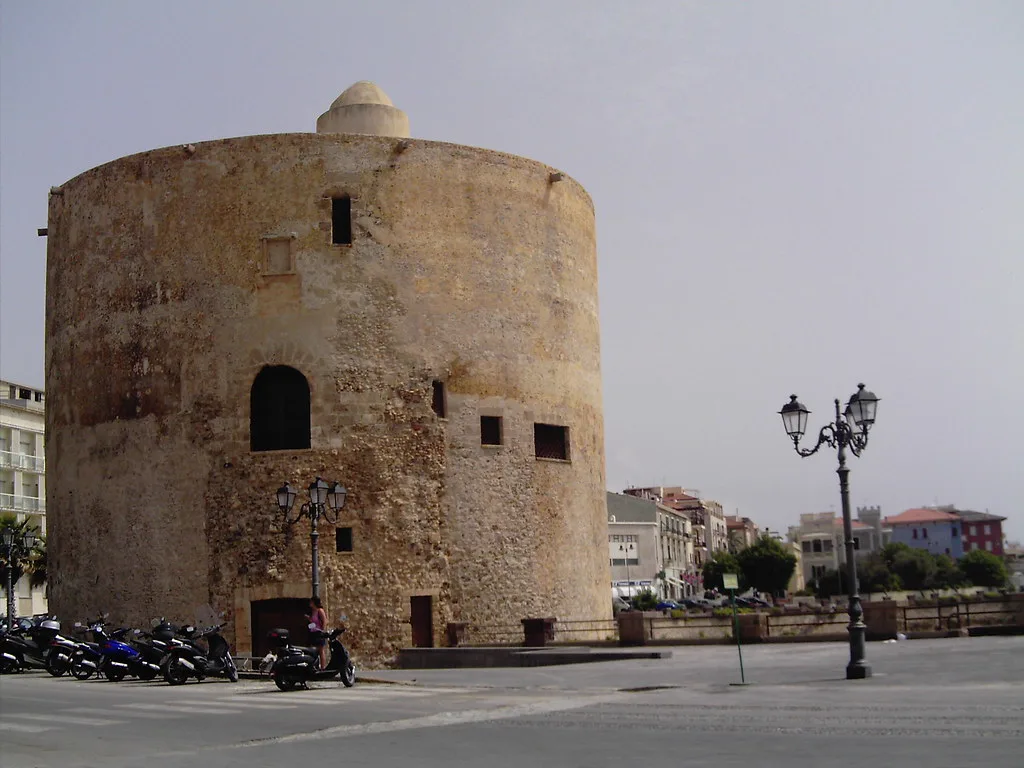
What you are looking at with Torre dell'Esperò Reale is a masonry defence built to watch over maritime approaches, not a palace or a church with a decorated interior to tour. Treat it as architecture in the urban landscape: the stonework, the position relative to the water and the way it anchors a stretch of wall are the substance of the visit. Photographs from the bastioni path work well because you can frame the tower against the sea without needing to go inside.
Interior access, opening hours and any ticket arrangement for this specific tower are not documented, so do not build a day around touring it. The honest approach is to walk the circuit, look for published notices on site or ask at the tourist information point in the city before assuming anything. If a door is open when you pass, that is a bonus rather than a plan.
One nearby comparison is useful: the Torre del Portal, also known as Porta Real, is described as the only surviving tower not standing in the sea after others were dismantled. That detail tells you how much the defensive line has changed over the centuries and why you should not expect a complete, uniform set of towers. Reading the gaps is part of reading the walls.
Orienting Yourself: Porta a Mare and Piazza Sulis
The two anchors most walkers use are Porta a Mare, where the sea walls begin near the harbour, and Piazza Sulis at the far southern end of the old town. Between them runs the long bastioni stretch along Bastioni Marco Polo, which one account singles out as the favourite section for a late-afternoon circuit. Start at whichever end is closer to your accommodation and walk the full line rather than doubling back.
The Torre di Sulis marks the southern edge of the historic centre and carries its own story, having once been known as the Tower of the Royal Supply before being renamed for the Sardinian revolutionary Vincenzo Sulis, who spent twenty-two years in solitary confinement inside it. It now hosts exhibitions and theatrical performances on its lower floors. That makes Piazza Sulis a natural finishing point, with a small cultural stop built in if something is running.
Because the centre is pedestrian-only, you will walk the entire circuit on foot and cannot shortcut by car. If you are staying outside the walls, park once near the edge and commit to the walk, then re-emerge for dinner rather than moving the car. This is the single most practical decision for a bastioni day.
Which Towers You Pass and How They Differ
Along the circuit you will encounter Torre di San Giacomo, Torre della Polveriera and Torre di Sant'Elmo, each with a slightly different silhouette and story. Sant'Elmo is the one arriving visitors spot first from the airport road and is locally nicknamed La Madonnina for the statue of the Virgin above it, while San Giovanni, the so-called central tower, now serves as a space for temporary exhibitions. That variety is exactly what makes the walk worth doing slowly.
Not every structure along the water is a tower, and not every tower is in the same condition, so resist the urge to make a strict list and tick them off. A more useful habit is to pause where the wall widens, read any panel that happens to be there, and look back at the harbour. Expect to spend a couple of hours if you stop often, and under an hour if you walk briskly.
Timing the Walk: Sunset, Siesta and Summer Heat
The bastioni walk is at its most popular around sunset, when bars along the walls spill into the street for aperitivo and the light on the sea does most of the work. That popularity is a trade-off: you get atmosphere and company, but you also share narrow stretches with a crowd. Arriving roughly an hour before golden hour usually gives you the best balance. Further visitor details appear in The Best Things to Do in Alghero, Sardinia: A Complete Travel Guide - Bon Traveler.
Siesta matters here. Like most Italian towns, Alghero quietens down in the mid-afternoon, with many shops and some venues shutting for a few hours, so a wall walk timed for early afternoon can feel flat when you want a coffee afterwards. Walking late morning or late afternoon also avoids the strongest sun on the exposed seaward side. Summer visitors should carry water and wear shoes that cope with uneven stone.
The wider seasonal advice for the region is to favour late April to early June and September to mid-October, when the weather is pleasant and the crowds thinner, while July and August bring the best beach conditions but the highest prices and busiest streets. For a walking circuit rather than a beach trip, the shoulder months are the better bet. Check a forecast before committing to a sunset slot, since coastal wind can change the feel of the seafront quickly.
Combining the Walls with the Historic Centre
Step off the walls and you are immediately in the Catalan-Gothic lanes of the old town, where cobbles, coral jewellers and small churches sit within a few minutes of each other. The Centro storico rewards unstructured wandering more than route-following, so build in an hour simply to get lost between the bastioni and Piazza Civica. That contrast between the open sea wall and the tight lanes is the defining pleasure of Alghero.
Santa Maria Cathedral, one of the largest churches in Sardinia, combines a late Gothic rear with a neoclassical facade and a majolica-tiled bell tower, and it is worth checking whether it is open before treating it as a fixed stop. The Church of San Michele, built by the Jesuits in the seventeenth century, is known for its patterned ceramic dome, best appreciated from a distance rather than from directly beneath it. Both are exteriors you can enjoy without any ticket, with interiors dependent on the day.
For a dose of local identity, the Coral Museum sits just outside the walls in an Art Nouveau villa, and the surrounding workshops sell red coral pieces, some carrying the official mark of the Corallium Rubrum consortium. Read the displays first if you intend to buy, so you can distinguish certified Mediterranean coral from the imitation sold in markets. It is a short detour that pairs neatly with the southern end of the wall circuit.
Practical Decisions: Where to Stay and Whether to Drive
Stay inside or beside the pedestrian centre if the walls are your priority, and accept that you will not need the car for the old town at all. Keep a rental car only if you plan day trips, and choose accommodation with parking so you are not re-parking after an evening on the bastioni. That single booking decision removes most of the friction from an Alghero stay.
Without a car, the old town remains entirely walkable and the nearer beaches are reachable on foot, by bike or by local bus, but the regional sights further out become awkward. With a car, Capo Caccia, Porto Conte and the archaeological sites are all within comfortable reach. Decide which of those you actually want before you book transport.
Where to Go Next: Caves, Nuraghi and Day Trips
Neptune's Grotto at Capo Caccia is the obvious next stop, reached either by boat from the harbour or by road followed by the Escala del Cabirol staircase cut into the cliff. The cave visit itself is guided and requires booking, and the official site publishes current times, admission fees and booking details rather than leaving them to third parties. Read that page before you go, since schedules shift with season and sea conditions.
Inland, the Necropolis of Anghelu Ruju near Alghero is Sardinia's largest prehistoric cemetery, with thirty-eight tombs cut into sandstone and used from the Late Neolithic into the Early Bronze Age. The operator publishes seasonal opening hours and a full adult ticket plus reduced categories, and the site is included in the Alghero Ticket pass. Hours and prices can change, so confirm on the official page before travelling out.
Further afield, Bosa is about forty-five minutes south by car and rewards a half day with its riverside old town and the Malaspina castle above it, while La Pelosa near Stintino is roughly an hour north and requires advance booking in a regulated system. Pick one, not both, if you are basing yourself in Alghero for only a few nights. The city's own tourism consortium lists operators and current events if you want to check what is running during your stay.
Plan Your Bastioni Walk
Torre dell'Esperò Reale is a landmark, not an itinerary item, and the most rewarding way to see it is as one element in a walk from Porta a Mare to Piazza Sulis. Go late in the day for the light and the atmosphere, accept the company, and keep the mid-afternoon free for a siesta rather than a sun-baked wall.
Before you travel, check the official city and tourism pages for anything that requires booking, and read the Neptune's Grotto site directly if the cave is on your list. Everything else on the walls is a matter of comfortable shoes, water and a willingness to wander. For related planning, see Torre di San Giovanni and Sperone Reale, Alghero: Visitor Guide.
Frequently Asked Questions
Can you go inside Torre dell'Esperò Reale?
There is no published information confirming that this tower can be entered or toured, so plan to see it from the bastioni path outside. Check on-site notices or ask at the city's tourist information point when you arrive, and treat any open door as a bonus rather than something to schedule around.
Is there a ticket or opening time for the tower?
No ticket price, opening time or booking channel for Torre dell'Esperò Reale is documented. The walls and streets around it are public ground you can walk freely; anything that turns out to be ticketed should be confirmed with the operator or the city's tourism office on the day.
How long does the Alghero bastioni walk take?
The old town is compact, about fifteen minutes end to end on foot, so the wall circuit itself can be walked in under an hour if you keep moving. Allow two hours or more if you stop at towers, take photographs and finish with an aperitivo near Piazza Sulis.
Where does the wall walk start and end?
Most walkers use Porta a Mare near the harbour as the northern anchor and Piazza Sulis with the Torre di Sulis as the southern end, following Bastioni Marco Polo between them. Start at whichever end suits your accommodation and walk the line once rather than doubling back.
When is the best time to walk Alghero's walls?
Late afternoon into sunset is the most atmospheric and the most crowded, while late morning is quieter but more exposed to sun. Avoid the mid-afternoon siesta lull, and in summer carry water and wear shoes suited to uneven stone.
Which towers can you see along Alghero's bastions?
Among the named towers along or near the circuit are San Giacomo, della Polveriera, Sant'Elmo and San Giovanni, plus the Torre di Sulis at the southern end and the Torre del Portal, the only surviving tower not standing in the sea. Each differs in shape and current use, which is part of the interest.
Do you need a car in Alghero?
No for the old town and the walls, which are pedestrian-only and compact. Yes if you want Capo Caccia, Porto Conte, the nuraghe sites or day trips to Bosa and La Pelosa, so decide on those before booking transport and pick accommodation with parking if you keep a car.
What else is near the old town walls?
Santa Maria Cathedral, the Church of San Michele with its tiled dome, the Coral Museum just outside the walls and the lanes of the Centro storico are all within a short walk. Neptune's Grotto and the Necropolis of Anghelu Ruju make sense as separate outings rather than add-ons to the same afternoon.
Sources
- Torre del Portal – Torre di Porta Terra, Alghero, Italy - Reviews, Ratings, Tips and Why You Should Go – Wanderlog
- The Best Things to Do in Alghero, Sardinia: A Complete Travel Guide - Bon Traveler
- Top Things to See in Alghero ⋆ Lifeguin
- Visit Alghero Italy ⭐️ Unmissable Things to Do in 2026
- 10 Best Things to Do in Alghero, Northern Sardinia (+ Map!)
- Grotta di Nettuno: sito ufficiale della Città di Alghero
- Necropolis of Anghelu Ruju | Alghero Experience
- Homepage | Comune di Alghero
- Visit Alghero | Consorzio Turistico Riviera del Corallo
Continue exploring
More guides you'll find useful





