
Nuraghe Palmavera Guide: Visiting the Nuragic Complex Near Alghero
Plan a visit to Nuraghe Palmavera near Alghero: what the Nuragic complex contains, how to reach it by car or bus, and whether to join a guided tour.
On this page
Nuraghe Palmavera sits on the edge of the Porto Conte area outside Alghero, close enough to the city for a half-day trip and rich enough to reward a slower one. The complex pairs a defensive tower group with the remains of a village, so you see domestic life alongside monumental architecture rather than a single isolated ruin. It is often compared with Su Nuraxi of Barumini, the best-known nuraghe on the island, and for many travellers it is the most memorable archaeological stop in this corner of Sardinia.
This guide covers what the site actually contains, how the drive and the bus-plus-walk alternative work, and how to plan around tickets and seasonal opening times that are not reliably published online. One concrete planning detail up front: a bare-bones visit usually fits comfortably into an hour, while adding the information panels, a guided explanation or a walk into the surrounding landscape supports a fuller half day. Treat that duration as a sensible suggestion rather than an official figure, and confirm the essentials with the operator before you set out.
Who the Nuragic People Were and Why Sardinia Is Covered in Nuraghe
The Nuragic civilisation was an indigenous Sardinian culture that emerged in the Bronze Age and persisted in some areas into the late Roman era. Its name comes from the nuraghe, the distinctive stone towers the population built, of which roughly seven thousand survive across the island in very different states of preservation. Palmavera is one of the better-kept examples, which is why it appears on shortlists of Sardinian archaeological sites alongside Su Nuraxi.
Scholars still argue about how complex Nuragic society was, with views ranging from a fairly simple subsistence culture to a structured society with hierarchy and possibly writing. The likeliest picture is a civilisation that changed over many centuries, since no static society could have raised buildings on Palmavera's scale. Keeping that debate in mind makes the ruins more interesting: you are looking at evidence under interpretation, not a finished story.
What You Actually See at Palmavera
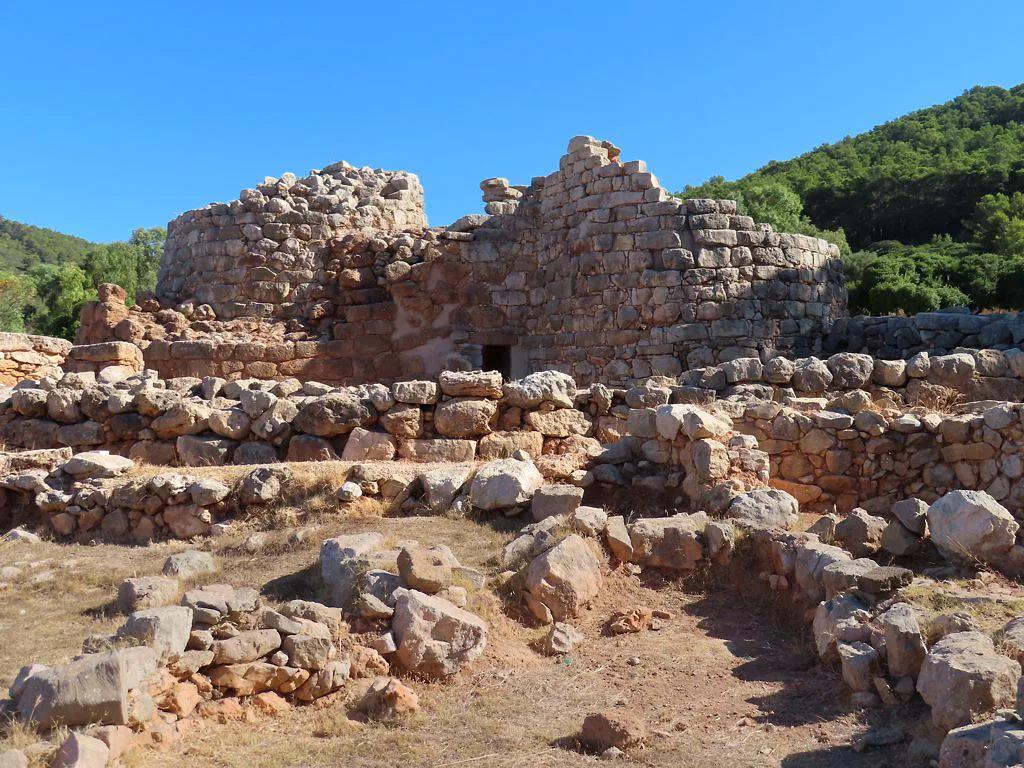
The main structure looks as though it was built and reworked across different periods, which is itself a clue to how the settlement evolved. Around it, a defensive wall encloses the core towers, and beyond that lie the remains of roughly fifty huts that housed ordinary members of the community. The whole complex was originally about four times larger than what survives today, so the visible footprint is a fraction of the original village.
Walking between the huts and up to the walls is the part most visitors remember, because the layout reads like a lived-in settlement rather than a monument. The site also yields a useful reminder that excavation is ongoing: objects found here, including the most celebrated relic, a miniature model of the nuraghe itself, have ended up in archaeological museums in Alghero and Sassari. Seeing the ruins and then the finds in town gives you a more complete picture than either does alone.
The Meeting Hut and Its Throne Seat
Palmavera's signature feature is a council or meeting hut where the community's most important members are thought to have gathered. Inside, a seat resembling a throne is generally identified as the place reserved for the village leader. It is a small architectural detail with outsized effect, because it turns an abstract description of Nuragic society into a room you can stand in.
If you only have time for a quick pass through the complex, make this hut a priority and read the panels around it carefully. The interpretation boards placed around the site carry enough context to make the meeting hut legible without a guide, though they cannot answer follow-up questions. Photographers should note that the hut interiors are cramped and dim, so a wider lens and a slower pace serve you better than a long zoom.
Abandonment, Fire and Where the Finds Went
Palmavera was abandoned around the eighth century BC, reportedly after a serious fire, and later arrivals in the area are thought to have removed many of its treasures. That history explains why the visible ruins feel stripped back: the structures survive, but much of what filled them does not. It also explains why the miniature nuraghe model found here matters so much, since it helps reconstruct what the complex originally looked like.
Knowing where the excavated material is kept changes how you plan the day. Because finds are distributed between museums in Alghero and Sassari, a visit to the site pairs naturally with a museum stop in town, especially if the weather turns. Check the museums' own published information for current displays rather than assuming any particular object is on show.
Getting There from Alghero by Car
Driving is the simplest way to reach the site. Head towards Fertilia, the district near Alghero's airport, then follow the SS 127 bis towards Porto Conte and Capo Caccia, where road signs begin pointing to Nuraghe Palmavera.
Because the route passes Fertilia and continues towards the Porto Conte nature park, it slots neatly into a day that combines archaeology with the coast. If you are staying in the Centro storico, plan the drive for the morning and keep the afternoon flexible for the coast road back. Parking arrangements at the site are not something to assume, so have a fallback in mind near the entrance area.
Reaching Palmavera Without a Car
Public transport is possible but requires a walk at the end. One account reports buses 9320 and 9321, with the option of alighting at Lazzaretto Beach and walking about twenty minutes, or asking the driver to stop at Bivio Le Bombarde and walking roughly fifteen minutes from there. Treat those route numbers as reported rather than confirmed current service, and check locally before relying on them.
The final stretch is on foot along ordinary roads, so this option suits travellers with time, daylight and a tolerance for heat. It is a poor fit for a tight schedule or a late afternoon arrival, when a missed connection leaves you exposed. The city's tourism pages are a sensible place to confirm how to arrive and get around before committing to a car-free plan.
Tickets and Seasonal Opening Times: Check Before You Travel
Published figures for Palmavera should be read as dated reporting rather than confirmed current practice. One visitor guide, updated in 2026, gives seasonal hours running from roughly 10:00 to 14:00 in November to March, 10:00 to 18:00 in April, May and October, and 10:00 to 19:00 from June to September, with the site said to close on Christmas Day. The same source lists a full-price ticket of five euros and a reduced four-euro rate, with a combined Palmavera and Anghelu Ruju option at eight euros full and six reduced, plus audio guides at three euros.
None of that is guaranteed to be current, and the official sources in this field are patchy. The regional museums portal has not published usable detail for this site, so do not rely on it or on any single blog for final. Before travelling, confirm hours and ticket scope directly with the site, and check whether any single ticket actually covers both Palmavera and the necropolis rather than assuming a combined ticket exists.
Guided or Self-Guided?
The site is equipped with information boards, so self-guided visitors can follow the main structures and understand the meeting hut without paying extra for commentary. For travellers with a serious interest in prehistory, though, a guide adds interpretation that boards cannot: how the phases fit together, what the finds imply, and what remains disputed.
Booking options exist in both directions. One report says tours can be arranged with the site by phone, while noting that the Italian-language website does not specify prices or confirm languages other than Italian. Third-party tours combining Palmavera with Anghelu Ruju, or with the Porto Conte nature park, are described as including transport and an English-speaking guide; verify availability, group size and what is included before booking.
Pairing Palmavera with Anghelu Ruju or Porto Conte
Anghelu Ruju Necropolis is the natural companion. It is the largest necropolis on the island, made up of around forty domus de janas cut into the rock, discovered by chance in 1903 by workers at the nearby Sella & Mosca vineyard. It sits on the opposite side of the road from the winery along the SP 42 towards Sassari and Porto Torres, which makes a two-site day logistically clean.
If you would rather trade stones for landscape, the Porto Conte nature park and the Capo Caccia coast are on the same road as Palmavera, so a single outing can mix a ruin visit with a coastal walk. That combination justifies the detour outside the city in a way a rushed twenty-minute stop does not. Pairing rather than cramming is the better strategy here.
How Long to Allow and When to Arrive
A suggested allowance is one hour for a focused walk through the towers and huts with a skim of the boards, or two to three hours if you read carefully, use an audio guide or add a guided tour. Add travel time from Alghero on top of that, and remember the walk from the bus stop eats into a car-free schedule.
Mornings are the more forgiving choice: the site is open-air with little shade, and temperatures on this stretch of coast climb through the summer day. Arriving near opening also leaves room for a museum stop in Alghero afterwards if the finds have sparked your interest. Confirm the day's closing time on arrival so the gate does not end your visit early.
Practical Tips for the Visit
Expect uneven ground, loose stone and a lot of standing rather than a paved circuit, and wear closed shoes; the operator does not publish accessibility information, so anyone with mobility concerns should ask directly before travelling. Carry water and sun protection, since shade is limited and the wind on this coast can disguise how strong the sun is.
Bring a layer for the breeze off the sea and keep valuables light, because you will be walking rather than sitting. If you are travelling by bus, build slack around the return trip instead of timing it to the minute. A quick look at broader options for your stay helps you slot the ruin visit into a fuller plan without overloading one day.
Plan Your Visit
Palmavera earns its place on an Alghero itinerary because it does something most ruins do not: it shows you where a community met, debated and stored its authority, not just where it defended itself. The main tower group, the roughly fifty huts and the meeting hut with its throne seat together make the Nuragic world concrete. Go for the architecture, stay for the sense of a village that was once four times this size.
Before setting out, confirm current opening times, ticket scope and whether a combined Palmavera and Anghelu Ruju ticket exists, since published figures should be treated as a starting point rather than a promise. Decide in advance between driving via Fertilia and the Porto Conte road or taking the bus-and-walk route, and leave room for the necropolis or the coast. Book any guided tour directly and confirm the language on offer.
Frequently Asked Questions
Is Nuraghe Palmavera worth visiting near Alghero?
For anyone interested in prehistory or in seeing how a Bronze Age community actually lived, yes. The complex combines a walled tower group with the remains of around fifty huts and a meeting hut containing a seat identified as the leader's place, which is more revealing than a single isolated tower. It also sits on the road towards Porto Conte and Capo Caccia, so it pairs naturally with the coast or with Anghelu Ruju Necropolis.
How do I get to Nuraghe Palmavera without a car?
One reported option is a bus towards the Porto Conte coast and then a walk, with alighting near Lazzaretto Beach or at Bivio Le Bombarde adding roughly fifteen to twenty minutes on foot. Route numbers and timetables change, so verify current service locally before relying on this. Travellers short on time or visiting late in the day are better served by driving or joining an organised tour with transport.
How long does a visit to Nuraghe Palmavera take?
Allow around an hour for a focused walk through the towers and huts with a quick read of the information boards, or two to three hours if you use an audio guide, read in depth or join a guided tour. Travel time from Alghero is additional, and the walk from a bus stop adds more. This is a planning suggestion, not an official duration.
Can I visit Nuraghe Palmavera and Anghelu Ruju on the same ticket?
A combined ticket for Palmavera and the Anghelu Ruju Necropolis has been reported, alongside separate pricing for each site, but treat that as dated third-party information rather than current policy. Ask at the ticket office or check with the operator before you travel, and do not assume one ticket covers everything on your itinerary.
What are the opening hours and ticket prices for Nuraghe Palmavera?
Third-party reporting describes seasonal hours with shorter days in winter and longer summer opening, and lists a full-price ticket, a reduced rate, a combined option and an audio guide charge. Those figures are not confirmed current, and the regional museums portal does not publish usable detail for this site, so confirm hours and price scope directly with the operator before travelling.
Is a guided tour of Nuraghe Palmavera necessary?
No. Information boards around the site let self-guided visitors follow the towers, the huts and the meeting hut without extra cost. A guide helps if you want interpretation of the building phases, the excavation finds and the unresolved debates about Nuragic society. Some third-party tours combine the site with Anghelu Ruju or the Porto Conte park and include transport and an English-speaking guide, so check what each option covers before booking.
Sources
Continue exploring
More guides you'll find useful





