Santa Maria Cathedral Alghero: What to See Inside
See what to look for inside Alghero's Santa Maria Cathedral, from its Catalan-Gothic core to later phases, and how it fits into an old-town walk.
On this page
Alghero's cathedral sits in the heart of the historic centre, a short step from the harbour gate, and it rewards a slower look than most visitors give it. The building reads as a sequence of construction phases rather than a single design, which is why the rear and the front seem to belong to different centuries. This guide explains what to notice, separates the church from any paid bell-tower access, and shows where the visit fits in a walk through town.
Why the cathedral anchors Alghero's historic centre
The cathedral is the focal point of a town that has kept a strong Catalan cultural identity, and it stands on Piazza Duomo just inside the old-town walls. Read the square as a hinge between the harbour and the lanes behind: you pass Porta a Mare from the seafront, cross Piazza Civica, and the cathedral opens on your right. Treat it less as a single monument and more as the anchor for a loop that takes in the bastions and towers.
If you are building a day or two in the city around several sights, it helps to see the cathedral in context with the other monuments and coastal stops nearby. The wider Alghero Attractions collection covers the structures and viewpoints worth pairing with the church, from the sea walls to the archaeological sites north of town. Skim it before you fix your route, so you do not end up doubling back through the lanes.
Alghero's municipal site is the place to check for road works, temporary traffic changes and city notices that can affect how you reach the centre on a given day. It also publishes cultural and tourist items that occasionally touch on the old town's monuments and events. A quick look before a visit is more reliable than assuming the streets around Piazza Duomo are always open to traffic.
Where it sits: Piazza Duomo, Porta a Mare and the old-town approach
The cathedral faces Piazza Duomo, reached from the Magellano waterfront through Porta a Mare, which opens between the de Castilla and de la Magdalena towers onto Piazza Civica. From there you turn right into the small square of the Duomo. Arriving this way gives you the building's setting as it was meant to be experienced, from the sea side inward, rather than from a car park on the edge of the walls.
Because the centre is compact, the practical choice is usually to leave the car outside the walls and walk in. The cathedral, the bastions and the coral workshops all sit within a small radius, and the paving is uneven cobblestone, so comfortable shoes matter more than any transport plan. Save driving for the day trips north to Capo Caccia or the nuraghe sites.
Reading the building: Catalan-Gothic origins and the Renaissance turn
Alghero was elevated to city status in 1501 and a papal bull of 1503, promulgated by Julius II, reorganised the Sardinian dioceses with a new seat at Alghero, but for years the town had no building worthy of the role. Construction of the cathedral began in the third decade of the sixteenth century and dragged on amid financial difficulties. That stop-start history explains the building's layered character.
By around 1547 the choir with its five radial chapels and the octagonal bell tower over the central chapel are thought to have been in place, following the Catalan cathedral model seen in Barcelona. An Italian or classicist architect then gave the works a Renaissance turn, and the last of the radial chapels shows the shift in taste. Stand in the crossing and compare the ribbed Gothic survivals with the later, more classical proportions.
The later rebuild: neoclassical facade and what changed
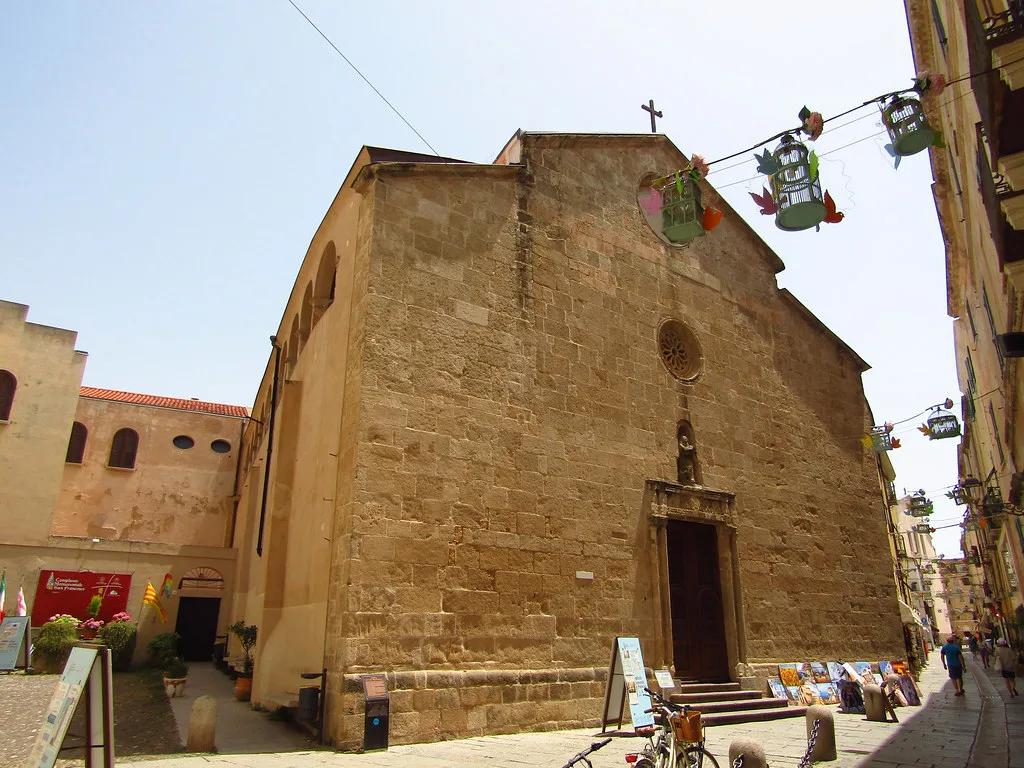
Consecration came in 1593 under Bishop Bacallar, though the fabric was not finished until around the middle of the seventeenth century, when the transept and crossing were vaulted. The long nave, divided into three aisles, was added against the older Gothic body by way of a broad transept. What you see from the square, the neoclassical portico, belongs to a nineteenth-century reconstruction of the original late-Renaissance facade, so the entrance elevation is the youngest part of the story.
This is the single most useful thing to know before you go in: the church's exterior and its interior do not read as one period. If the front looks austere and white, the back and the chapels tell a different story. Walk around the outside if the doors are shut and you will still see the massing of the Gothic body under the later shell.
Inside: three naves, radial chapels and the marble furnishings
Inside, the three aisles are covered by slightly lowered barrel vaults carried on classical corbels, and the radial chapels wrap the choir in a girdle. Among the marble furnishings, the pulpit and the monumental high altar by Giuseppe Massetti of Genoa, dated 1727, are the pieces to seek out. Look for the baroque overlay of the late eighteenth century, which sits over the earlier structure rather than replacing it.
The cathedral is also the setting for the city's religious life rather than a museum room, and daily services can restrict movement through parts of the interior. Time your look at the chapels around any service in progress, keep voices low, and treat the high altar as a place of worship rather than a photo set. If you want the building's history in depth, a licensed local guide adds real value on the Catalan phases.
The bell tower: octagonal drum, majolica spire and the Catalan model
The campanile is an octagonal barrel crowned by a pyramidal spire, a type common in Catalonia and comparable to models such as the Sant'Agata chapel and Barcelona cathedral. It is reached through a Catalan Gothic entrance on Via Principe Umberto, and the climb is by a narrow spiral staircase to the bells, with a full panorama of the city at the top. The view is the reward, but the stair is tight and not for anyone uneasy in confined spaces.
Access to the tower should be treated as a separate question from entry to the church. The regional culture portal notes that a guided tour of the bell tower operates through a cumulative ticket bought at the Diocesan Museum of Sacred Art, which is not the same as simply walking into the cathedral. Confirm current arrangements at the museum or the city's tourist information before you count on the climb.
Church versus bell tower: separate access, so check before you plan
The safest planning assumption is that the church and the tower are two different visits with two different sets of conditions. Churches in Italy commonly open for services and close at other hours, and tower access often depends on staffing, group size and time slots. Build your day so the cathedral is a bonus rather than a fixed appointment, and you will not lose a morning to a locked door.
One traveller account from a spring visit found the cathedral closed despite expecting it to be open, which is a reminder that published expectations and actual opening can diverge. Have a backup in the same loop: the sea bastions, the towers and the coral shops are all within a few minutes' walk. If the doors are open, go in first and walk the walls afterwards.
What is free and what may be ticketed
Published figures for cathedral and tower entry circulating online are out of date and should not be relied on. This guide deliberately gives no amount, because the church's own access policy and any tower ticket need to be confirmed locally on the day. Ask at the Diocesan Museum about tower tours and at the tourist office about the church, and check whether any small contribution is requested for maintenance.
Separate ticketed attractions elsewhere in the city are sometimes confused with the cathedral, so keep the scopes distinct. Neptune's Grotto, for example, sells its own admission, and the operator states plainly that cave entry does not include the shuttle bus fare or a boat ticket if you arrive by sea. Those are separate purchases from anything at Piazza Duomo.
Opening hours: how to confirm before travelling
There is no reliable public schedule for the cathedral's daily opening that can be quoted in advance, so confirmation has to happen close to your visit. Try the tourist office in town, the Diocesan Museum for tower tours, or the parish notice board at the entrance. If you are planning around a single day in Alghero, check the day before rather than weeks ahead.
Remember that much of Italy still slows in the mid-afternoon, and shops and some attractions shut for a few hours after lunch. Plan the cathedral for the morning and use the early afternoon for a long lunch or a shaded walk on the bastions. That rhythm saves you from standing in front of a closed door in the hottest part of the day.
How long to allow, plus a suggested time budget
As a suggestion rather than an official figure, allow around thirty to forty-five minutes for the interior if you want to read the chapels and the high altar without rushing. Add twenty to thirty minutes outside for the square and the walk around the exterior. If the tower is open and you climb it, budget the stair and the view separately.
Half a day covers the cathedral plus the old-town circuit comfortably. A full day lets you add the Coral Museum and a long harbourside lunch. Three nights in the city, as one frequent visitor suggests, is enough to take in both the town and a couple of day trips beyond it, which is a more realistic base than a single rushed stop.
Combining the cathedral with bastions, towers and the Coral Museum
A natural loop starts at Porta a Mare, takes in the cathedral, then follows the sea walls past the bastions and towers toward Piazza Sulis. The stretch along Bastioni Marco Polo is the classic sunset walk, and the towers of San Giacomo, della Polveriera and Sant'Elmo punctuate the route. End with an aperitivo on the walls rather than doubling back through the lanes.
For the coral story behind Alghero's most famous craft, add the Coral Museum, housed in an Art Nouveau villa near Piazza Sulis. Its displays cover how red coral is harvested and worked into jewellery, with historic photographs and examples of the craft. That context makes the coral boutiques in the old town far more interesting to browse, and it pairs naturally with the cathedral visit on the same afternoon.
Combining with Neptune's Grotto or Anghelu Ruju on the same day
The cathedral makes a sensible morning, with a coastal excursion in the afternoon. Neptune's Grotto at Capo Caccia can be reached by land down the Escala del Cabirol or by boat from the port, and the official site publishes opening times and booking arrangements. Check the ticket page before you go, since admission, shuttle and boat are priced and booked separately.
Inland, the necropolis of Anghelu Ruju is a compact prehistoric cemetery of rock-cut tombs, discovered by chance in 1903 and excavated into the 1960s. The operator publishes seasonal opening hours that shorten outside October, plus admission categories and a public bus route with a stop on request. Check the current timetable and ticket before setting out, since both change with the season.
Practical tips: footwear, siesta timing and heat
The old town's paving is large, rounded cobbles that are hard on thin soles and heels, so wear something flat and grippy. Carry water on the bastions, which are fully exposed, and save the sunniest stretch for early or late. If you plan the tower climb, remember the spiral stair and the heat inside the drum.
Avoid scheduling the cathedral for the middle of the afternoon, when both churches and shops tend to pause. Morning light is better for the interior and for photographs of the square. Keep a light layer for the church, which stays cool even in high summer.
Common mistakes first-time visitors make
The first mistake is expecting one uniform style and walking past the building because the facade looks plain. Go round the back and look up at the octagonal tower before you decide. The second is assuming the bell tower is included with the church; treat it as a separate, staff-dependent visit.
The third is treating the cathedral as a quick photo stop and missing the chapels and the Massetti altar inside. Give the interior a proper look, then use the remaining time on the walls. If you are short of time, the harbour, the bastions and the cathedral square form the tightest, most rewarding circuit.
Plan Your Visit
Alghero's cathedral is best approached as a layered building in a layered town: a Catalan-Gothic core, a Renaissance turn, a later neoclassical front, and a campanile that belongs to a wider Mediterranean family of towers. Go in the morning, wear flat shoes, and treat tower access as something to confirm rather than assume.
Before you travel, check the tourist office and the Diocesan Museum for current access and any tour arrangements, and leave the rest of the day for the bastions, the coral workshops and a long lunch. That combination is what makes the old town memorable, and it does not depend on any single door being open.
Frequently Asked Questions
Is the Cathedral of Santa Maria in Alghero free to enter?
Published entrance figures for the cathedral are out of date and cannot be relied on, so this guide does not give an amount. Ask at the tourist office or the Diocesan Museum, or check the notice at the entrance, for the current arrangement and whether any contribution is requested.
Can you climb the bell tower of Alghero cathedral, and is it a separate ticket?
The tower is reached through a Catalan Gothic entrance on Via Principe Umberto, up a narrow spiral stair to the bells and a panorama of the city. The regional culture portal describes a guided tower tour operating through a cumulative ticket bought at the Diocesan Museum of Sacred Art, which is separate from entry to the church itself. Confirm current arrangements at the museum before planning the climb.
How long should you spend at the cathedral?
As a suggestion rather than an official figure, allow about thirty to forty-five minutes inside to read the chapels and the high altar, plus twenty to thirty minutes outside for the square and a walk around the exterior. If the tower is open and you climb it, budget that separately.
What architectural styles can you see in Alghero's cathedral?
Construction began in the third decade of the sixteenth century, and the choir with five radial chapels and the octagonal bell tower follow the Catalan cathedral model. A classicist architect later gave the works a Renaissance turn, and the present neoclassical portico is a nineteenth-century reconstruction of the original late-Renaissance facade.
Where exactly is the cathedral in Alghero's old town?
It faces Piazza Duomo inside the walled centre. The usual approach is from the Magellano waterfront through Porta a Mare, between the de Castilla and de la Magdalena towers, onto Piazza Civica and then right into the small square of the Duomo.
What else can you combine with a cathedral visit on the same day?
The sea bastions and towers, including the sunset walk along Bastioni Marco Polo, and the Coral Museum near Piazza Sulis fit naturally into the same loop. For a longer day, Neptune's Grotto at Capo Caccia or the necropolis of Anghelu Ruju inland are possible, but check opening times, booking and separate admission before you set out.
Sources
- Homepage | Comune di Alghero
- The Best Things to Do in Alghero, Sardinia: A Complete Travel Guide - Bon Traveler
- Cattedrale Di Santa Maria | Welcome Alghero
- SardegnaCultura - Alghero, Cathedral of Santa Maria
- Visit Alghero | Consorzio Turistico Riviera del Corallo
- Coral Museum, Museum in Sardinia, Italy
- Necropolis of Anghelu Ruju | Alghero Experience
- Grotta di Nettuno: sito ufficiale della Città di Alghero
- Info Ticket · Grotta di Nettuno
Continue exploring
More guides you'll find useful