
Trento Viewpoints: Cable Car, Castle Towers and City Views
Compare Trento's elevated viewpoints, from the Sardagna cable-car terrace to Buonconsiglio's towers and loggia, with what each looks onto and what it demands.
On this page
Trento is a compact university city in the Trentino region of northern Italy, set in a valley where mountains fill the background whichever way you turn. Almost everything in the historic centre is within walking distance, which makes a viewpoint stop easy to slot into a day rather than a separate excursion.
Climbing for a view pays off here because the valley floor is flat and low: the Duomo, the castle and the river all sit in the same horizontal band. Rising even a few dozen metres reorders the whole city into rooftops, towers and a wall of mountains.
One practical anchor before you plan: third-party visitor guidance suggests allowing roughly two to three hours inside Buonconsiglio Castle, and about one to one and a half hours for a quicker visit focused on the Eagle Tower frescoes and the main courtyard. Treat those as planning estimates, not official timings, and confirm current details on the museum's own site before building a day around them.
How Trento's Geography Shapes the View
Trento lies in a mountain valley, and the Dolomite foothills rise at the edge of the historic centre. That geography is why the city reads as a film set from almost any elevated point: the architecture is handsome at street level, but the drama comes from the ridges behind it.
It also means you do not need altitude to get a panorama. A castle loggia, a tower window or a cable-car terrace a few minutes from the centre will all give you the layered view — roofs, then vineyards and slopes, then peaks. The real choice is not which summit to conquer but which kind of elevation suits your tolerance for stairs, tight spiral steps and barred floors.
The Sardagna Cable-Car Terrace: A View With a Grating Floor
At the edge of the centre, a cable car lifts you up the slope in a few minutes, and the viewing platform at the top opens onto the city spread out below. A travel account describes a fantastic panorama of Trento from the platform, with Bistrot Trento Alta nearby for an aperitivo or a glass of Trentodoc, the local sparkling wine, after the descent. Further visitor details appear in Best things to see in Trento, Italy | Trip Unlocked.
The catch is honest and specific: the platform floor is built from metal bars that let you stare straight down into the drop. If you are uneasy with heights, that design may be the obstacle rather than the height itself. The same account describes shuffling across and retreating, so treat this as a viewpoint for people who are comfortable with exposed floors.
Fares, timetables and frequency for the cable car are not something this guide can confirm, so check the operator's own information on the day you plan to go rather than relying on older trip reports. The terrace and the bar are separate things: the view is the reason to ride up, and the bar is a bonus if it happens to be open.
Buonconsiglio Castle: A Cluster of Viewpoints, Not One
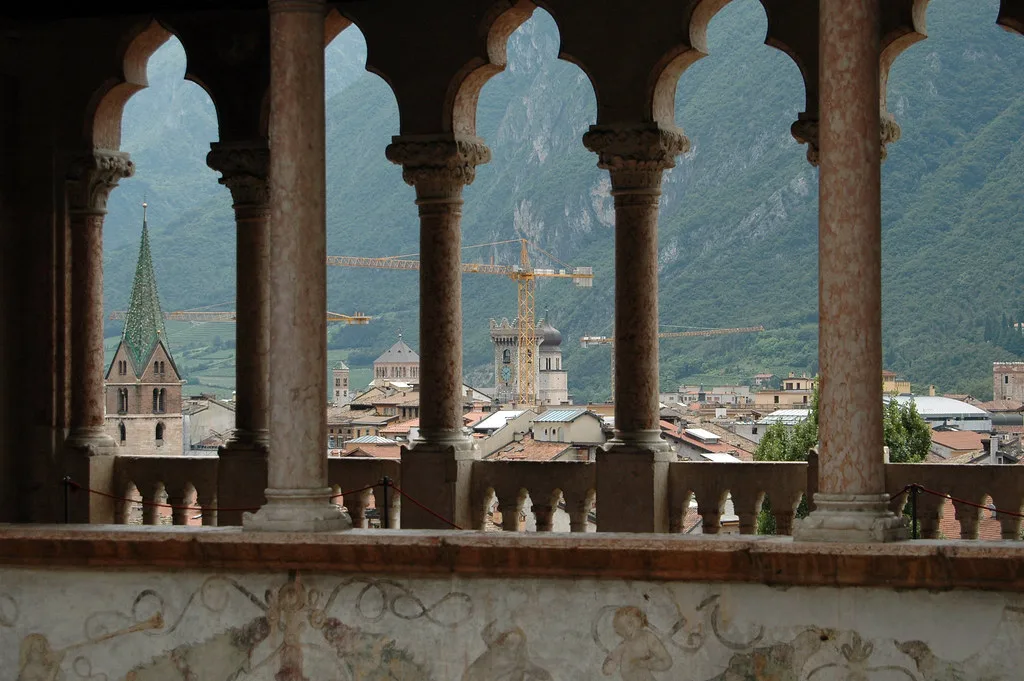
Castello del Buonconsiglio is the most significant secular monument in Trentino-Alto Adige and the former residence of the prince-bishops who governed the region for centuries. It stands on a rocky outcrop at the edge of the historic centre, which is precisely why it works as a viewpoint: the complex sits above the streets and looks across the city towards the mountains.
Inside, the viewpoints multiply. The Renaissance Magno Palazzo, added in the sixteenth century, has a loggia-lined courtyard and frescoed interiors, and one traveller singles out the Loggia del Romanino for its open side onto the garden, its views over Trento and its painted vaulted ceiling. Tower windows along the route give quick, framed glimpses of the town and the castle gardens.
The complex is not uniform: Castelvecchio, the thirteenth-century core, keeps a medieval, military character, while the later additions feel like a palace. Practically, that means courtyards and grounds are separate from the ticketed interiors, and the Torres are separate again. Do not assume one ticket covers every element; the museum's own visiting pages are the place to check what a ticket includes.
The museum publishes its own programme, exhibitions and visiting information, and that is the page to check for current hours, which areas are open and whether anything is closed for installation. The official site lists changing exhibitions and events throughout the year, so a quick look before your visit avoids disappointment.
Torre Aquila and the Cycle of the Months: A Timed Interior
The highlight of the castle for many visitors is the Torre Aquila, whose walls carry the Cycle of the Months, painted around 1400 and showing aristocratic and peasant life through the seasons. It is a fragile, enclosed space reached by a steep spiral staircase, not a casual lookout point where you wander in for a photo and leave.
Secondary sources describe a timed-entry system with strictly limited numbers and advise booking in advance, especially in summer and at weekends. Treat those descriptions as guidance rather than a guarantee of how the system works today, and confirm the current booking rules and whether the tower carries a separate charge on the museum's official site before you travel.
Accessibility is a real constraint here: the spiral staircase is described as unsuitable for wheelchair users and difficult for anyone with limited mobility. Ground-floor areas of the Magno Palazzo are more manageable, and staff can advise on routes, but a complete visit of every section is not realistic for people who cannot manage stairs.
Torre del Falco: Frescoes, Not a Panorama
Torre del Falco sits on the same guided route as the Torre Aquila, and its upper walls carry hunting and outdoor scenes painted in the early 1530s, one of which shows the city of Salzburg. It is a fascinating stop for the painting rather than for the view, so do not book the tower tour expecting an open panorama over Trento.
Because it is threaded into the same guided itinerary, your time in Torre del Falco depends on the pace of the group rather than your own. If frescoes are the main reason you came, budget your attention here and treat the glimpses of the city through the tower windows as a bonus.
Palazzo Pretorio's Tower: The Piazza-Level Stop
On Piazza Duomo, the Torre Civica rising from Palazzo Pretorio offers a different kind of elevated stop: a civic tower in the middle of the square, with a museum inside rather than a castle complex around it. Local heritage descriptions note that the tower, now a museum, spoke to Trentini of civic power, and that from the thirteenth century its bells dominated the city's soundscape.
The tower also served as the city jail for centuries, and graffiti carved by the condemned is still visible inside according to the same heritage description. That combination — clock, bells, prison and museum — makes it a compact stop that mixes a piazza-level perspective with a dose of civic history, very unlike the aristocratic scale of Buonconsiglio.
Opening times for the tower museum change with the season, and the heritage listing shows limited daily hours. Check the current schedule rather than assuming it will be open when you arrive. It is the easiest elevated stop to fold into a wander around the square, but it is not a substitute for the castle if you want the wide valley view.
Practical Trade-Offs: Stairs, Cobblestones and Time
Pick one elevated stop rather than collecting all of them. The cable-car terrace gives the broadest panorama for the least physical effort once you are at the top, provided the barred floor does not trouble you. The castle gives you architecture and frescoes alongside the views, at the cost of a ticket, stairs and a longer visit. The civic tower is the shortest commitment and keeps you in the heart of the historic centre.
Surfaces matter. The approach to Buonconsiglio runs through cobblestoned streets with moderate inclines, and inside the complex multiple levels are connected by historic staircases, with not every area served by lifts. Courtyards are irregular stone and doorways in the older sections can be narrow, so sturdy shoes and a realistic sense of your own pace help more than a packed schedule.
Light changes the experience. One photographer recommends a morning visit to the castle for the rose trellis and gardens before crowds arrive, since the morning light brings out the colours against the blue sky and castle walls. It is one suggestion among many rather than a rule, but pairing an early viewpoint with a late-afternoon walk in the square spreads the distances.
Pairing a Viewpoint With a Ground-Level Walk
A viewpoint works best as a punctuation mark in a walking day. Start on Piazza Duomo, where the cathedral of San Vigilio faces the Palazzo Pretorio and the Fountain of Neptune, then drift through the painted facades and porticoes of the surrounding streets before climbing anywhere. The self-guided tour notes that the city has several buildings with painted facades, a tradition inspired by what happened in the Veneto in the fifteenth and sixteenth centuries.
The Basilica di Santa Maria Maggiore is worth a detour on the same circuit: the final, crucial sessions of the Council of Trent were held there in 1562 and 1563, and it remains an active parish church. Services and closures take priority over sightseeing, so check locally whether it is open for visitors when you pass.
If you want more ground-level ideas to balance the climbing, the city's hidden gems are mostly at street level: painted courtyards, quiet churches and corners that reward slow walking rather than altitude. Build the day around one climb and let the rest unfold on foot.
Where the Evidence Stops: Parks and Hill Paths
You may see Parsi park paths or generic hill trails above Trento suggested as viewpoints. This guide cannot verify them as visitor viewpoints — their access, condition, signage and safety are not documented in the sources consulted here — so treat them as unverified rather than as recommendations.
If you want to explore them anyway, ask at the tourist information office in the centre, where staff can confirm whether a path is open, waymarked and suitable for your footwear. A quick question at the desk is a better use of time than following an outdated blog post up a slope.
Accessibility: Which Viewpoints Involve Stairs
The castle is a medieval-Renaissance fortress built on uneven terrain, and while access has improved, significant challenges remain: historic staircases, irregular courtyard stone, narrow doorways in older sections and a steep spiral staircase to the Torre Aquila. Ground-floor areas of the Magno Palazzo are the most manageable part of a visit.
The cable-car terrace is reached by lift rather than stairs, but the barred floor is its own barrier for people uneasy with heights. The civic tower involves a museum visit inside a historic building, so expect steps. None of these stops is a flat, step-free panorama, and contacting the venue directly before visiting remains the most reliable way to plan around specific needs.
A Suggested Half-Day Shape
What follows is a suggestion, not an official itinerary. Begin with a morning walk through Piazza Duomo and the surrounding streets, then head to Buonconsiglio Castle for the courtyard, the loggia and a museum visit if the frescoes appeal. Expect to spend a couple of hours there, and book any timed tower entry in advance if the current rules require it.
Finish with the cable car in the afternoon, when the light softens and the city below takes on a warmer tone, and stop at the terrace bar if it is open. If heights are not for you, swap in the civic tower on the square and keep the day at street level, which is no bad way to see Trento.
Plan Your Visit
Trento rewards a single well-chosen climb more than a checklist of high places. Decide whether you want the widest panorama, the richest interiors or the shortest detour, then check the operator's or museum's own information for hours, booking rules and any separate charges before you go.
Whatever you choose, leave time for the flat city too: the squares, the fountain, the painted facades and the churches are where Trento's character lives, and they cost nothing but a slow walk.
Frequently Asked Questions
Is the Sardagna cable car worth it if you dislike heights?
It depends on which part of the experience troubles you. The ride itself is short, but the viewing platform has a floor built from metal bars that lets you look straight down into the drop, and even confident travellers have admitted retreating from it. If exposed floors unsettle you, choose the castle loggia or the civic tower instead and enjoy the city from a solid surface.
Do you need to book the Torre Aquila in Buonconsiglio Castle?
Secondary sources describe timed entry with strictly limited numbers and recommend booking ahead, particularly in summer and at weekends. Those descriptions are guidance rather than a guarantee of current practice, so check the museum's official site for the latest booking rules and any separate charge before you travel.
Can you get a city view in Trento without climbing stairs?
The cable car lifts you to Sardagna without stairs, though the barred platform floor is its own challenge. Inside Buonconsiglio, ground-floor areas of the Magno Palazzo are more manageable, but the tower frescoes involve a steep spiral staircase and much of the complex is connected by historic steps. Contact venues directly to plan around specific needs.
How long does a viewpoint visit take in Trento?
Third-party guidance suggests allowing roughly two to three hours for Buonconsiglio Castle, including the main collections and the tower, and about one to one and a half hours for a quicker tour focused on the famous frescoes and courtyards. The cable-car terrace needs much less time once you are up there. Treat all of these as estimates and check current information before setting your schedule.
Is Buonconsiglio Castle walkable from Trento's historic centre?
Yes. The castle sits at the edge of the historic centre, on a rocky outcrop a short walk from Piazza Duomo, and third-party guidance puts the walk from the railway station at roughly ten to fifteen minutes. The approach involves cobblestones and moderate inclines, so comfortable shoes make the difference.
Sources
- Best things to see in Trento, Italy | Trip Unlocked
- Trento time jump: stories of the city - Apple Maps
- Self-guided Sightseeing Tour #2 in Trento, Italy | Visit Sights
- Official event website
- Castello del Buonconsiglio - Trento
- Buonconsiglio Castle Museum in Trento: Tickets & Guide
- Buonconsiglio Castle - Art and History - RaulersonGirlsTravel
- Museo Castello del Buonconsiglio - Events in Italy by Dolcevia - Dolcevia®
Continue exploring
More guides you'll find useful





