
Self-Guided Walking Tour of Sorrento: Historic Center Route
Follow a self-guided walking route through Sorrento's historic center, from Piazza Tasso to Marina Grande, with practical tips for pacing the walk yourself.
On this page
Sorrento's historic center is compact, close to the traffic and easy to explore on foot, and a self-guided route covering its main sights can be completed in just a few hours, according to Sorrento Insider. That makes the town unusually well suited to a walk you shape yourself: you can linger over a view, skip the shops that do not interest you and shorten the route at several points.
Expect cobbles, steps and slopes, especially on the descent toward the water. Comfortable shoes matter more than any app. The town is small, but its cliffside geography means you will notice every change in elevation.
Why Sorrento Suits a Self-Guided Walk
One practical pleasure of exploring Sorrento is that the center sits close to the traffic and is easy to cover on foot, and a self-guided itinerary of the main sights can be completed in just a few hours. That flexibility is the whole point of going without a guide: the route below is a suggestion, and you can extend or cut it to suit the day.
The town also works as a base for wider day trips, with ferries to Naples, Positano and Capri and the Circumvesuviana train toward Pompeii and Naples. Those connections let a short walk fit between larger excursions. If you want to see the coast from the water rather than the cliff, build that into another day. Further visitor details appear in A slow travel walking tour of Sorrento, Italy | My Wandering Voyage.
Before You Set Out
Wear sturdy shoes with grip. Sorrento's streets are charming but cobbled in places, and some stretches are sloped or stepped, so footwear affects how much of the route you enjoy. Bring water and sun protection too; fountains exist for refills, but the Mediterranean sun is strong. A hat and a bottle are light to carry and make the walk more comfortable.
Starting early or late in the day helps you avoid crowds and walk in cooler temperatures. Download an offline map before you leave, since signal can drop in narrow lanes. If you plan to enter churches or museums, check their hours in advance, because many close for a few hours around midday. That single check prevents a wasted detour.
Start at Piazza Tasso
Piazza Tasso is the most obvious place to begin. The square is named for the poet Torquato Tasso, who was born in Sorrento, and a statue of him stands in one corner behind the stand where horse-drawn carriages pick up passengers. The square itself is relatively recent, dating back only about a century, and it was built above a gorge. Cafes line the piazza, making it the most popular spot for a coffee and a bit of people-watching.
Standing in the square, remember that you are walking over a filled-in valley. Where you now see cars and cafe tables, local women once washed laundry in a stream that ran from the hills to the sea. The statue of Sant'Antonino, the city's patron saint, also stands in the piazza, and his feast day is celebrated each year on February 14th.
The Valley of the Mills Overlook
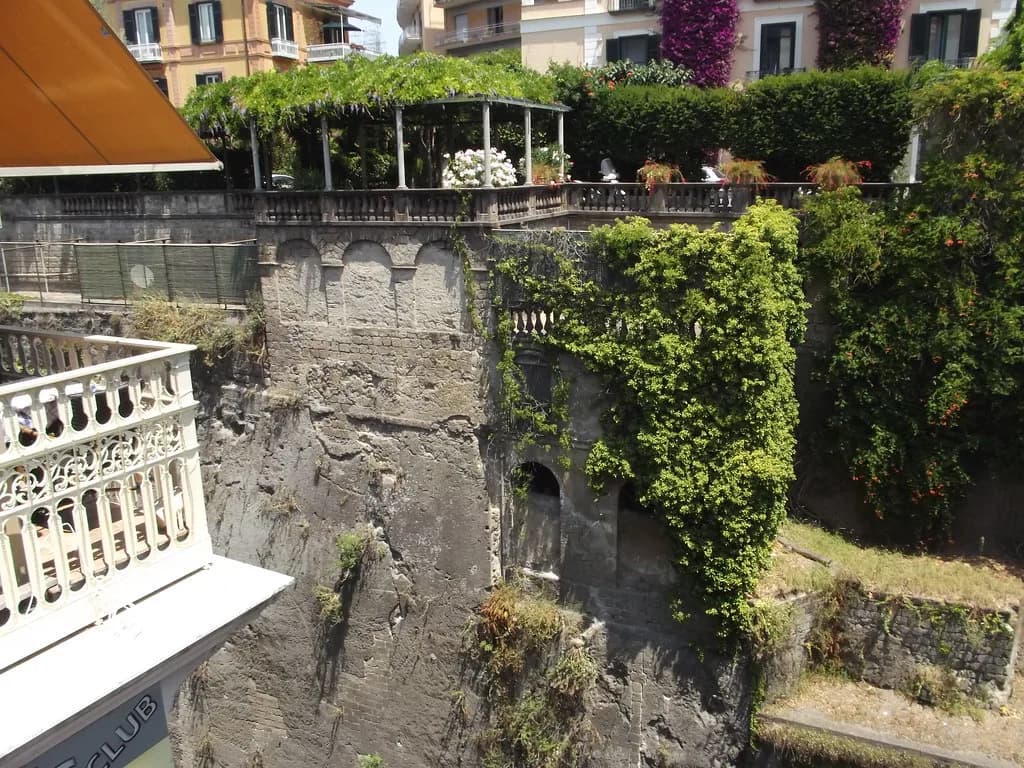
From Piazza Tasso, take a short detour south to peer down into the Vallone del Mulini, the Valley of the Mills. The gorge is easy to miss if you do not look over the edge, which is part of its appeal. Below you, the valley is overgrown and green, and the humid atmosphere supports unusual plants. Some of the mills in the valley were built as far back as the 13th century and powered by the rushing water.
Treat this as a viewpoint stop, not a site you can enter. The abandoned mills are visible from above but closed to visitors, and the valley itself is not a walking route. Planning around the overlook, rather than expecting a descent, avoids a common mistake. Take your photos from the street and move on.
Via della Pietà, a Quieter Alternative to Corso Italia
Instead of heading straight down Corso Italia from Piazza Tasso, slip behind the statue of Torquato Tasso and follow Via della Pietà. This street belongs to the old town, laid out in a grid, and it holds several examples of medieval architecture. Palazzo Correale and the neighboring Church of Santa Maria della Pietà are among the buildings you pass, and further along you reach the porticoes of Vico Galantario. The detour adds historical texture without much distance.
One traveler describes Via della Pietà as almost deserted compared with the bustle of the main street, which makes it a peaceful way to reach the same part of town. It is a good example of how a small change in route changes the mood of the walk. Keep an eye out for the limoncello shops and leather boutiques that cluster nearby.
Corso Italia and the Cathedral Exterior
Corso Italia is Sorrento's main shopping street, lined with boutiques, gelaterias and restaurants. Near its start you find the Cathedral of Santi Filippo e Giacomo, a Baroque building with an antique Nativity scene from the 1700s on permanent display inside. Look up for the bell tower, which dates back to the 11th century and is decorated with columns, arches and ceramic tiles. From the outside, the bell tower and the Baroque facade are the main things to notice.
Whether you go inside depends on the hour and on your own interest. Church interiors in Italy often close for a few hours around midday, so check the posted hours on the door rather than assuming it will be open when you arrive. The exterior, at least, is always part of the streetscape.
The Historic Lanes and Sedil Dominova
After walking the length of Corso Italia, turn right and then right again onto Via San Cesareo, one of the most charming historic streets in town. Artisan workshops line the street, and the route feels narrower and more intimate than the main thoroughfare. Look for Sedil Dominova, an open-air frescoed corner easy to spot by its cupola. Historically a social club for Sorrento's upper class, it is now a landmark to admire from the street rather than a public room to enter.
The lanes around Via San Cesareo reward slow walking. Step into side streets such as via Accademia and look for small shops selling local crafts. If you are interested in the food side of Sorrento, this is the part of town where a detour to a deli or bakery makes sense. Keep the historical center's scale in mind: it is compact, and you can always loop back.
Cloister of San Francesco
Take Via Reginaldo Giuliani down toward Villa Comunale. Near the villa you find a small medieval cloister dating from the 1300s, often used for weddings. The courtyard is a peaceful pause in the middle of a busy walk. Upstairs, art and photography exhibits are sometimes on display, though the schedule varies.
Walkers often describe the cloister as a little oasis within town, and it is worth a few minutes even on a short visit. The church beside it, Chiesa di San Francesco, was built on an earlier oratory. Keep your visit brief if you are on a tight schedule; the waterfront still lies ahead.
Villa Comunale and the Gulf Views
Villa Comunale is a large terrace overlooking the Gulf of Naples, directly above the beach clubs of Marina Piccola and the port beyond. It is one of the best free viewpoints in town, with gardens and sculptures to wander through. From here you can either return to Piazza Tasso through Piazza Sant'Antonino or continue toward Marina Grande. This is a natural point to shorten the walk if your energy or the weather turns.
Below the terrace, the port and beach clubs sit at sea level. A lift connects the two, but any fare is volatile and best checked on the ground rather than planned around. A staircase is the free alternative, though it is steep. Choose based on your knees and your time, not on what an old blog post said.
Marina Grande, the Fishing Village
From the cloister, walk past the Hotel Tramontano to Piazza della Vittoria, another scenic overlook, and follow the road that begins at the entrance to the Bellevue Syrene hotel down to Marina Grande. Pass beneath the historic city gate and you enter Sorrento's fishing village, a favored spot for a seafood meal at the water's edge. The atmosphere is different from the center: boats, nets and restaurants facing the sea.
If you want to eat here, look for the restaurants along the water and check the catch of the day. This is also a place to slow down and watch the harbor rather than rush back. Allow more time than you think for the descent, because the road drops steeply.
Returning to the Center
The walk back up to the center is steep, and that is the honest trade-off of ending at Marina Grande. Sorrento Insider notes that if you would rather not climb the cliffside, you can catch a bus from the marina back to the center, but bus service can change and should be confirmed locally before you rely on it. The alternative is simply to walk back up at an easy pace, or to retrace your steps to Piazza della Vittoria and reassess.
If you have time, the walk down to Marina Piccola and along the boardwalk is a good way to end the day. The beaches are reached by stairs or a lift, and in summer you can rent a chair on a pier. At the far end of the boardwalk you find Bagni Salvatore, a beach club wrapped around old Roman ruins. Check arrangements on site.
Practical Tips for Pacing the Walk
Bank holidays can make the historic center very busy even when shops and churches remain open. If your visit coincides with one, start earlier than you planned. Crowds concentrate in Piazza Tasso and along Corso Italia, so the quieter lanes are a useful escape. The route is short enough that you can return to a favorite spot later in the day.
Midday heat is another real constraint. Water fountains exist, but shade is uneven, especially on the descent to the marinas. Plan the steepest sections for cooler hours if you can. Keep the total walk flexible: the center is compact, so a shorter version is always possible.
Where the Route Fits in a Longer Stay
This walk covers the historic center in a few hours, which makes it a good first orientation on a longer trip. If you have a full day, combine it with the harbor area and a slow lunch, or use it as the basis for a more structured itinerary. The free sights along the way, including the Villa Comunale and the cloister, keep costs down. For wider planning, see Sorrento One Day Itinerary.
For a deeper sense of the town beyond the obvious stops, seek out the hidden gems that sit just off the main streets. A neighborhoods guide can help you decide whether to base yourself near the center or closer to the water. Either way, the route is easy to repeat with different priorities.
Plan Your Visit
Sorrento rewards walkers who accept its slopes and steps as part of the experience. Start at Piazza Tasso, look down into the Valley of the Mills, take the quieter Via della Pietà, then follow the lanes to the cloister and the Villa Comunale before descending to Marina Grande. The route is a suggestion, and you can stop at any point.
Check church hours and any lift fares on the day rather than planning around old figures. Carry water, wear shoes with grip, and leave room for an unplanned coffee. The town is small enough that getting slightly lost is part of the pleasure.
Frequently Asked Questions
How long does a self-guided walking tour of Sorrento take?
The center is compact, and a route covering Piazza Tasso, the Valley of the Mills overlook, the cathedral exterior, the lanes, the cloister and Marina Grande can be done in a few hours. That is a suggested duration, not an official figure, and it depends on how often you stop. Add time for coffee, photos and the steep descent to the water.
What should I not miss on a self-guided walk in Sorrento?
Prioritize Piazza Tasso, the view into the Valley of the Mills, Via San Cesareo and Sedil Dominova, the Cloister of San Francesco, the Villa Comunale terrace and Marina Grande. The cathedral exterior and bell tower are worth a look even if you do not go inside. These stops give a mix of history, views and village atmosphere.
Can I visit the Valley of the Mills?
No. The valley is a gorge below street level, and the abandoned mills are closed to visitors. You can see the overgrown valley and the mill buildings from the overlook near Piazza Tasso. Treat it as a viewpoint stop and do not plan a descent.
Should I walk to Marina Grande or start there?
Most walkers start in the center and end at Marina Grande, which puts the steep descent at the end of the route. The climb back up is the trade-off, so consider your energy and the heat. Walking back up is possible, and local transport options can be checked on the ground.
What is the best way to get around Sorrento's historic center?
On foot. The center is compact, with narrow lanes and short distances between the main squares and sights. Wear comfortable shoes for cobbles and steps, and carry water in warm weather. For longer trips, ferries and the Circumvesuviana train connect Sorrento with the wider bay.
Sources
Continue exploring
More guides you'll find useful





