
Positano Two-Day Itinerary: Village, Beaches and a Coastal Day
Plan two days in Positano with a village-and-beach first day and a hiking or coastal second day, plus practical timing and booking advice for both routes.
On this page
Two days is enough to see Positano properly if you resist the urge to treat it as a base for the whole Amalfi Coast. One day belongs to the village itself: the lanes above the beach, a swim, the church, and a slow sunset. The second is better spent either on a half-day hike above the coast or on a short ferry-and-bus excursion to a neighbouring town, not on trying to do both.
Positano is a single compact town stacked on a hillside, so almost everything on day one is walkable, though often up or down stairs. The second day requires a decision, because the Path of the Gods and a Ravello or Amalfi trip each consume a large block of the day and demand different footwear, weather and energy levels. Pick one before you arrive and book whatever needs booking.
Before You Go: Arrival Shapes Your First Day
How you arrive sets the tone. Coming in by ferry drops you at the Marina Grande landing right beside the main beach, which makes an easy start, while arriving by road means the final stretch along State Road 163, the single coast road, can be slow in summer traffic.
One published itinerary suggests a train to Salerno followed by a ferry as a reasonably priced and scenic combination, and treats a hired car with a driver as the comfortable but expensive option. Renting a car is the choice that source actively discourages, citing tolls, fuel, scarce parking and the difficulty of the coast road. Check current ferry times and fares with the operator before committing.
Where you sleep matters more than usual here, because steep stairways turn a short map distance into a climb at the end of a long day. Accommodation ranges from luxury hotels to B&Bs and villas, and the same itinerary advises booking early because high season fills up. Compare locations before price alone.
Day One Morning: A Slow Start and the Village Lanes
Give the first morning a gentle shape. Breakfast on a terrace, then wander the winding streets without a fixed route: the point of day one is absorption rather than ticking off sights, and the village rewards aimless walking past ceramics shops, sandal makers, linen clothing boutiques and delicatessens selling lemon products.
Via dei Mulini, the street running inland from the main beach, is the densest stretch of independent shops, with limoncello, ceramics and linen on display. Expect premium prices for locally made goods rather than bargains, and treat browsing as part of the day rather than an afterthought.
If you want a structured hour instead of drifting, a self-guided walk through the lanes, stairways and viewpoints gives the morning a route while leaving the afternoon free. Keep the pace light: the afternoon involves beach time and an evening walk, and the town's vertical layout is tiring in heat.
For a different angle on the town's quieter corners, browse the hidden gems in Positano guide before you set out; it helps you notice details you would otherwise walk past.
Day One Midday: Spiaggia Grande and Its Free Corners
Spiaggia Grande is the town's main beach, backed by restaurants and bars along Via del Brigantino and directly facing the classic view of the stacked houses. It is the busiest beach in Positano, and a large share of it is taken up by paid sun loungers, but small free public sections remain for anyone with a towel.
Set expectations about the surface: the beaches are pebbles rather than sand, and the water near the busiest stretch can be less clear because of boat traffic. Visitors who have reported on it found the free public areas perfectly usable and the atmosphere lively. Beach clubs charge for loungers, so ask at the entrance rather than assuming a price.
A swim here is the simplest way to spend the middle of the day, and it keeps the afternoon open for Fornillo. One source notes four beaches in total, all with both private and public areas, so if Spiaggia Grande feels crowded you have alternatives within the town.
Day One Afternoon: Fornillo and the Path of Lovers
Walk to Fornillo, the smaller beach on the far side of the headland, along Via Positanesi d'America, a panoramic lane often called the Path of Lovers. It takes only a short walk from the main beach and delivers a calmer setting with two old defensive towers at one end.
Fornillo is even rockier than Spiaggia Grande, and much of it is covered by beach club loungers, but its bars and restaurants feel more low-key and the free public strip is enough for a swim and a lie-down. It is a good place to eat a simple lunch without committing to a long seated meal.
If you would rather not pay for a lounger anywhere, plan the day around the public sections and carry what you need. A towel, water and shade awareness go a long way on a pebble beach in the afternoon sun, and it leaves budget for dinner instead.
Day One Evening: The Church, the Villa Beneath It, and Sunset
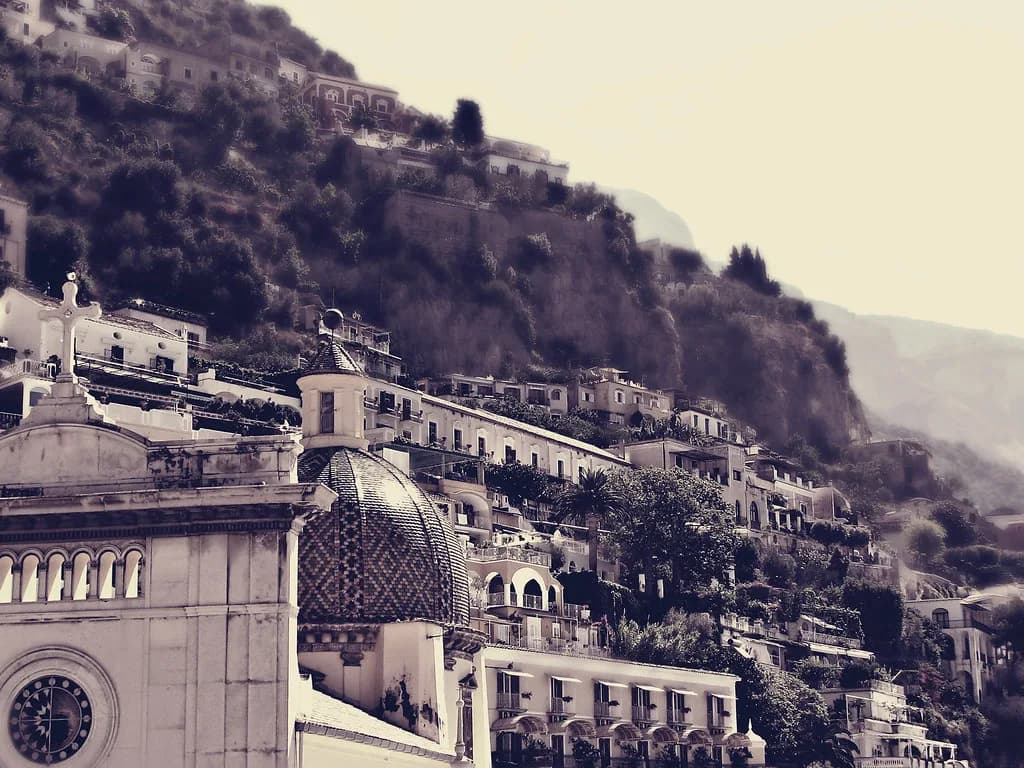
The Chiesa di Santa Maria Assunta, with its tiled dome, anchors the town both visually and geographically, and stepping inside costs nothing. Look for the thirteenth-century Byzantine icon of the Black Madonna and child, and note the separate bell tower outside in Piazza Flavio Gioia.
Beneath the church lies a Roman villa buried by the eruption of Vesuvius in 79 AD, excavated and opened to the public in 2018. Entry is ticketed separately from the church and access is by timed slot, so ask at the small kiosk outside or check the town's official channels for current opening times and prices rather than relying on older visitor reports.
End the day on the beach for sunset. Spiaggia Grande gives a foreground of boats and the town rising behind, and it is a short walk from the restaurants along the seafront and on Viale Pasitea. Arrive a little early, since the light goes quickly behind the ridge.
Where to Eat and How to Book
Seafront dining is about setting as much as food, and several restaurants on the promenade have reputations that do not match their prices. Walking a few minutes inland up Viale Pasitea or Via Cristoforo Colombo often yields better value and a calmer table, with terraces still looking over the town.
Reserve dinner ahead, especially in high season and for anywhere with a view or a name. Popular spots are regularly fully booked, and a table on the beach or a rooftop is worth arranging a day or two in advance rather than gambling on a walk-in. Restaurants handle their own bookings, so contact them directly.
For a late evening, Music on the Rocks is the well-known club carved into the rock near the beach, and it suits anyone who still has energy after a day of stairs. Otherwise, an early night is the sensible preparation for whichever day-two plan you have chosen.
Day Two Option A: The Path of the Gods
The Path of the Gods is the headline hike above the coast, and it consumes roughly half a day whichever way you tackle it. The usual approach is a bus from Positano to Amalfi, a change to a bus for Bomerano in Agerola, then a mostly downhill walk to Nocelle, the village above Positano.
Sources describe the route length differently, so treat any figure as approximate: one account gives about 5.5 km for the Bomerano-to-Nocelle stretch, while another describes a walk of around 8 km for the trail as a whole. Check your own route and the day's conditions before setting out, and carry water and proper shoes for rocky ground.
From Nocelle you either take a local bus down or walk the long staircase of roughly 1,700 steps into Positano, a descent that is hard on the knees at the end of a hike. The views take in Capri and the Li Galli islands, and the village is a good place for a lemonade before the final push.
Combined ferry-and-bus tickets for reaching the trail are sold by operators, which simplifies the logistics if you would rather not piece the journey together yourself. Confirm departure points and times with the operator on the day, since coastal transport schedules shift with the season.
Day Two Option B: Ravello or Amalfi by Sea and Bus
If a long hike does not appeal, take a ferry along the coast instead. Travelmar ferries connect Positano with other Amalfi Coast towns and are the fastest and most comfortable way to reach Ravello's gateway, which is then a bus ride up the hill since the town sits around 400 metres above sea level.
In Ravello, the two fourteenth-century villas are the draw: Villa Rufolo and Villa Cimbrone, the latter with gardens and the Terrace of Infinity overlooking the coast. Each has its own admission arrangements, so check separately before you go rather than assuming a combined ticket.
The alternative is Amalfi itself, the town that gave the coast its name and one of the medieval maritime republics. The Cathedral of Sant'Andrea, with its long staircase, the Cloister of Paradise and the old Arsenale shipyard are all in the compact centre, and the Paper Museum adds an industrial chapter to the town's history.
In Amalfi, try the lemon sweets at the historic Pasticceria Pansa before heading back to the port. Ferries return to Positano in the late afternoon, leaving you time for a last swim or a final wander through the shops near the beach.
How to Choose Between Hiking and a Day Trip
Choose the hike if you have sturdy shoes, reliable weather and the energy for a full morning outdoors; choose the ferry trip if you want scenery without effort, or if the forecast is unsettled. The Path of the Gods has little shade and exposed sections, so heat and rain both change the calculation.
Neither option combines well with a leisurely morning, so protect the day by deciding the night before. If you try to fit the hike and a Ravello visit into the same day, you will spend most of it in transit and see neither properly, which is the opposite of what two days in Positano should feel like.
A third, quieter alternative is to stay in town and visit the Roman villa site under the church, then spend the afternoon on a beach further along the coast. It suits travellers who have already hiked elsewhere on the Amalfi Coast and would rather not repeat the experience.
Shopping, Souvenirs and What to Leave for Next Time
Positano's shopping is narrow but good: handmade leather sandals, ceramics, linen clothing and limoncello, all produced with real craft skill. Prices reflect that, so buy one thing you love rather than a bag of souvenirs, and check that ceramics and liquids can travel in your luggage.
Two days will not cover the coast. Capri, the Emerald Grotto and the smaller towns towards Salerno are all easy to add on a longer trip, and a return visit lets you spend a whole day on the water rather than half of one.
Fitting Two Days Into a Longer Trip
Two days in Positano work best when day one stays local and day two commits to one bigger outing. That structure gives you the beaches, the church and the lanes at an unhurried pace, plus either a serious hike or a boat trip to a neighbouring town, without the exhaustion of trying to see the whole coast at once.
Book dinner and any ticketed site ahead, confirm ferry and bus times with the operators, and leave the evenings free for sunset. For more context on the town's sights before you arrive, browse the wider collection of Positano guides and plan around the things you actually want to do.
Frequently Asked Questions
Is two days enough for Positano?
Yes, two days cover the village core, the main beaches, the church and one larger outing. You will not see the whole Amalfi Coast, but you will experience Positano at a reasonable pace rather than rushing between towns.
Can you do Positano and Amalfi in the same day?
It is possible by ferry, but it makes for a rushed day. Amalfi's cathedral, cloister and old shipyard deserve several hours, so consider giving Amalfi its own day or pairing it with a shorter stop rather than squeezing it into a Positano day.
Is the Path of the Gods worth it on a two-day trip?
If you enjoy hiking and have good weather, yes: the coastal views are the reason many visitors come. If you are short on time or energy, the ferry trip to Ravello or Amalfi gives you comparable scenery with far less effort.
How do you get to the Path of the Gods from Positano?
Most walkers take a bus to Amalfi, change to a bus for Bomerano, then walk to Nocelle and descend to Positano by bus or on foot. Combined ferry-and-bus tickets are sold by operators, and times should be confirmed on the day.
Should you choose Ravello or Amalfi for a day trip from Positano?
Ravello suits garden lovers and anyone wanting hilltop views from Villa Rufolo and Villa Cimbrone. Amalfi is better for history, the cathedral and a livelier town centre. Both are reachable by ferry, with Ravello requiring a bus up the hill.
Do you need to book restaurants in Positano in advance?
It is strongly advisable for dinner, especially in high season and at anywhere with a view. Many popular places fill up, so reserve a day or two ahead by contacting the restaurant directly.
Are Positano's beaches free?
Each beach has a free public section as well as paid beach club areas with sun loungers. The public strips are small but usable; ask at the club entrance for current lounger prices rather than assuming.
What can you see in Positano in a few hours?
With only a few hours, focus on the lanes around Via dei Mulini, the church of Santa Maria Assunta and a swim at Spiaggia Grande. Add the short walk to Fornillo if time allows, and save the hike for a longer stay.
Sources
Continue exploring
More guides you'll find useful





