
Two Days in Perugia: A Practical 48-Hour Itinerary
Plan two days in Perugia with a sensible split: the Piazza IV Novembre core and Rocca Paolina first, then quieter eastern churches and garden views.
On this page
Perugia rewards travellers who stop treating it as a stopover between Florence and Rome and give it a proper two-day rhythm. The historic centre stacks a medieval piazza, an Etruscan well, papal fortifications and a chocolate tradition into a compact hilltop grid, so the main planning decision is sequence rather than distance. Front-load one practical detail: Italia.it describes the Rocca Paolina's underground section as a buried medieval village of houses, streets, arches and stairways, reached by escalator from Piazza Indipendenza or Piazza Italia. That escalator is transport as much as sightseeing, and it sets the tone for a city where you constantly move between levels.
This itinerary is an editorial suggestion, not an official schedule or a timed programme. It divides the two days so you are not criss-crossing the hill: day one stays on the civic and Etruscan core around Piazza IV Novembre and the Rocca Paolina, while day two heads toward the quieter eastern churches, San Pietro and a garden viewpoint before returning to the centre for the evening. Treat the order as flexible and swap days if weather or fatigue argues for it.
How to Divide Two Days in Perugia
The useful split is geographic, not thematic. Day one clusters Piazza IV Novembre, the Fontana Maggiore, the Cathedral of San Lorenzo, the Palazzo dei Priori and its National Gallery of Umbria, then drops underground into the Rocca Paolina and picks up the medieval aqueduct walk toward Porta Sole. These stops sit close enough that you can walk between them and let the escalators handle the steepest level changes.
Day two belongs to the eastern side: the Chiesa di San Michele Arcangelo near the end of the aqueduct, the Basilica of San Domenico with the National Archaeological Museum next door, a slow lunch and a stroll down Via del Persico, then the Abbey and Church of San Pietro and a garden terrace such as the Giardini Carducci. The evening returns you to the centre for chocolate and the Via della Viola street art. If you only have one day, keep day one and save the eastern cluster for a return trip.
Two days is enough to see the centre without rushing, but it is not enough to do everything. Our Escape Clause, a travel blog, lists an unusually long set of Perugia viewpoints and churches in its city guide, which is a reminder that the real constraint is your own pace rather than a shortage of stops. Choose fewer interiors and walk more between them, because the pleasure here is in the alleys, arches and staircases that connect the sights.
Build in slack. Churches and museums in Italy often keep limited or seasonal hours, and individual sites publish their own schedules rather than a shared city timetable. Check each site's own page or the city tourism office before you set out each morning, and keep one flexible afternoon for whatever turns out to be closed.
Day One Morning: Piazza IV Novembre and the Civic Core
Start at Piazza IV Novembre, where five medieval streets meet on the site of the Roman forum. The Fontana Maggiore, designed by Nicola and Giovanni Pisano, anchors the square with its pink and white stone and bronze basin, and Italia.it calls it a marvel of medieval sculpture. Use the piazza as an orientation point: the cathedral and the Palazzo dei Priori both face it, and the Corso Pietro Vannucci begins at the square's edge.
The Cathedral of San Lorenzo is free to enter, and its unfinished exterior is part of the story: work stretched over several centuries and the facade was never completed. Its side, rather than its front, faces the piazza, which surprises many first-time visitors. Inside, look for the Chapel of Saint Bernardino before moving on, and allow more time than you think for the quiet detour.
Next door, the Palazzo dei Priori houses the National Gallery of Umbria on its third floor, a collection of art from the 1200s to the 1900s. Italia.it highlights the Collegio del Cambio within the same complex, where the Sala delle Udienze holds frescoes by Perugino. Treat these as separate, individually ticketed collections rather than one combined pass, and confirm admission arrangements at each entrance rather than assuming a single ticket covers the building.
Day One Midday: A Coffee and a Perugian Lunch
Take the mid-morning pause in Piazza IV Novembre itself, as the city's open-air meeting place, and watch the square fill up. For lunch, Italia.it recommends an osteria with Umbrian cold cuts, cheeses, torta al testo and local wines. That is a sensible order for a walking day: the flatbread and salumi are filling without being heavy, and Umbrian wines are easy to find by the glass.
Resist the urge to book a long, multi-course lunch on day one. The afternoon still includes the Rocca Paolina and a climb toward Porta Sole, and both involve stairs and slopes. A shorter seated meal leaves room for a coffee later and keeps the day's energy even.
Day One Afternoon: Rocca Paolina, the Aqueduct and Porta Sole
Ride the escalator down from Piazza Italia or Piazza Indipendenza into the Rocca Paolina, the fortress built by Pope Paul III as a symbol of papal power. What survives is a buried streetscape of houses, arches and stairways, and Italia.it treats the descent as a step back in time. Parts of the underground complex are free to wander, with a museum and exhibition areas in specific sections, so check locally what is accessible on the day rather than assuming every chamber is open.
After climbing back up, follow the steps beneath the remains of the medieval aqueduct. Italia.it describes the walk as long but worth it, because the elevated line gives you a different angle on the city. The aqueduct runs about 2.5 miles in total, though only sections near either end are visible from above; most of it lies underground and can be seen only on a guided tour. You do not need the full route to enjoy the walkway.
Finish at Porta Sole, one of the old Etruscan gates, where the view opens over the city and the Umbrian countryside. Come before sunset if the light matters to you, and take the steps rather than hurrying past. For more overlooked corners and quieter angles on the city, our guide to hidden gems in Perugia pairs well with this afternoon.
Day One Evening: Chocolate and the Corso
Return to the centre for chocolate. Perugia is the headquarters of Eurochocolate, the European festival on the theme, and Italia.it points to the Museo Storico Casa del Cioccolato Perugina for the history of one of Italy's best-known brands, with tastings of freshly made chocolate. Outside festival time, sample Baci at the city's chocolate shops and cafes; several are within a short walk of the cathedral.
End with a passeggiata along Corso Pietro Vannucci, the pedestrianized spine that runs from Piazza IV Novembre to the Giardini Carducci. It takes only about ten minutes to walk end to end, passing Piazza della Repubblica and Piazza Italia on the way. That makes it a low-effort evening loop rather than a sightseeing task, and it positions you for an early start the next morning.
Day Two Morning: Quieter Eastern Churches and the Museum
Begin day two at the Chiesa di San Michele Arcangelo, a round church believed to date to between the 5th and 7th centuries and counted among the oldest Paleo-Christian churches in Italy. It sits near the far end of the medieval aqueduct, so the walk there retraces yesterday's route from a new direction. The building is small and the visit short, which suits a morning that continues on to San Domenico.
The Basilica of San Domenico is enormous and dates to the 14th century, but its visiting hours are limited, so check before you go rather than planning the morning around it. Next door, in the church's former convent, the National Archaeological Museum of Umbria concentrates on Etruscan material, with views from the second floor and an underground tomb exhibit. Signs are in Italian, so bring a translation tool or a phrasebook.
Plan for the possibility that one of these interiors is closed when you arrive. The churches are free to enter but not always open, and the museum keeps its own schedule. If San Domenico is shut, the archaeological museum next door may still be running, and the walk itself between the two clusters remains the point of the morning.
Day Two Midday: A Slow Lunch and Via del Persico
Take a slower lunch on day two, since the morning involves more walking between separate clusters. Then stroll down Via del Persico, the small residential street directly in front of the Basilica di San Domenico, lined with colourful houses, abundant plants and an enclosed bridge between buildings. It is a short detour rather than a destination, so treat it as a pleasant pause on the way south.
This is also the moment to decide how much further you want to walk. The Abbey and Church of San Pietro lie about twenty minutes on foot from Piazza IV Novembre, and the return leg climbs. If your legs are tiring, keep the afternoon short and save the abbey for a future visit rather than forcing it into an already full day.
Day Two Afternoon: San Pietro and a Garden Viewpoint
The Abbey and Church of San Pietro date to the 10th century and stand on the site of Perugia's earlier cathedral. The complex includes frescoed interiors, three cloisters and a garden, which makes it a longer visit than a quick church stop. Budget more time than the exterior suggests, and check the abbey's own opening arrangements before making the walk.
On the way back into the upper town, use the Rocca Paolina escalators to avoid the steepest climb. Then choose a viewpoint: the Giardini Carducci at the southern end of the Corso, or the terrace above the covered market, both offering free views over the countryside. Both are outdoor spaces with no ticket, so they suit the end of a day when interiors have closed.
Day Two Evening: Street Art and a Final Passeggiata
Spend the last evening on Via della Viola, where street art runs alongside medieval architecture and the works range from bold graffiti to subtle three-dimensional pieces. The scene changes over time, so walk it slowly and look for details rather than expecting a fixed list of murals. It is a free way to end the day and a reminder that Perugia is a living university city, not only a medieval stage set.
Finish with one last loop through the centre for chocolate or a drink, then plan your departure. If you are travelling by train, Perugia is genuinely accessible without a car, which makes the two-day format easy to slot into a longer Italian trip. The city's tourism pages are the place to confirm current transport and event information before you go.
Free Versus Ticketed: What to Expect
Keep the distinction clear so your budget and expectations match reality. The Cathedral of San Lorenzo is free to enter, the Piazza IV Novembre and Fontana Maggiore are public space, and much of the Rocca Paolina can be explored without a ticket. Both garden viewpoints mentioned here are also free, which is why they work well as backup stops.
Paid and separately managed collections include the National Gallery of Umbria inside the Palazzo dei Priori and the National Archaeological Museum beside San Domenico. The Perugia Underground beneath the cathedral is visited on a guided tour, and the Etruscan Well is a separate small site with its own arrangements. None of these should be assumed to share one ticket, and current admission arrangements should be checked at each entrance or on each museum's page.
Trade-offs and Common Mistakes
The most common error is overpacking day one. It is tempting to add every church and museum to the first afternoon, but the Rocca Paolina descent, the aqueduct walk and the climb to Porta Sole already fill it. Leave the eastern cluster for day two and accept that some interiors will be missed.
A second mistake is assuming every underground site is open and bookable. The Perugia Underground requires a guided tour, the Etruscan Well has its own access, and the Sciri Tower has limited access even according to a travel blog, which could not find an official confirmation of its hours. Check at the tourist office rather than building a day around any single underground stop.
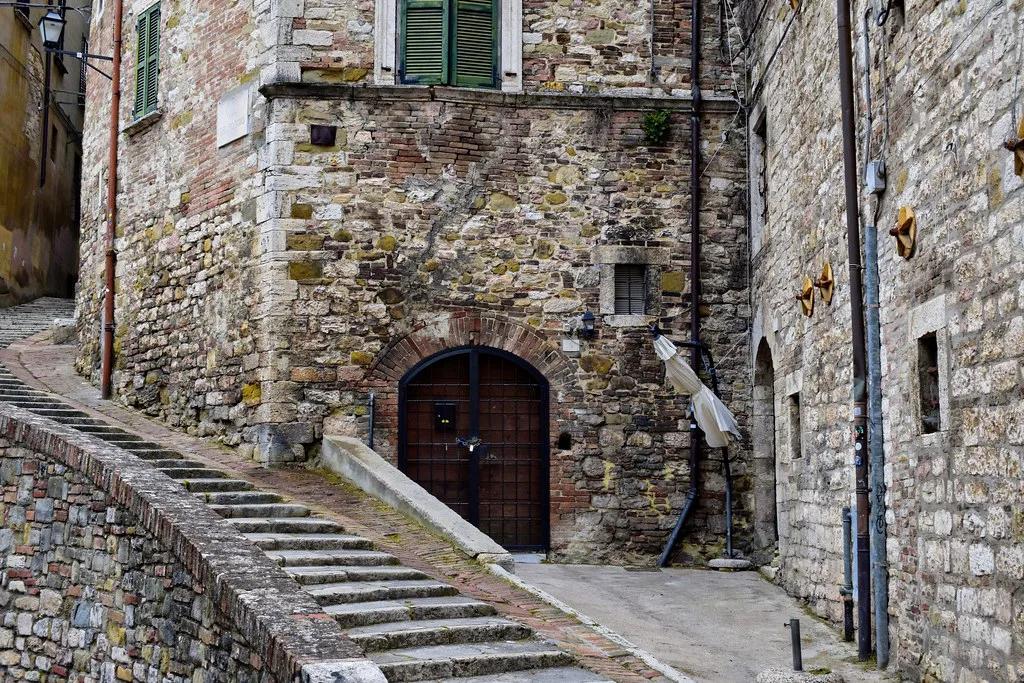
Finally, do not skip the walking between clusters. The pleasure of Perugia is in the connecting fabric: the Etruscan gate, the small oratory of San Bernardino, the alleys off the Corso. Cutting every walk with a bus or escalator saves time but loses the city.
Practical Logistics Without Invented Timings
Perugia sits on a hill, and the centre is best handled on foot. Escalators connect the lower town with the upper town at key points, including the Rocca Paolina route between Piazza Italia and Piazza Partigiani, which some commuters use daily. That blend of historic architecture and everyday movement is part of the city's character, and it saves you a steep climb.
By train, Perugia is reachable and the station links to the centre, though exact services and schedules change. Check the operator's timetable on the day rather than relying on a guidebook. If you arrive by car, park in the lower town and use the escalators or lifts instead of trying to drive into the medieval grid.
An Optional Half-Day Out
If two days feels generous, add a half-day to Lake Trasimeno, the largest lake in central Italy and roughly 40 minutes from Perugia by car according to Italia.it. Castiglione del Lago is one of Italy's most beautiful villages, with the Palazzo della Corgna, its frescoes by Pomarancio and the Rocca del Leone. Keep Perugia as your base and treat the lake as a side trip, not a replacement for the city.
Assisi is the other obvious excursion, but it deserves its own day rather than a rushed afternoon. If your time is limited, choose between the lake and Assisi instead of attempting both.
Where to Stay in Perugia
Staying in the upper town puts the piazza, the cathedral and the restaurants within walking distance, but it means a climb or an escalator ride whenever you come and go from the station or a car park. Staying lower down makes arrivals easier but adds effort every time you want the centre. For a two-day visit built around walking, the upper town usually wins on time saved.
Choose a hotel near Piazza IV Novembre or the Corso if you want the evening passeggiata on your doorstep. Choose the lower town if you are arriving late or travelling with heavy luggage. Either way, check whether your hotel is up a flight of steps, since many buildings in the centre have no lift.
Plan Your Visit
Two days in Perugia works best when you resist the urge to see everything. Give the first day to the civic core and the Rocca Paolina, the second to the quieter east side and a garden terrace, and let the evenings belong to chocolate and the Corso. That structure leaves room for the city's real texture: stairs, arches, hidden corners and viewpoints that reward a slower pace.
Confirm opening arrangements for the cathedral, the galleries, the underground sites and San Domenico before each day begins, because limited hours can reshape a plan. Book any guided underground tour you want directly with the operator, and keep a free afternoon in reserve. Then walk, and let the hilltop city set the rhythm. For related planning, see Day Trips from Perugia: Umbria by Train and Car.
Frequently Asked Questions
How many days do you need in Perugia?
Two full days are enough to cover the historic centre at an unhurried pace: Piazza IV Novembre and the civic core on day one, then the eastern churches, San Pietro and a garden viewpoint on day two. Add a third day if you want a half-day trip to Lake Trasimeno or Assisi, or if you plan to visit several museums in depth.
What should you do in Perugia for two days?
Spend day one around Piazza IV Novembre, the Fontana Maggiore, the Cathedral of San Lorenzo, the Palazzo dei Priori and the National Gallery of Umbria, then descend into the Rocca Paolina and walk the aqueduct toward Porta Sole. On day two, visit San Michele Arcangelo, San Domenico and the archaeological museum, pause on Via del Persico, then see San Pietro and a garden terrace before returning to the centre for chocolate and street art.
Is it better to stay in Perugia or Assisi?
For a two-day city itinerary, Perugia is the more practical base because the sights in this plan are all there. Assisi makes sense if your main interest is the basilica and the Franciscan sites. From Perugia, Assisi works as a separate day trip rather than something to squeeze into a half-day between museums.
What should you not miss in Perugia?
Do not skip the Rocca Paolina, both for its buried streets and because the escalator route is a genuinely useful way to move between levels. The Fontana Maggiore, the cathedral, the walk to Porta Sole and at least one chocolate tasting belong on any first visit. If art is your priority, the National Gallery of Umbria is the collection to plan around.
Is Perugia worth visiting?
Yes, especially for travellers who want a medieval hilltop city with a strong local food and chocolate identity and fewer crowds than Florence. It is compact enough to explore on foot in two days and well connected by train. The main trade-off is the hill itself, which means stairs and escalators rather than flat strolls.
Which Perugia sights are free and which are ticketed?
The Cathedral of San Lorenzo, the piazzas, the aqueduct walkway and the outdoor viewpoints are free to enter. Much of the Rocca Paolina can be explored without a ticket, though specific museum and exhibition areas within it are separate. The National Gallery of Umbria and the National Archaeological Museum are individually ticketed collections, and the underground sites have their own arrangements, so check each one rather than assuming a single pass covers them all.
Sources
Continue exploring
More guides you'll find useful





