
Perugia Self-Guided Walking Route: Old Town in Half a Day
Walk Perugia's old town unaided: Etruscan Arch, medieval aqueduct, Corso Vannucci, Piazza IV Novembre and the free Rocca Paolina passage, with steep-lane tips.
On this page
Perugia rewards walkers because the historic centre is compact and stacked: the old city sits on a steep hill above the modern town, and a network of escalators and a driverless mini-metro link the car parks and lower districts to the ridge. That means a self-guided loop is realistic in half a day, provided you plan for cobbles, short sharp climbs and a couple of stops worth lingering over.
This route runs roughly north to south: start at the Etruscan Arch, follow the aqueduct walkway, drop onto Corso Vannucci, cross Piazza IV Novembre, then finish underground in the Rocca Paolina. Budget three to four hours at an unhurried pace, longer if you add a paid interior. Most of the route is free public space; the Etruscan Well and the national gallery are separate ticketed sites you decide on the day.
Why Perugia Suits a Self-Guided Walk
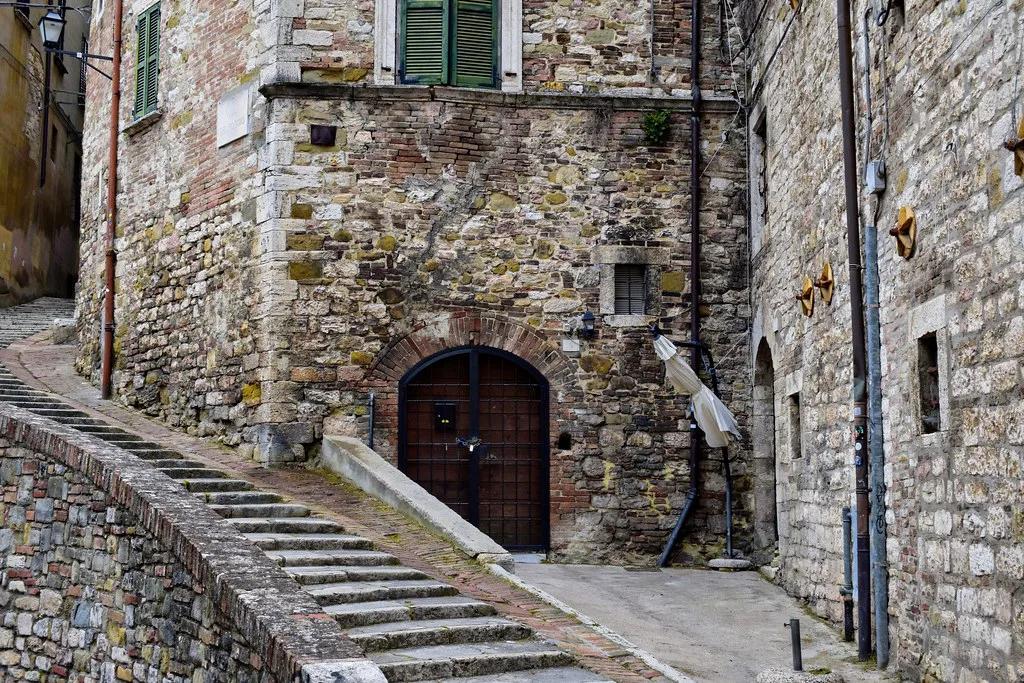
The upper town is small enough to cross on foot, but it is anything but flat. Travel writers who have walked it describe the old city draping over a long, steep gradient, with narrow cobbled streets and escalators placed at the steepest links; even with mechanical help, the climb to the main square is still a climb. Plan shoes for stone paving rather than distance.
Connections between levels are the city's quiet engineering story. The mini-metro runs from the lower town towards the ridge and is described as an automated single-carriage system with very frequent departures, while escalators carry pedestrians up from car parks and the bus area into the centre. Use them to save energy for the walking rather than treating them as a novelty.
If you want more than this half-day loop, the wider city hides underground passages, small museums and overlooked corners beyond the obvious piazza. Browse our guide to the hidden gems in Perugia to decide which extra stop is worth your remaining time.
Before You Set Off: Footwear, Gradient and Getting Up the Hill
Treat the day as a short hill walk with city stops. Comfortable shoes with grip matter more than fashion on wet cobbles, and a light layer helps because the lanes are shaded while the piazzas and viewpoints are exposed. Carry water; the historic centre is full of drinking fountains, but you should still top up before the long climbs.
The most useful planning decision is where you enter the upper town. Arriving by mini-metro or by the escalators from the lower town and car parks puts you near the ridge with the main sights ahead of you, rather than at the bottom of a long stair climb. The escalator route also passes through the vaulted remains of the Rocca Paolina, so the fortress can be your entry point or your finale.
Check conditions before you travel rather than trusting any fixed list. For civic notices, transport updates and temporary works, the city of Perugia website is the authority. For regional context and route ideas beyond the centre, the Umbria tourism board publishes destination material worth a look the evening before.
Stop 1: The Etruscan Arch and Via Ulisse Rocchi
Begin at the Etruscan Arch at the northern edge of the old town, at the end of Via Ulisse Rocchi. It is a surviving gate from the city's pre-Roman walls and is generally treated as the most striking of Perugia's ancient gateways, built into the defensive circuit that still shapes the street plan. Give it ten minutes from the outside, then turn uphill into the lanes.
The gate's Roman inscription above the arch, referring to Augusta Perusia, is a reminder of how the city was folded into Rome after resisting it. It is free to see from the street, which makes it the right first stop before any ticketed interiors. The nearby streets are residential, so keep your voice down at doorways and windows.
From the arch, head uphill toward the centre along the marked lanes rather than trying to cut across traffic. Guided walking tours in Perugia, such as the one offered by a local operator, typically cover the arch among the headline sights and last around ninety minutes, which gives you a sense of what a fast pass looks like; a self-guided walk should be slower and more selective.
Stop 2: Via dell'Acquedotto and the Medieval Aqueduct Walkway
Perugia's medieval aqueduct once carried spring water from Monte Pacciano to the Fontana Maggiore, and the surviving elevated channel now functions as a pedestrian route towards the university area. In places the walkway runs at eye level with the windows and doorways of houses that grew up around the arches, so it feels like walking through a neighbourhood rather than along a monument.
Go slowly here and look out over the rooftops and the valley beyond; this is one of the route's best free viewpoints and its most photogenic stretch. The path is narrow in parts and popular with residents going about their day, so step aside at passing points. It is a good place to pause if stairs have already tired anyone in your group.
For the wider picture of the city, including the aqueduct and squares nearby, the Perugia Attractions collection is a useful index when you are deciding what else merits a detour. Combine the aqueduct with a short walk toward the northern lanes rather than doubling back immediately.
If you prefer an audio format with a fixed route, a self-guided app tour covers the aqueduct among other stops and lists a duration of about one hour and forty-five minutes. It pairs commentary with the same streets, but you still need to manage gradients, crowds and opening hours yourself.
Stop 3: A Coffee Break the Perugian Way
Coffee in Perugia is a short, standing ritual rather than a long seated affair: order at the counter, drink quickly, and watch the morning crowd of students and office workers do the same. A pastry alongside the espresso is standard, and working out the local habit is part of the pleasure. This is the right moment to rest calves before the central streets.
Historic cafés on and around Corso Vannucci have long been part of local life, but their opening hours can shift seasonally and are not something to plan around. Check on the door or by phone rather than assuming a published schedule. If your chosen café is closed, coffee counters elsewhere in the centre serve the same brief ritual without the queue.
Stop 4: Corso Vannucci, Perugia's Pedestrian Spine
Corso Vannucci is the wide, stone-paved street running from Piazza Italia to the main square, lined with shops, cafés and historic palaces. It takes only about ten minutes to walk from end to end, which makes it the efficient axis for the rest of the route. Walk it once in the morning and again at dusk if you can, because the passeggiata transforms it.
The Palazzo dei Priori, the Gothic civic palace, anchors the street and now houses the Galleria Nazionale dell'Umbria. That gallery is a paid interior with its own ticket scope, so treat it as an optional extension rather than assuming it is included in the walk. If art is your priority, allow two hours.
This street is also where the city's everyday rhythms are easiest to read: students between lectures, residents greeting each other, and the shift from coffee to aperitivo. It is a good place to break the day, find a bench in the nearby gardens, or simply sit outside for ten minutes.
Stop 5: Piazza IV Novembre, Fontana Maggiore and the Cathedral
The main square sits where five medieval streets meet and where the Roman forum once stood, flanked by the cathedral and the Palazzo dei Priori. In the centre, the Fontana Maggiore is a thirteenth-century marble fountain carved with dozens of reliefs covering the months, zodiac signs, arts and civic themes, and it remains the city's visual anchor.
Look carefully at the cathedral and you will notice that its side wall, not its front, faces the piazza. The planned pink and white marble cladding was never completed, leaving a facade that finishes in brick and limestone, which is an odd, memorable detail rather than a shortcoming to skip past.
The cathedral interior is free to enter, but it is an active place of worship: services take priority, modest dress is expected and hats come off. Its high windows leave it darker than the gilded cathedrals of Siena or Florence, so give your eyes a minute to adjust and keep quiet near worshippers.
Enjoy coffee or a spritz on the edges of the square when the weather allows and watch the steps become an informal gathering place. The adjoining Sala dei Notari, part of the palace, is decorated with elaborate frescoes and coats of arms of old Perugian families and is worth a look if it is open as you pass.
Optional Paid Stop: The Etruscan Well and Palazzo Sorbello
Behind the cathedral, five minutes from the main square, the Etruscan Well drops about thirty-seven metres into an ancient cistern, roofed by a structure of heavy travertine beams that has held without mortar for more than two thousand years. You descend on a metal walkway to within about a metre of the water, which still fills the shaft.
There is no separate ticket office for the well: access comes with the Casa Museo di Palazzo Sorbello, a furnished noble apartment on the same site, and the combined ticket was reported at nine euros on a check dated 4 September 2026. The museum alone is listed separately, and the well plus house museum are included in the city museum card. Prices change, so confirm at the entrance before paying.
Allow twenty minutes for the well and around half an hour more if you also tour the house. Some opening-hours listings online show a lunchtime closure on one weekday, but these change often, so confirm the day's times with the venue or the city before you build the stop into a tight schedule.
Stop 6: Rocca Paolina and the Escalator Passage
Finish underground in the Rocca Paolina, the fortress Pope Paul III Farnese ordered after Perugia's revolt over the salt tax in 1540. Instead of demolishing the quarter on the hill, workers earth-filled the houses, streets and shops and built the fortress foundations on top, so today you walk through a medieval neighbourhood roofed by sixteenth-century vaults. The city demolished the fortress itself after unification in 1860 but left the buried foundations.
The passage is a public route, not a staged museum: locals use the escalators between Piazza Italia and Piazza Partigiani with their shopping, and there is no ticket office. Look for Porta Marzia, the Etruscan gate that Antonio da Sangallo had dismantled and rebuilt stone by stone into the new wall rather than destroying it.
As of the source's check date, entry from Porta Marzia runs 7am to 8pm and the escalators from Piazza Partigiani run 6:15am to 2am, but those hours are operational details that can change, so verify them before relying on a late-evening passage. The ride up is genuinely useful if you have walked all afternoon.
Optional Detours: Towers, Viewpoints and a Southern Abbey
If your legs allow it, Torre degli Sciri is the last standing medieval tower in the city, and climbing it offers one of the broadest views. Opening hours have changed between seasons and some sources give only Friday to Sunday slots, so treat any timetable you find online as unconfirmed and check locally.
Another viewpoint tradition in Perugia is the Porta Sole area, one of the highest points of the city, where the streets open onto wide views toward Assisi and the countryside. The gardens at Carducci, near the southern end of Corso Vannucci, give a shorter and easier alternative if you have already climbed enough.
With a full day, walk south through the Borgo XX Giugno district to the Basilica and Abbey of San Pietro, founded around 996 and rebuilt after a fire in 1398; it keeps a cloister, garden and carved choir. Reported opening times have varied between sources, so check before making the twenty-odd minute walk each way.
For a taste of Perugia beyond the walking route, tour guides point to the city's Etruscan heritage and its long chocolate tradition as the two themes most worth pursuing with extra time. Both are easy to fold into a slower second afternoon.
Finishing the Loop: Where to End and What to Eat
The natural finish is Piazza Italia, where the escalator ride through the Rocca Paolina sets you down with easy links back to the lower town and the mini-metro. From there you can walk back along Corso Vannucci for an evening pass, or drop straight to your transport.
Perugia's food identity runs through truffles, cured meats from Norcia and hand-rolled strangozzi pasta, with chocolate as the sweet counterpoint. A long lunch is the local way to recover from the hills, and student numbers keep many trattorias informal and relatively affordable.
If you would rather build a second day around the city, the Perugia guide in our attractions hub helps you choose between the national gallery, the archaeology museum and the smaller churches. That keeps the walking route focused and leaves the paid interiors for when you have time to enjoy them.
Plan Your Visit
This loop works because it mixes free public sights with optional ticketed interiors, so you can walk it in three hours or stretch it across a day. Start at the Etruscan Arch, keep the aqueduct for the morning light, and finish through the Rocca Paolina.
Before you go, confirm the hours that matter for your plan: the Rocca Paolina passage and escalators, the Etruscan Well with the Palazzo Sorbello house museum, and any paid gallery or tower you intend to enter. The city website and the venue's own page are the places to check, and prices should always be confirmed on the spot. For related planning, see Getting to and Around Perugia: Escalators, MiniMetro & Hills.
Frequently Asked Questions
Is there a free self-guided walking route in Perugia's old town?
Yes. The route described here uses public streets and squares, including the Etruscan Arch, the aqueduct walkway, Corso Vannucci, Piazza IV Novembre and the Rocca Paolina passage, none of which needs a ticket. Optional interiors such as the national gallery or the Etruscan Well have their own tickets and should be treated separately.
How long does a self-guided walk through Perugia's centre take?
Allow three to four hours at an unhurried pace, including a coffee stop and time in the main square. Add roughly an hour if you want the Etruscan Well and Palazzo Sorbello, and two hours for the national gallery. The route is short in distance but steep, so pace yourself rather than racing between stops.
Is the Rocca Paolina free to walk through?
Yes, the passage through the buried quarter is public space with no ticket office, and locals use the escalators as a normal route between Piazza Italia and Piazza Partigiani. Entry hours and escalator running times are operational details, so check them with the city or the venue before planning a late visit.
Do I need a ticket for the Etruscan Well?
Yes. The well is visited through the Casa Museo di Palazzo Sorbello on a combined ticket that covers both, and the museum is also sold separately. A published check dated 4 September 2026 reported the combined ticket at nine euros, but prices change, so confirm at the entrance or via the venue before paying.
How hilly is Perugia's historic centre?
Very. The old city drapes over a long gradient of cobbled lanes, and even with escalators the climb to the main square is real. Wear shoes with grip, carry water and use the mini-metro or escalator links to save energy for the parts you actually want to explore on foot.
What should I not miss on a one-day walk in Perugia?
Prioritise the Etruscan Arch, the aqueduct walkway, the Fontana Maggiore and cathedral exterior on Piazza IV Novembre, and the Rocca Paolina passage. Add one paid interior if time allows, such as the national gallery or the Etruscan Well, and leave the towers and the southern abbey for a second visit.
Sources
- Walking The Streets Of Perugia - Legging It Travel
- https://www.expedia.com/things-to-do/historias-ocultas-de-perugia-tour-de-audio-autoguiado.a50288574.detalles-actividades
- Walking Tour Perugia: Guided Tour of the Historic City Center - Secret Umbria
- Official event website
- Etruscan Well, Perugia Travel Guide | Evendo
- Perugia – Tour Guide Umbria
- Basilica of San Pietro, Perugia | Religiana
- 13 Wonderful Things To Do in Perugia, Italy — ALONG DUSTY ROADS
- Perugia, Italy – A Complete Travel Guide to The Capital of Umbria
- 21 Things to Do in Perugia, Umbria's Picturesque Capital - Our Escape Clause
- Fontana Maggiore: things to do in Perugia - Italia.it
- Underground Perugia: Rocca Paolina and Etruscan Well
Continue exploring
More guides you'll find useful





