
Free Things to Do in Perugia: What Actually Costs Nothing
A low-cost Perugia day built on free squares, free cathedral entry, Rocca Paolina passages and viewpoint walks, with honest notes on which sights need a ticket.
On this page
Perugia is a hilltop city of stone alleys, escalators and stacked walls, and much of what makes it memorable costs nothing to enter. The Cathedral of San Lorenzo on Piazza IV Novembre is free to visit as a working church, the square and its thirteenth-century fountain are open to all, and the Rocca Paolina works as a public route through the city as well as a monument.
The catch is that a few Perugian sights look like public space but sit behind a ticket, and others are free churches or grounds whose interiors, collections or towers are charged separately. Knowing which is which saves money and wasted uphill walking. Use this guide alongside our wider look at the hidden gems in Perugia, and dip into the Perugia Attractions hub when you want the full visiting detail for a single sight.
Why Perugia Suits a Free Day Out
Perugia is the capital of Umbria and sits roughly halfway between Rome and Florence, which makes it an easy stop rather than a pilgrimage. It is also a large student city, with one of the highest ratios of students to residents in Italy, and that shapes the atmosphere: people gather on the cathedral steps and stroll the main street rather than filing through turnstiles. Much of the pleasure is simply being in the streets.
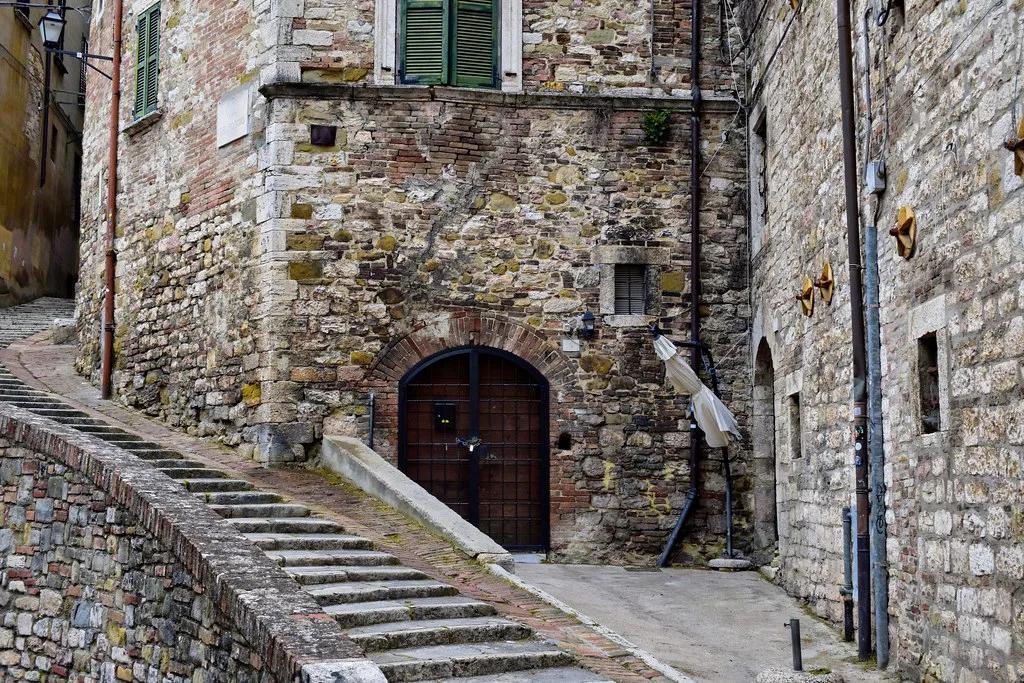
The historic centre is compact but built on a hill, with steps, slopes and tunnels connecting the lower town to the upper one. Expect to climb. A network of escalators links the modern city to the medieval core, including the route up through the Rocca Paolina from Piazza Partigiani, so comfortable shoes matter more here than any entrance fee.
Piazza IV Novembre and the Fontana Maggiore
Start at Piazza IV Novembre, the sloping square where several medieval streets meet and where the city's Roman forum once stood. At its centre the Fontana Maggiore, carved by Nicola and Giovanni Pisano between 1275 and 1278, is among the most important and best preserved medieval fountains in Italy, its basins decorated with dozens of reliefs showing months, zodiac signs, the arts and civic life. You can circle it freely and read the carvings at no cost.
The Palazzo dei Priori dominates one side of the square with its Gothic crenellations and ornate portal, and its exterior and the fan-shaped steps up to the Sala dei Notari are free to admire. The distinction that matters: the Galleria Nazionale dell'Umbria occupies the palace's upper floors as a ticketed museum, so standing in the courtyard or on the steps does not get you into the collection.
Cathedral of San Lorenzo: Free Entry, Working Church
The Cathedral of San Lorenzo, dedicated to Saints Lawrence and Ercolano, is free to enter and remains an active place of worship rather than a ticketed attraction. Its most striking feature is its unfinished facade, bare stone with spaced ridges where a grand frontage was planned and never completed. Inside, the mood is sober and dim compared with the gilded cathedrals of Siena or Florence, and the building still functions as a parish church first.
Because services take priority, tourists are politely turned away during Mass, and a curtain marks off a space for private prayer. Dress modestly, remove hats, keep your voice down and time your visit to avoid the hour after a service.
Outside, the cathedral steps are one of the city's free spectacles, filled most days with students sitting in clusters, talking and eating. Sitting there for twenty minutes is a legitimate way to spend an afternoon in Perugia, and it costs nothing.
Rocca Paolina: A Free Passage, Not a Ticket Office
The Rocca Paolina is the remnant of a sixteenth-century papal fortress built for Paul III after Perugia's revolt over a salt tax. What makes it unusual is what lies inside: rather than demolish a whole quarter of houses, workshops and streets, the builders filled it with earth and used it as foundations. You now walk past original house fronts and doorways under Renaissance vaults, along a climbing street with its old cobbles.
This is not a staged museum with theatrical lighting. It is a public passage that residents use as a shortcut, and the escalators from Piazza Partigiani carry shoppers and commuters as well as visitors up toward Piazza Italia. Treat it as city infrastructure you are lucky enough to walk through, and keep your voice and pace considerate.
Entry times can be adjusted for services and events, so check locally before planning a late or early crossing rather than relying on a figure printed in any guide.
Porta Marzia and the Etruscan Layer
On the Viale Indipendenza side of the Rocca complex stands Porta Marzia, an Etruscan gate of the third century BC with a frieze of figures between small columns. It is not in its original position: when the fortress wall would have blocked it, the architect had it dismantled and rebuilt a few metres away. Passing under an Etruscan arch into a medieval alley roofed by a Renaissance vault is one of Perugia's most distinctive free experiences.
Elsewhere in the centre, stretches of Etruscan wall and further gates survive among later buildings, including the Arco Etrusco on the north side, a remnant of the fourth-century BCE walls. These are outdoor monuments you can see at no charge while walking between stops.
Free Viewpoints: Carducci, Porta Sole and Pincetto
Perugia rises on a series of hills, and several of its best viewpoints are simply public gardens and terraces. The Giardini Carducci, at the southern end of the main street, is a small park on the site of a demolished fortress with wide views over cypress-cloaked hills, and it is free to sit in. At sunset people bring drinks to the steps and the rooftops turn golden.
Higher up, Porta Sole is an ancient gate and one of the highest points in the city, with views over terracotta rooftops, olive groves and cypresses toward the Apennines. It is popular at sunset, and a short walk down Via delle Prome leads to another fine belvedere. This is one of the stops covered in more detail in our hidden gems in Perugia guide.
If you come up from the lower town by escalator or lift at the Pincetto station, the Giardino del Pincetto meets you with east-facing views that reach toward Assisi. It is a small park with a library and a playground, and the outlook is genuinely impressive for somewhere you pass through on the way into town.
These are uneven, stepped places with low walls rather than railed observation decks with lifts. Wear shoes with grip, watch your footing after rain and do not assume level, accessible paths at every viewpoint.
The Medieval Aqueduct Walk
Perugia's medieval aqueduct once carried spring water from Monte Pacciano to the Fontana Maggiore, and a stretch of it now forms a raised stone walkway through the northern city. Walking it is free and takes you along a channel threading past honey-coloured houses, windows and washing lines. Entering through the arch and down the steps gives the best first impression.
Etiquette matters here more than at a formal sight. At points you are level with bedroom windows and front doors, so keep noise down, do not linger at windows, and remember this is a residential route rather than an attraction. The reward is a slice of ordinary Perugia that stays with you longer than many paid entries.
Corso Vannucci and the Evening Passeggiata
Corso Pietro Vannucci runs from Piazza IV Novembre to the Giardini Carducci and is the city's main pedestrian street, lined with shops, cafés and historic buildings. Its early evening passeggiata, when locals and foreign students walk up and down in the soft light, is a zero-cost activity worth planning around, and a leisurely stroll from end to end takes only about ten minutes.
Café terraces cost money, but the parade does not. Take a spot on the cathedral steps or the edge of the Carducci Gardens and watch the city go about its evening instead.
Churches You Can Enter for Free
Beyond the cathedral, several Perugian churches are free to enter and reward a short detour. The Basilica of San Domenico, with roots in the fourteenth century, is enormous and cavernous, and catching it near-empty at dusk with a small Mass sung in a side chapel stays in the memory. Its hours are limited, so check before walking over.
The Oratory of San Bernardino, built in the mid-fifteenth century, has a striking polychrome facade and free entry. The interior feels plainer after the exterior, but the door behind the altar opens onto a grander oratory. Outside, the grass in front often fills with students.
The Chiesa di San Michele Arcangelo, near the end of the aqueduct route, is among the oldest churches in Italy, dating to somewhere between the fifth and seventh centuries, and its round shape makes it distinctive. Combine it with the aqueduct walk rather than making a separate trip.
Chocolate Browsing Without the Factory Tour
Perugia is the home of Perugina and the bacio, the chocolate and hazelnut sweet created by Luisa Spagnoli and Giovanni Buitoni. Chocolate shops are scattered across the centre, and browsing them or buying a single bacio is a cheap way to taste the city's signature product. The Perugina factory and museum runs tours and classes that are paid and require booking through Casa del Cioccolato, which is open Monday to Saturday.
What Looks Free but Is Not
The Etruscan Well looks like an archaeological curiosity you might drop into, but it has no ticket office of its own. Access is through the Casa Museo di Palazzo Sorbello on a combined ticket covering both, and the well sits behind the cathedral at Piazza Danti. It is a remarkable third-century BC shaft about thirty-seven metres deep with a travertine roof structure that has held without mortar for more than two thousand years, but it is not a free sight.
The Galleria Nazionale dell'Umbria is a ticketed state museum inside the Palazzo dei Priori, holding works by Perugino, Pinturicchio, Piero della Francesca and Fra Angelico. Check the gallery's own site for current prices and any free-entry days rather than relying on older guides, whose figures may have changed. Perugia's official city site and the regional tourism board are useful starting points for verified visitor information.
The medieval Torre degli Sciri is sometimes described as free to climb, but access arrangements and hours vary by season and are not consistently published by an official source. Treat any claim of free entry as unconfirmed and check on arrival or through a tourist office before counting on it.
Routes by Time Available
For a half day, start at Piazza IV Novembre to see the fountain and the cathedral, walk the length of Corso Vannucci to the Giardini Carducci for the view, then descend through the Rocca Paolina and exit via Porta Marzia. That is almost entirely free and takes in the civic heart, one of the best viewpoints and the city's most unusual passage.
With a full day, add the aqueduct walk in the morning while it is quiet, reach Porta Sole for the view, and finish with a passeggiata on Corso Vannucci in the evening. These are suggested shapes for a day, not fixed timetables. If you want one paid stop, pick either the Etruscan Well with the house museum or the Galleria Nazionale dell'Umbria, and check current opening times and prices on the operator's own pages before you go.
Plan Your Free Day in Perugia
Perugia's best free experiences are not lesser versions of paid attractions; they are the city's everyday fabric, from the cathedral steps to the escalators residents ride home. Build a day around the square, the cathedral, the Rocca Paolina and the viewpoints, and you will have spent almost nothing while seeing what makes Perugia distinct.
Before you travel, confirm opening times and ticket arrangements for anything you plan to enter, especially the Etruscan Well and the national gallery, on the venue's own website. Then leave room in the plan for getting lost uphill, sitting on a step and watching the light change over the hills. For related planning, see Perugia Viewpoints and Terraces: A Practical Views Guide.
Frequently Asked Questions
Is Perugia worth visiting on a budget?
Yes. The cathedral is free to enter, the main square and its medieval fountain are open to everyone, and the Rocca Paolina is a free public route through the underground remains of a medieval quarter. Several viewpoints and the aqueduct walk also cost nothing, so a rewarding day is possible with very little spending.
What can you do in Perugia for free in one day?
Start at Piazza IV Novembre to see the Fontana Maggiore, step into the Cathedral of San Lorenzo, walk Corso Vannucci to the Giardini Carducci for the view, then descend through the Rocca Paolina and exit under Porta Marzia. Add the medieval aqueduct walk or the Porta Sole viewpoint if you have time. All of these are free.
Is the Cathedral of San Lorenzo in Perugia free to enter?
Yes. It is an active place of worship with free entry rather than a ticketed attraction. Visitors are asked to dress modestly, remove hats and keep quiet, and entry may be restricted during Mass and services.
Is the Rocca Paolina free to visit?
Yes. It is best understood as a free public passage rather than a museum, and residents use it as a shortcut between the lower town and Piazza Italia. Check current entry and escalator times locally before relying on an early or late crossing.
Does the Etruscan Well cost money?
Yes. It has no ticket office of its own and is visited through the Casa Museo di Palazzo Sorbello, which sells a combined ticket covering both. Check the museum's official site for current prices, hours and any closures before you go.
Which Perugia viewpoints are free?
The Giardini Carducci, the Porta Sole terrace and the Giardino del Pincetto at the top of the escalators are all free public places with wide views. They are uneven and stepped, so wear shoes with grip and take care after rain.
How much time do you need in Perugia?
A half day is enough for the square, the cathedral, Corso Vannucci, the Carducci Gardens and the Rocca Paolina passage. A full day adds the aqueduct walk and the Porta Sole viewpoint, and two or three days allows one paid museum and a day trip to Assisi or Lake Trasimeno.
Sources
- 5 Best Things to Do in Perugia, Italy - Lonely Planet
- City Break in Perugia: what to see in 2 days - Italia.it
- Official event website
- 13 Wonderful Things To Do in Perugia, Italy — ALONG DUSTY ROADS
- 21 Things to Do in Perugia, Umbria's Picturesque Capital - Our Escape Clause
- Fontana Maggiore: things to do in Perugia - Italia.it
- Underground Perugia: Rocca Paolina and Etruscan Well
Continue exploring
More guides you'll find useful





