
Parma Music and Festivals: Verdi, Opera and the Teatro Regio
Plan a music trip to Parma: Verdi's legacy, the Teatro Regio opera season, Festival Verdi timing, and how to see inside the theatre on a guided visit.
On this page
Parma is a small Emilian city with an outsized musical reputation, and most of that reputation hangs on two names: Giuseppe Verdi, born in the countryside nearby, and the Teatro Regio, the opera house on Strada Garibaldi. If you are planning a music-focused visit, the single most useful fact is that the theatre's own guided visit runs hourly from Tuesday to Sunday and does not operate on Mondays. That schedule comes from an independent guide rather than the theatre itself, so confirm it before you build a day around it.
This guide separates what is reliably known from what changes season to season. It covers Verdi's local footprint, the shape of the opera year, how to see inside the theatre without buying an opera ticket, and the music sites that sit within a short walk or a short drive of the centre.
Why Parma Matters for Opera Lovers
The Teatro Regio was commissioned by Duchess Maria Luigia, built by the architect Nicola Bettoli between 1821 and 1829, and opened on 16 May 1829 with Bellini's Zaira, written for the occasion. That opening night was received coldly, according to the independent guide that records the theatre's history. The building took its current name after Italian unification.
What makes the house distinctive is not only the red-and-gold horseshoe of boxes but the audience in the gallery, the loggione. The guide describes it as one of opera's most demanding galleries, generous with cheers and equally quick to signal a wrong note. For a visitor, that means a night at the Regio is as much about the room's reaction as the performance.
Parma's opera culture also has a formal structure: the Club dei 27, founded in 1958, counts 27 members, one for each of Verdi's operas, as the same guide notes. You are unlikely to encounter the club as a visitor, but its existence explains why Verdi programming here is treated as a civic matter rather than a marketing theme.
Verdi's Legacy In and Around Parma
Verdi was born in the village of Roncole, near Busseto, roughly 35 kilometres from Parma according to the guide. His operas form the core of the Regio's identity: the Italian premiere of I vespri siciliani took place there in 1855 under the censored title Giovanna di Guzman. Verdi's birthplace, Busseto and its Teatro Verdi are the standard day trip for anyone following the composer's trail.
The composer's reach extends to the city's other music collections too. Casa della Musica groups Parma's music museums and is the seat of the Club dei 27, and the Verdi monument stands close to the Regio. None of these requires a ticket to the opera, so they work well as a half-day of context before an evening performance.
If your interests run beyond Verdi, the hidden gems in Parma include quieter corners of the old town that reward a slow walk between music stops. The Baptistery of Parma, the Teatro Farnese and the Pilotta complex all sit within the same compact centre, so a music-themed day naturally merges with general sightseeing.
The Teatro Regio: A Short History of the House
The theatre occupies the site of a former monastery on Strada Garibaldi, behind a portico of ten Ionic columns that you can admire for free at any hour. Inside, the hall was redecorated in 1853 by Girolamo Magnani in white, gold and red velvet, around four tiers of boxes and the gallery. The ceiling was painted by Giovan Battista Borghesi.
The centrepiece overhead is a gilded bronze chandelier made in Paris. The guide gives its weight as roughly 1,100 kilograms, a figure worth treating as reported rather than measured. The royal box was once reached by a passage from the ducal palace, a detail that makes the theatre's court origins concrete.
The address is Strada Garibaldi 16/a, and the theatre sits beside the Palazzo della Pilotta and a few minutes from Piazza Garibaldi. That position means you can combine the Regio with the Pilotta in a single morning without any transport. Parma's wider set of Parma Attractions gives the surrounding sights their own context if you want to plan a fuller stay.
What a Guided Visit Covers
The theatre's own visit is short: about 30 minutes, with groups capped at 20 people, moving through the foyer, the hall and the boxes. The guide reports that visits leave every hour, with Tuesday to Saturday hours in the morning and mid-afternoon and a Sunday window, and that the theatre is closed to visits on Mondays. Treat all of that as needing confirmation, because rehearsal and performance schedules can cancel or shift times at short notice.
The guide also lists the guided visit at EUR 12 full price, with reduced rates for under-25s, over-65s and groups of 20 or more, and a lower rate for under-18s. Because that pricing is published by a third-party guide rather than the theatre, check the current tariff at the box office or on the theatre's own channels before you go. Opera and concert tickets, by contrast, are priced per show.
Groups larger than 20 must book, and backstage visits are possible on request for small groups according to the same source. If seeing the backstage areas matters to you, ask when you arrive rather than assuming it is part of the standard circuit. The practical takeaway is that the visit is easy to slot into a morning but should not be treated as a fixed appointment.
The Shape of Parma's Opera Year
Parma's musical calendar has two reliable anchors. The guide states that the opera season runs from January to May, while Festival Verdi fills October. It dates the 2026 festival from 1 to 25 October at the Teatro Regio and in Busseto, but that window should be verified with the theatre before you book travel, since festival programmes and dates are set by the organiser.
Festival Verdi has a long history of pairing the main house with Busseto's smaller Teatro Verdi. The 2018 edition, for example, programmed Macbeth and Attila at the Regio, Un giorno di regno at Busseto's theatre, and La traviata's relative rarities across the two venues. That older programme is history, not a forecast, but it shows the festival's habit of spreading performances across the territory.
Outside those windows, the city's musical life does not stop, but the evidence here is thin on a fixed public calendar beyond the opera season and the festival. If your trip depends on a specific concert or event, check the theatre's official announcements rather than relying on aggregator listings. Building your dates around the two known seasons is the safest planning move.
How to Buy Opera and Festival Tickets
Opera tickets at the Regio are sold by the theatre itself, through its box office and official website. The guide notes that Festival Verdi nights can sell out early, which is a prompt to book as soon as a programme is published rather than waiting for your travel dates to firm up. Tour platforms do not sell the theatre's opera tickets.
That distinction matters because many Parma tours are sold through GetYourGuide and Viator, and the guide is explicit that the theatre's own guided visit is not among them. If you see a product promising opera tickets, verify the seller against the theatre's official channels before paying. There is no reliable way to confirm availability from a third-party listing alone.
Note also that Parma's official-looking tourism domain is not a usable reference: visitparma.it is currently a parked domain offered for sale, so it should not be treated as a city tourism source. Use the theatre and the city's own institutional pages instead when cross-checking dates.
Theatre Visit or Booked Tour?
The simplest way inside is the theatre's own short guided visit, which you buy at the theatre rather than in advance online. Booked tours serve a different purpose: they add Parma's other music sites, food stops or transport, and most walking tours stop at the Regio's columns rather than entering. The guide identifies only one bookable product that goes inside, a private opera day sold through Viator, which is non-refundable.
Choose the theatre visit if your priority is the hall, the foyer and the chandelier, and you are comfortable with a fixed hourly slot. Choose a private guided day if you want the Teatro Farnese, Toscanini's birthplace and the Regio in one block with entries handled for you, accepting that cancellation terms are strict. Cheaper walking tours are best treated as an orientation to the city rather than a way to see the auditorium.
For families or mixed groups, splitting up works well: one person takes the theatre visit while others explore the Pilotta, then everyone reconvenes on Strada Garibaldi. The theatre's central location makes that kind of hand-off practical, and it avoids paying for tour inclusions you will not use.
Beyond the Regio: Parma's Other Music Sites
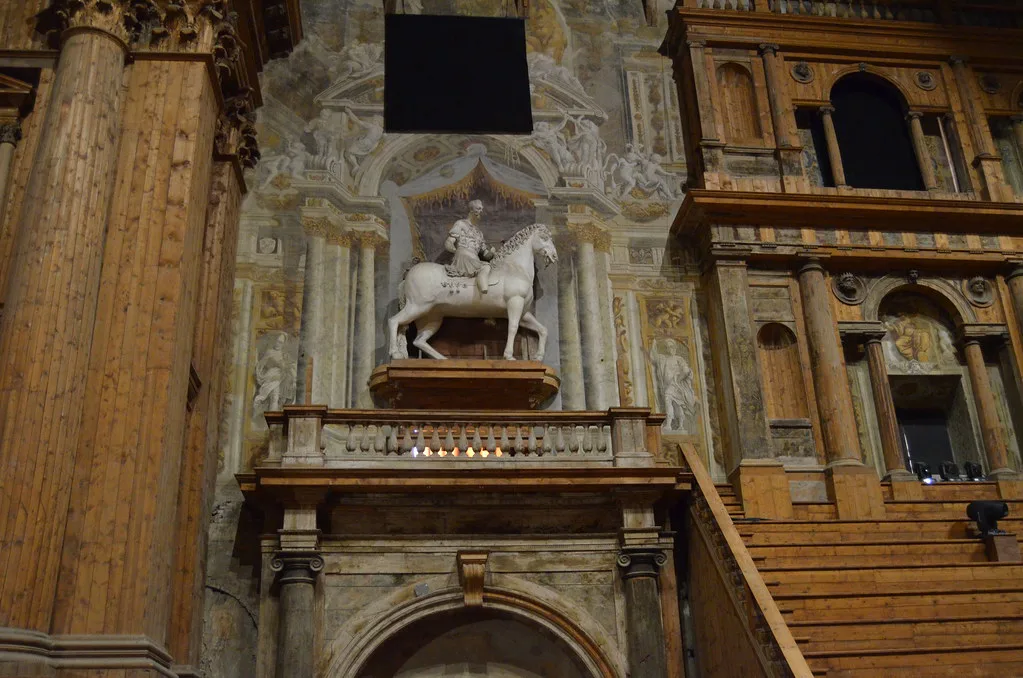
The Teatro Farnese, a wooden theatre of 1618 inside the Palazzo della Pilotta, is the obvious companion visit. The guide describes it as next door to the Regio, and its own guided entries are sold separately from the opera house, so do not assume one ticket covers both. Pairing them in a single morning is the most efficient use of a day.
Across the river, Toscanini's birthplace is a small museum devoted to the conductor, reachable on foot from the centre. Casa della Musica gathers the city's music collections. Both are modest, low-key stops that reward an hour rather than an afternoon, and neither requires an opera booking.
For a slower day, the Baptistery of Parma and the old-town lanes between these sites make a natural loop back toward Piazza Garibaldi. The city is compact enough that most of this is walkable, which is the main reason a music-focused visit here feels unhurried rather than rushed.
Building a Music Day in Parma
A workable shape is this: take the theatre's morning guided visit, cross to the Pilotta and the Teatro Farnese, walk over the river to Toscanini's birthplace, and return for an evening performance if your dates coincide with the season. This is a suggested itinerary, not an official one, and the visit times must be confirmed because rehearsals can move them.
If your trip falls between June and September, expect no opera season and no festival, so the guided visit and the music museums become the core of the day rather than an add-on. That is not a lesser visit, but it is a different one, and it is worth adjusting expectations before booking travel.
For a longer stay, the Parma guide hub explains the city's main sights in more depth and helps you sequence the Pilotta, the cathedral and the Regio without doubling back. If you want to go deeper into the city's overlooked corners, the hidden gems in Parma piece is a useful companion to this one.
Practical Constraints Worth Knowing
Mondays are the most common planning mistake: there are no guided visits that day. Rehearsal days are the second: visit times can change or be cancelled, so the guide advises calling the theatre ahead. Build flexibility into any day that depends on entering the auditorium.
Parma's old town has limited traffic, so the guide suggests parking outside the centre and walking in. Parma station sits on the Milan-Bologna line and is about 15 minutes away on foot from the theatre, which makes the train a practical option if you are coming from Bologna or Milan. Travel times can vary, so check current services before you set out.
If you want to extend the musical theme, Milan's La Scala is roughly an hour from Parma by train according to the guide, and Verdi's Nabucco triumphed there in 1842. That makes a two-city opera itinerary feasible, though you should verify train schedules and theatre calendars independently for each leg.
Plan Your Music-Focused Visit
Treat Parma as a two-season city: the opera year from January to May, and Festival Verdi in October. Confirm the festival's published dates with the theatre before booking, and remember that opera tickets come from the theatre itself rather than from tour platforms.
For everything else, the theatre's short guided visit and the ring of music sites around it make a compact, walkable day. Check the Monday closure and rehearsal-driven time changes first, then build the rest of your Emilia-Romagna itinerary around what is actually open.
Frequently Asked Questions
Can you visit the Teatro Regio di Parma without seeing an opera?
Yes. The theatre runs its own short guided visit through the foyer, the hall and the boxes, with groups capped at 20 people. It is bought at the theatre rather than through tour platforms, and you should confirm the current schedule with the theatre before relying on it.
When is the opera season in Parma?
An independent guide describes the opera season as running from January to May, with Festival Verdi filling October. Verify exact dates and productions with the theatre, since programmes are set by the organiser and change each year.
When is Festival Verdi held?
It is an October festival, traditionally split between the Teatro Regio and Busseto's Teatro Verdi. The 2026 edition is reported as running from 1 to 25 October, but confirm the dates with the theatre before booking travel.
How do you buy Teatro Regio opera tickets?
Opera tickets are sold by the theatre through its box office and official website, not through GetYourGuide or Viator. Festival nights can sell out early, so check as soon as a programme is published.
Is the Teatro Regio open on Mondays?
According to the independent guide, guided visits do not run on Mondays. Treat that as needing confirmation, since rehearsal and performance schedules can change the pattern at short notice.
Do walking tours go inside the Teatro Regio?
Most walking tours stop at the exterior colonnade on Strada Garibaldi rather than entering. The guide identifies only one bookable tour that goes inside, a private opera day that is non-refundable, so check the inclusions carefully before booking.
Sources
Continue exploring
More guides you'll find useful





