
Getting Around Parma: Arrival, Walking, Parking and ZTL Tips
How to reach Parma and move around its compact centre on foot, with practical advice on the A1 exit, narrow streets, camera-enforced restricted zones and parking.
On this page
Parma rewards travellers who treat the historic centre as a walking zone and keep the car out of it. The monuments most visitors come for sit a few minutes from one another, so the main transport decision is not which bus to take but where to stop driving. Here is how arriving on the A1, reading restricted-traffic signs, parking at the edge and pacing a slow half day fit together.
One detail worth knowing before you plan a route: the church of San Giovanni Evangelista, directly behind the cathedral, is free to enter, while the Baptistery and the Diocesan Museum are ticketed and managed separately. A suggested forty minutes covers the church itself; longer is needed if the cloisters and pharmacy happen to be open. Where this guide cannot confirm a current fare, line or opening time, it points you to the operator instead of guessing.
Arriving by Car: The A1 Exit and Its Traps
Parma sits in Emilia-Romagna on the Autostrada A1, the motorway that runs south past Bologna toward Rome and Naples. Arriving from the north, you leave the A1 at the Parma exit and pay the toll as you come off. Deciding your lane before the toll booth matters, because the signs immediately after it demand a fast choice.
A frequently reported failure mode is worth repeating: the exits after the toll plaza sit so close together that a navigation device can struggle to keep up, and a wrong choice puts you back on the A1 heading the way you came. Because motorway exits are far apart, correcting that mistake costs time and, in the example reported, a second toll. If you miss the turn, follow signs for the centre rather than improvising a U-turn.
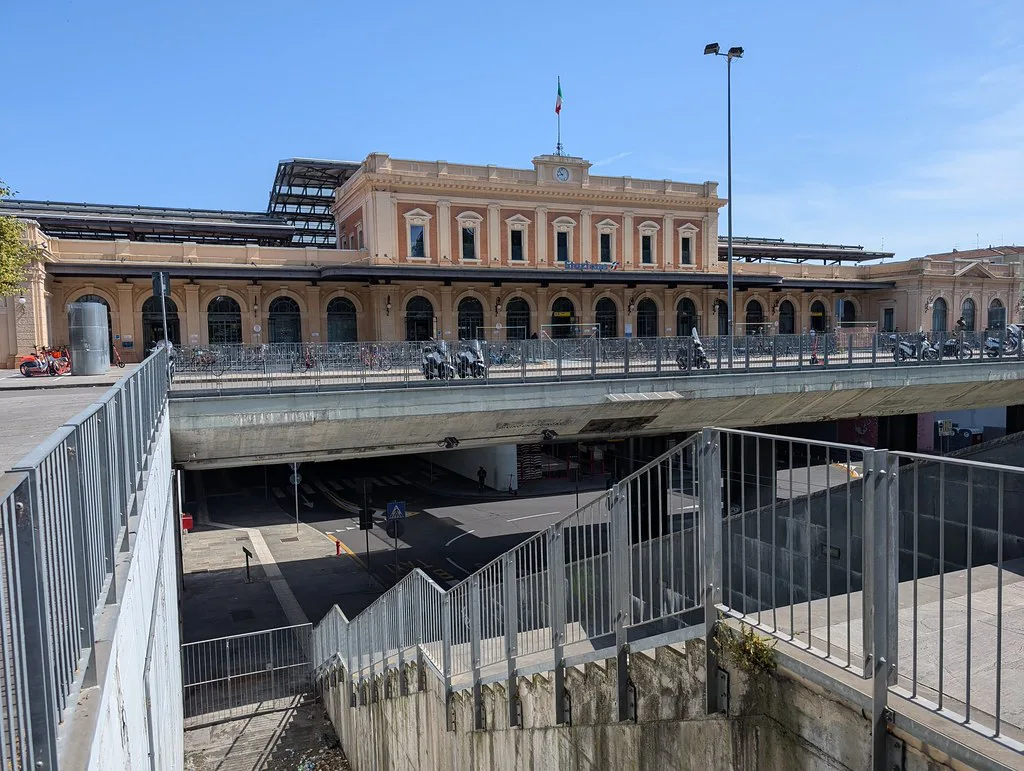
Travelling by rail removes the problem entirely, since Parma's station sits on the edge of the historic centre and the cathedral square is a short walk from it. Current operators, timetables and fares vary, so confirm them with the operator before you commit. For local transport and city information, start from the municipality's own pages rather than a third-party summary.
ZTL Reality Check: Restricted Zones and Cameras
Many Italian historic centres, Parma included, use a Zona Traffico Limitato: a restricted-traffic area where only permitted vehicles may pass. The boundary is marked by a red circle on a white background, and cameras record plates rather than relying on an officer at the entrance. The practical consequence is that a fine can arrive weeks after you have left Italy, long after you assumed the street looked harmless.
This is why a navigation instruction to turn down a very narrow side street deserves a second look. Drivers report exactly this moment in Parma: a tiny street that may or may not be restricted, no obvious sign, heavy bicycle and pedestrian traffic, and no easy place to turn around. The safer habit is to ignore the last stretch of a route into the core and park outside the boundary instead.
Do not expect one published map to answer every boundary question: entry points, hours and permit rules can differ from street to street. Check the municipality's pages or ask your accommodation which zone their address falls in before you drive to the door. If a hotel is inside a restricted area, ask them in advance how guests are meant to arrive, because that procedure is theirs to explain, not something to improvise at the barrier.
Walking the Historic Core
The centre is compact enough that the main sights form a single walk rather than a series of transfers. Piazza Duomo gathers the cathedral, the pink-marble Baptistery and the church of San Giovanni Evangelista within a couple of minutes of each other, and Piazza Garibaldi, the city's main square, works well as an orientation point for the rest of the day.
Piazza Garibaldi sits on the crossing of the old Roman streets and holds the Governor's Palace with its clock tower, which makes it a natural place to pause, check a map and pick a direction. From there the cathedral square and the Palazzo della Pilotta are both reachable on foot without a bus or taxi. Treat the square as your compass rather than a destination, and the day arranges itself.
Allow time for the surfaces as well as the sights: the centre is paved in stone, the streets between squares are narrow, and the walking is slow rather than long. Comfortable shoes matter more than a detailed route. Our suggestion is to pick two clusters per half day, not five, and let the distance between them be the pleasure rather than an obstacle.
Free Versus Ticketed Stops on Foot
San Giovanni Evangelista holds Correggio's earlier dome, painted before the cathedral's Assumption, and entry to the church itself is free. The cloisters and the historic Spezieria di San Giovanni pharmacy are managed separately, with hours that vary, so ask inside the church rather than assuming you can walk straight through. A suggested forty minutes covers the church; add more if the cloisters happen to be open.
The Baptistery and the Diocesan Museum are ticketed, and their passes are issued by the cathedral's own administration rather than shared across every church in the city. Because ticket structures and visiting hours change, check the current arrangements on the Piazza Duomo site before you go rather than relying on a guidebook figure. A combined pass only makes sense if you genuinely intend to see both interiors.
Beyond the cathedral square, the Palazzo della Pilotta complex holds a national gallery, an archaeological museum, the Palatine library and the wooden Teatro Farnese, and one ticket covers several of those collections. The theatre was rebuilt from fragments after wartime bombing and is worth timing your visit around. Confirm current days and any partial closures with the complex, since individual rooms can be shut independently of the rest.
For a slower afternoon, the Museo Glauco Lombardi near Piazza Garibaldi holds the Maria Luigia collection, including wedding gifts, portraits and her fortepiano. It is a small museum rather than a major gallery, which makes it a sensible stop when your legs need a rest between walks. Consult the museum's own contacts and tickets page for current admission details.
Driving and Parking Decisions
Driving into the core is rarely worth it. Central parking is hard to find, side streets are narrow enough that a car may barely fit, and much of the traffic you meet is on foot or two wheels. The rule that works: park outside the historic centre and walk in, accepting ten or fifteen minutes on foot in exchange for avoiding restricted zones and circling.
Parking tariffs, lot capacity and payment methods are set locally and change, so this guide does not quote rates. Look for signed car parks on the edge of the centre, read the tariff board at the entrance before you take a ticket, and photograph the sign if the terms are unclear. Alternatively, ask your accommodation which car park they recommend for their street, since they know the local one-way system.
If you are only in Parma for a day, consider leaving the car at the edge and treating the whole visit as a walk. That removes the risk of accidentally entering a restricted zone, removes the search for a space, and turns the centre into the pedestrian experience it is designed to be.
Day Trips Without a Car Commitment
The countryside around Parma holds several easy excursions: Colorno with its ducal palace, the medieval castle at Torrechiara, and Busseto, the Verdi country. Each is described as a short trip from the city, but this guide does not quote drive times, bus lines or train schedules, because those change and vary by operator.
For Busseto and the Verdi sites, the regional tourist board's itineraries are a sound starting point for what to see, and regional rail or bus operators will have the current connections. Check both before you set out, especially in low season. If you rely on public transport for a return leg, confirm the last departure at the station rather than assuming the timetable you found online is current.
A Suggested Half Day on Foot
This is our suggestion, not an official route. Start at Piazza Duomo in the morning, when the square is quieter, and give the cathedral and its Correggio dome the first hour. Step behind the cathedral to San Giovanni Evangelista for the earlier dome, then decide whether the cloisters and pharmacy are open before committing to that extra stop.
Cross to the Baptistery only if you want its interior, since the pink Verona marble exterior is visible from the square regardless. Walk from Piazza Duomo toward Piazza Garibaldi for a coffee and a look at the clock tower, then continue to the Palazzo della Pilotta for the gallery and the Teatro Farnese if the day allows. Pick one ticketed collection rather than all of them.
If you want a quieter second half, look beyond the obvious squares. A guide to the hidden gems in Parma will suggest corners that receive fewer visitors, and it pairs well with an unhurried afternoon. The point of a slow half day is depth, not coverage, and Parma rewards the traveller who stands still in one square rather than racing between five.
A Pre-Arrival Checklist
Before you leave, decide how you are arriving and whether a car is involved. If it is, note the A1 exit, plan to pay on the way off, and choose a car park on the edge of the centre rather than a street address inside it. If you are arriving by train, plan the walk from the station and pack accordingly.
Second, confirm the restricted-traffic status of your accommodation's street with the property directly. Third, look up current opening arrangements for the Baptistery, the Diocesan Museum and the Palazzo della Pilotta, and treat any figure you read elsewhere as a prompt to verify. Fourth, keep one free option such as San Giovanni Evangelista in reserve for the moment your plans change.
Finally, build in slack. Parma's centre is small, but the surfaces are uneven, the streets are narrow and the churches invite you to sit down. A plan with fewer stops and more time between them will serve you better than a tightly timed list, and it leaves room for the detours that make a slow visit worthwhile. For wider planning, see Parma Attractions: Visitor Guides to 11 Sights.
Plan Your Visit
Parma is an easy Italian city to move around precisely because you barely need to move: arrive, park at the edge, and walk. The two real decisions are the motorway exit and the restricted zone, and both are solved by slowing down before you turn rather than after. Everything else, from free churches to ticketed palaces, works itself out on foot.
Confirm current hours, ticket arrangements and transport connections with the operators before you travel, since these are the details that change most often. Treat every route, price and timetable in any guide, including this one, as a starting point to verify. Then leave the car, put the map away and let the squares do the rest.
Frequently Asked Questions
Do you need a car to get around Parma?
No. The historic centre is compact and the main sights sit a few minutes from one another on foot, so a car is a hindrance rather than a help inside the city. If you arrive by car, park at the edge of the centre and walk in; if you arrive by train, the station is close enough that you can continue on foot.
What is a ZTL in Parma and how do you avoid a fine?
A Zona Traffico Limitato is a restricted-traffic area where only permitted vehicles may pass, marked by a red circle on a white background and enforced by cameras rather than an officer at the barrier. To reduce the risk of a fine, do not follow a navigation instruction into a narrow street in the core, park outside the boundary, and ask your accommodation whether their address sits inside a restricted zone before you drive to it.
Is the historic centre of Parma walkable?
Yes. Piazza Duomo, with the cathedral, Baptistery and San Giovanni Evangelista, and Piazza Garibaldi are all reachable on foot within minutes of each other, and the streets between them are narrow and paved. Comfortable shoes matter more than a route plan, and a realistic half day covers two clusters rather than five.
Is San Giovanni Evangelista free to enter?
The church of San Giovanni Evangelista behind the cathedral is free to enter, while its cloisters and the historic pharmacy are managed separately with varying hours, so ask on site. The Baptistery and Diocesan Museum are ticketed; check the current passes on the Piazza Duomo administration's own site before you visit, because structures change.
How do you reach Parma by car from the A1?
Leave the Autostrada A1 at the Parma exit and pay the toll as you come off. The exits after the toll plaza sit close together, so decide your lane early; a wrong choice can put you back on the motorway heading the way you came, and exits are far apart. If you miss the turn, follow signs for the centre rather than improvising on the motorway.
Where should you park when visiting central Parma?
Park outside the historic centre and walk in. Central parking is scarce, side streets are narrow and restricted zones are camera-enforced, so a signed car park on the edge of the core is the safer choice. Read the tariff board before taking a ticket, and ask your accommodation which car park they recommend for their street.
Sources
- Homepage - Comune di Parma
- Do & See - Parma | ArrivalGuides.com
- Getting to Parma - the Hard Way • Travel Letter
- San Giovanni Evangelista, Parma: Correggio's Other Dome
- Literary itinerary in Parma and surrounding areas | Visit Emilia
- Museo Glauco Lombardi – Maria Luigia e Napoleone – Parma tra '700 e '800
- Piazza Duomo Parma - Cathedral, Baptistery, Bishop's palace
Continue exploring
More guides you'll find useful





