
Ferrara Viewpoints Guide: Castle Tower, City Walls and Renaissance Streets
A practical guide to Ferrara viewpoints: the Estense Castle's Lions' Tower, the 9 km wall circuit and the Addizione Erculea, with access conditions made clear.
On this page
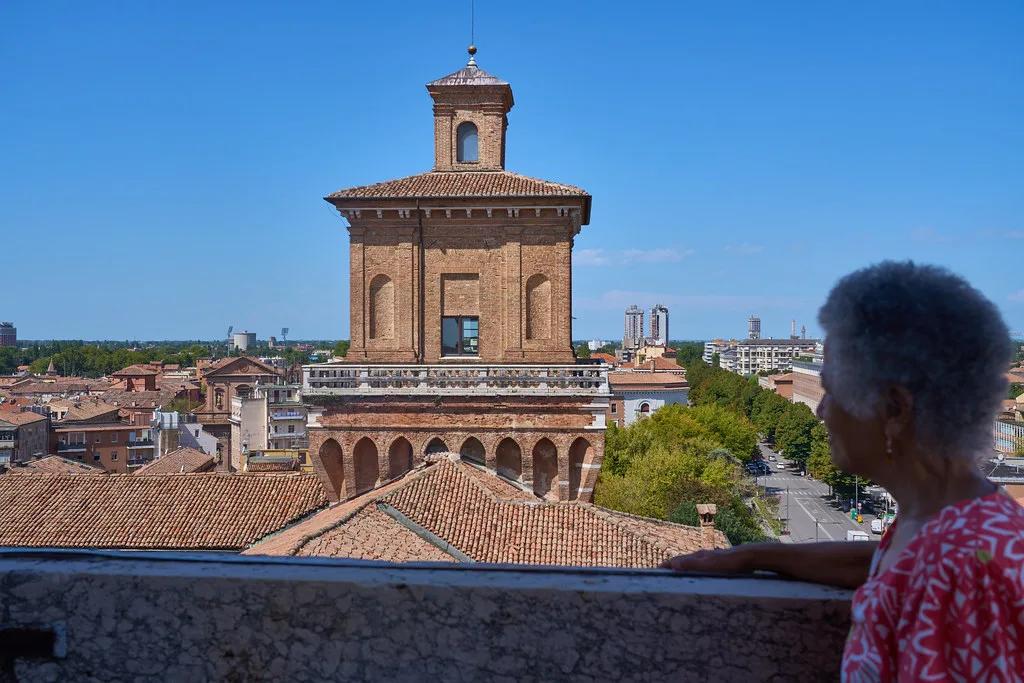
Ferrara is a city of horizontal views: long straight streets, low brick palaces and a flat plain that keeps the sky wide open. The most explicit vertical vantage point sits inside the Castello Estense, where the museum route ends at a panoramic lookout on the Lions' Tower, above the medieval rooms, basements, frescoed halls and Orange Garden. That single detail is worth planning around, because the tower view is one stop on a longer visit rather than a viewpoint you can buy separately.
This guide treats Ferrara's views in three layers: the moated castle at the centre, the nine-kilometre ring of sixteenth-century walls around the old town, and the broad Renaissance streets of the Addizione Erculea to the north. Each produces a different kind of view, and each has a different access rule.
How Ferrara's Three Layers Shape What You See
The medieval core is dense and irregular, with narrow lanes such as Via delle Volte running beneath brick arches. Views here are framed by buildings rather than opened up by them, which is why the castle, the cathedral square and the theatre courtyard matter so much as breathing spaces. Walking these streets is free, and the reward is architectural detail at close range rather than a panorama.
North of the centre, the Addizione Erculea added wide, straight streets and generous palaces at the end of the fifteenth century, and the city is often described as an early example of modern European town planning. That planning created the long sightlines visitors now photograph, particularly along Corso Ercole I d'Este. The third layer, the wall ring, is the only place where you can look back across rooftops and moats at the whole city edge.
Viewpoint 1: The Castello Estense and the Lions' Tower
The Estense Castle began as a fortress in the fourteenth century and later became the Este court's residence, standing in the middle of the city surrounded by a water-filled moat fed by the old Po channels. The museum circuit is the one place in Ferrara where a proper elevated panorama is built into a visit, ending at a vantage point on the Lions' Tower, after the medieval rooms, the basements, the frescoed halls and the Orange Garden. Allow generous time for the whole route rather than treating the tower as a quick photo stop.
The official operator site, castelloestense.it, is where current admission, opening times and any tower access restrictions should be checked. Third-party guides mention separate castle and tower-inclusive options but do not agree on details, and none of that should be treated as current. If climbing the tower is the reason for your visit, confirm first that the Lions' Tower lookout is open on your dates. Further visitor details appear in The Ferrara of the Grand Tour | Emilia Romagna Tourism.
Viewpoint 2: The Nine-Kilometre Wall Ring
The Mura di Ferrara form a circuit of roughly nine kilometres of sixteenth-century defences, with earthworks, moats, gates, bastions and towers encircling the historic centre. You can follow them on foot or by bicycle, starting conveniently near the Castello Estense. The walls are a public outdoor space rather than a ticketed monument, so this is the best value viewpoint in the city and the one that shows Ferrara's shape most clearly.
The practical decision is segment versus loop. A short stretch near the castle gives you a sample of the moat-and-bastion landscape without committing an afternoon, while the full ring suits cyclists and strong walkers. The terrain is flat throughout, which makes cycling realistic even for casual riders, though exposed sections offer little shade in high summer.
Viewpoint 3: Street-Level Views in the Addizione Erculea
Corso Ercole I d'Este is the spine of the Renaissance expansion, a broad avenue laid out under Duke Ercole I and celebrated by later poets for its austere, monumental character. Walking north from the centre, the street delivers the city's best urban-planning view: a straight line of palaces and gardens designed to impress. This is a view you experience at eye level, and it costs nothing.
At its northern end, Palazzo dei Diamanti presents a facade faced with thousands of diamond-cut marble blocks, built between 1493 and 1503. Morning light strikes the stone at an angle that makes the faceted surface read most clearly, and the surrounding streets are usually quiet before midday. The palace also houses the Pinacoteca Nazionale and hosts temporary exhibitions; the tourism portal lists such exhibitions generically, so check the palace's own site for what is on and whether a separate ticket applies.
Free Views and Paid Interiors: What Needs a Ticket
Much of Ferrara's best looking is free. You can walk around the castle's exterior and courtyards, cross Piazza Trento e Trieste in front of the cathedral, and pass through the oval courtyard of the Teatro Comunale known as Rotonda Foschini, which opens to the sky and is illuminated in the evening. The wall circuit is open outdoor space. None of this requires a museum ticket.
Paid entry applies once you go inside: the Castello Estense museum route, the frescoed halls of Palazzo Schifanoia, and the exhibition spaces at Palazzo dei Diamanti are separate sites with separate arrangements. Do not assume one ticket covers another. A local tourist card may exist and can be worth comparing against individual tickets, but its price and validity should be confirmed with the tourist office rather than assumed.
Sacred Interiors Worth Timing: Sant'Antonio in Polesine and Palazzo Schifanoia
Sant'Antonio in Polesine is the oldest continuously inhabited monastery in Ferrara, founded when Benedictine nuns arrived with Beatrice d'Este in 1257. Visitors are shown the nuns' choir, where frescoes from Giotto's school survive, and the visit takes in the cloister garden and the chapel holding Beatrice's relics. Entry is by free donation, and the monastery asks that groups be kept small, so phone ahead if you are more than a handful.
Palazzo Schifanoia is a different proposition entirely, with its own ticket and its own hours. Its Hall of the Months preserves seven of the original twelve sections of a vast fresco cycle by the leading painters of the Ferrarese school, arranged in three registers from court life to the zodiac. Standard opening is Tuesday to Sunday, with the ticket office closing before the museum does, and full admission is listed at twelve euros with reduced rates for younger and older visitors. Check the museum's own page before travelling, since hours can change.
Practical Shapes for a Viewpoint-Focused Day
For a half day, start at the castle in the morning, do the museum route including the tower lookout if it is open, then cross to Piazza Trento e Trieste and walk a segment of the walls before lunch. That combination gives you one elevated view, one square-level view and a taste of the perimeter without rushing. As a suggestion rather than an official schedule, this fits comfortably into three to four hours.
For a full day, add the Addizione Erculea walk up Corso Ercole I d'Este to Palazzo dei Diamanti in the morning light, then cycle the full wall ring in the afternoon. Ferrara is flat and compact, with the station about twenty minutes on foot from the castle, so a rented bicycle makes the perimeter realistic for most fitness levels. Spring and autumn give the most comfortable temperatures for exposed wall sections.
What to Skip or Reconsider
Rooftop bars are often recommended as viewpoint substitutes in Italian cities, but no reliable source confirms specific Ferrara venues, their locations or whether they are open. Treat any such recommendation as something to verify on arrival rather than plan around. Similarly, lift or wheelchair access to the tower is not documented in available sources, so travellers with mobility needs should contact the castle directly before buying a ticket.
Distant hill views do not belong to Ferrara: the city sits on a flat plain, and its panoramas come from towers, walls and long streets rather than elevation. If you want a wide landscape, the Po Delta lies beyond the walls to the east and rewards a separate excursion. Within the city, be realistic about what a tower climb delivers: a rooftop-level reading of the centre rather than an Alpine-style vista.
A Short Checklist Before You Set Out
Before leaving, check the Castello Estense operator site for current opening, admission and tower access, confirm Palazzo Schifanoia's hours on the museum page, and ring the nuns at Sant'Antonio in Polesine if you are bringing a group. Decide in advance whether you want the wall circuit as a short walk or a full cycle, since that choice shapes how much of the day remains.
Build the day around light and shade: morning for the diamond facade and the Erculean streets, late afternoon for the walls, and a museum interior for the middle of the day when the sun is strongest. If you have a second day, a Ferrara two day itinerary can absorb the remaining palaces and churches without turning the viewpoints into a tick-box exercise.
Frequently Asked Questions
Can you go up a tower in Ferrara for a city view?
The Castello Estense museum route includes a panoramic lookout at the top of the Lions' Tower, reached after the medieval rooms, basements, frescoed halls and Orange Garden. Because it is part of a larger ticketed circuit rather than a standalone viewpoint, plan enough time for the whole visit and confirm on the operator's site that the tower section is open on your dates.
Are the Ferrara city walls free to walk, and how long is the circuit?
The Mura di Ferrara form a circuit of roughly nine kilometres of sixteenth-century defences with earthworks, moats, gates, bastions and towers, and they function as public outdoor space rather than a ticketed monument. You can walk a short segment near the castle or cycle the full ring, which is realistic given the flat terrain.
Do you need a ticket for the Castello Estense, and what does it include?
Yes, going inside the castle requires a museum ticket, while walking around the exterior and courtyards does not. The route covers the medieval rooms, basements, painted halls, the Orange Garden and the Lions' Tower lookout. Current prices, hours and any restrictions should be checked on the official operator site before you travel.
Which Ferrara sights are free to enter and which charge admission?
The castle exterior and courtyards, the cathedral square, the Rotonda Foschini passage and the wall circuit cost nothing to see. Paid entry applies at the Castello Estense museum, Palazzo Schifanoia and the exhibition spaces at Palazzo dei Diamanti, which are separate sites with separate arrangements. Sant'Antonio in Polesine asks for a free donation rather than a ticket.
Sources
Continue exploring
More guides you'll find useful





