
Free Things to Do in Ferrara: Walls, Churches & Squares
Plan a low-cost day in Ferrara with free walls, squares and church exteriors, plus honest notes on which museum tickets and donations you actually pay.
On this page
Ferrara is unusually generous to a small budget. Its historic centre is compact and flat, the old walls form a continuous circuit around it, and the streets are lined with palaces whose exteriors you can study without buying anything. The trick is knowing which thresholds are free to cross, which ask for a donation and which belong to ticketed museums.
This guide works through the city on foot, from the walls and cathedral square to the quieter lanes and cloisters, and flags where prices or hours need checking before you set out. Where an entry is paid, it also notes the visitor categories that get in free. For a wider look at the corners most day-trippers skip, see our guide to the hidden gems in Ferrara.
Why Ferrara Suits a Free or Low-Cost Visit
The city's UNESCO World Heritage status covers the historic centre and the surrounding cultural landscape, not a single ticketed monument, so most of what makes Ferrara distinctive is public space. You can spend a satisfying morning circling the walls, crossing the cathedral square and walking the Renaissance grid without paying an entrance fee.
Budget planning here is mostly about three separate categories rather than one price list. Streets, squares, the walls and the exteriors of palaces and churches are open to everyone; the monastery of Sant'Antonio in Polesine welcomes visitors for a donation; and the civic museums charge admission, with free entry limited to particular visitor categories. Treating each on its own terms avoids the mistake of assuming that one ticket, or one free pass, covers everything.
The Walls: A Nine-Kilometre Free Circuit
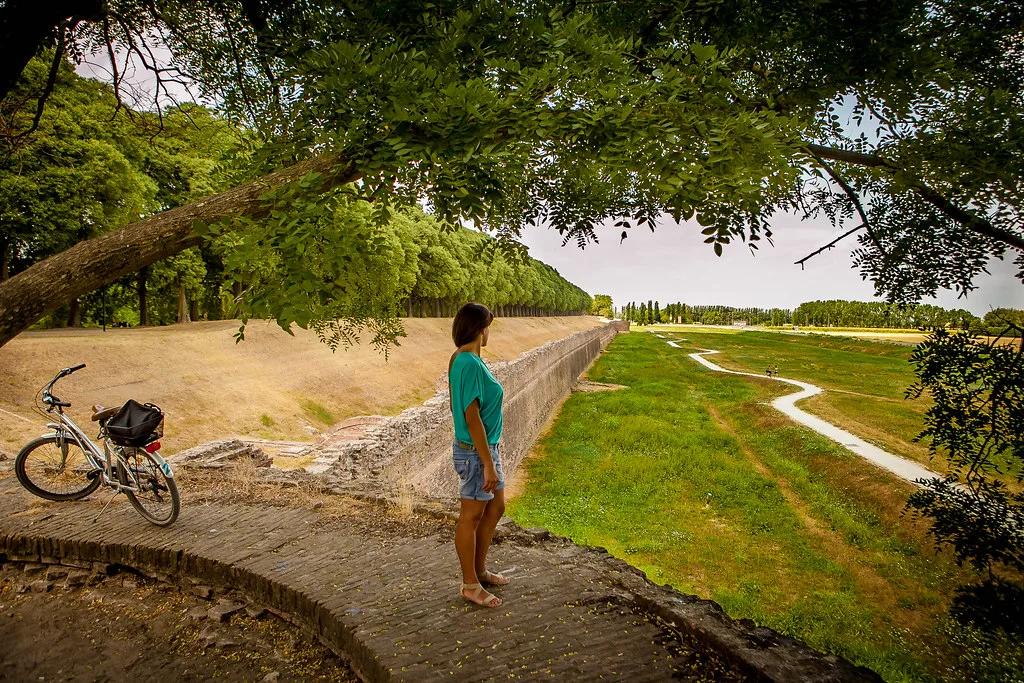
Start with the walls, because the history of the city begins there. Nearly nine kilometres of ramparts enclose the old centre and its monuments, and they can be enjoyed on foot or by bicycle. Plan a section rather than the whole loop if you are short of time, and keep in mind that a bicycle turns the complete circuit into a manageable outing.
The appeal is not a single viewpoint but the change of perspective: brick ramparts on one side, treetops and the roofs of the centre on the other, and gateways that punctuate the route. Because the circuit is public, it works at any hour you feel comfortable walking, which makes it a good early or late option. Allow more time than you expect, since the distance is real and the surfaces vary.
Piazza Trento e Trieste and the Cathedral Exterior
The cathedral dedicated to Saint George sits at the heart of the city, its facade mixing Romanesque solidity with Gothic detail after centuries of reworking. In practice, budget your time and attention for the square and the exterior: the state of the interior has changed with restoration work, and current access should be confirmed rather than assumed. The tourist information office can tell you what is open on the day you visit.
The square itself is free theatre. Market stalls have pressed against the cathedral, and the surrounding cafés make a natural pause. If you want to spend money, do it on a coffee and a seat rather than an entrance fee, and let the architecture do the work.
The Civic Heart: Municipio, Volto del Cavallo and the Clock Tower
Walk through from the cathedral side to the Palazzo Municipale, the Este family's first residence in the city before their later additions. You pass the Volto del Cavallo, the main entrance framed by statues on Roman columns, and reach the small, enclosed Piazza del Municipio with its arcades and cafés. None of this passage costs anything, and it is one of the city's best free sequences.
Nearby, the Torre dell'Orologio rises over Piazza Trento e Trieste with two flanking arches for vehicles, a seventeenth-century landmark that frames the square. Look up often in this part of town: the details, the staircases and the layers of building are the attraction, not a box to tick. The nearby Torre della Vittoria, rebuilt in the 1920s on a much older site, is another free landmark on the skyline.
The Addizione Erculea: Diamanti, the Quadrivio and Parco Massari
North of the medieval centre, the Addizione Erculea is the Renaissance expansion that earned Ferrara its reputation as an early example of planned town design. Broad, straight streets were laid out with palaces, churches and gardens, and the crossing known as the Quadrivio degli Angeli was intended as its focal point. The district is still residential and working, which is precisely why a slow walk feels rewarding.
Palazzo dei Diamanti is the set piece: a facade of thousands of pale stone blocks carved into pyramid shapes, built at the end of the fifteenth century for Biagio Rossetti's scheme. You can admire it from the street for nothing, but the collections inside, including the Pinacoteca Nazionale, are a paid visit with their own ticket. Do not assume that the palace, the gallery and the nearby museums share one entry.
For a free pause, Parco Massari sits between the Diamanti area and the Certosa, with large trees and a fountain, and it is the sort of place where a packed lunch makes sense. The neighbouring botanical garden is a small, quiet detour if you like plants. Neither is a blockbuster sight, and both give a low-cost day some breathing room.
Via delle Volte and the Medieval Lanes
Via delle Volte is Ferrara's most atmospheric street: a narrow medieval lane threaded with arches and suspended passages, once linking warehouses to small artisan workshops. It costs nothing to walk and asks only patience, since the surface is uneven and the light is often in shadow. Go slowly and look up at the brickwork rather than treating it as a route from one sight to another.
The surrounding lanes toward the old Jewish quarter and the streets near the cathedral repay the same unhurried approach. Pastel facades, small workshops and ordinary doorways are the texture of the city, and wandering without a fixed map is a legitimate way to spend a free hour. It is not a secret or a locals-only zone; it is simply the city's everyday fabric.
Sant'Antonio in Polesine: Low-Cost, Not Strictly Free
Sant'Antonio in Polesine is the oldest continuously inhabited monastery in Ferrara, founded in 1257 for Beatrice d'Este and the women who followed the Benedictine rule with her. A visit takes you through the ancient cloister, past the tomb of Beatrice, and into the nuns' choir, where the side chapels preserve frescoes of the Giotto school. For a city famous for Renaissance painting, these fourteenth-century survivals are rare and worth planning around.
Entry is by free donation rather than a fixed ticket, so this is a low-cost stop, not a guaranteed free one. The monastery publishes restricted visiting windows, with mornings and afternoons on weekdays and a Sunday afternoon slot. Those times are the ones published at the time of writing, so confirm them before you travel.
Groups are kept small, reportedly to a maximum of about fifteen people, and phone reservation is recommended, which matters if you are travelling as a family or a party. Access is not fully straightforward: sources conflict on wheelchair accessibility, so anyone with mobility needs should call ahead and ask about the specific route through the cloister and choir.
Civic Museums: What You Actually Pay
Palazzo Schifanoia is the great set piece on the paid side. Its Hall of the Months, painted by Cosmè Tura, Francesco del Cossa and Ercole de' Roberti, is one of the defining secular fresco cycles of the Renaissance, and the museum route was rebuilt after the 2012 earthquake. Expect a ticket: standard hours run Tuesday to Sunday, and the full and reduced prices are published on the museum's own page rather than fixed across the city.
Free admission at Schifanoia is category-based, not a general free day: under-eighteens, school groups with teachers, disabled visitors with a companion, licensed guides, journalists, first-year University of Ferrara students and MyFE Card holders are among those listed as free. MyFE is Ferrara's tourist card, sold at some museum ticket desks, and a separate purchase rather than a citywide pass. Always check the current list before relying on it.
Palazzina Marfisa d'Este is the other beautiful paid interior, built around 1559 for Francesco d'Este and later home to his daughter Marfisa, who stayed in Ferrara after the city returned to papal rule in 1598. It opens Tuesday to Sunday with a midday break, last admission thirty minutes before closing, and its own ticket. Free entry is again reserved for particular categories, including under-eighteens, birthday visitors, guides, disabled visitors with a companion and first-year University of Ferrara students.
Rotonda Foschini, Courtyards and the Certosa
The Rotonda Foschini, tucked behind the Teatro Comunale, is a small oval courtyard that once received visitors arriving by carriage. It is free to step into, and the curved walls and archway to the church of San Carlo make it one of the most photogenic corners in the centre. It is a five-minute pause rather than a destination, which is exactly how to treat it.
For a quieter detour, the Certosa di Ferrara began as a Carthusian monastery in 1452 and became a monumental cemetery after monastic life ended in 1813. Its arcades, cloisters and carved tombs are free to walk through, and it rewards a slow, respectful visit away from the busiest streets. Dog owners should note that pets are not allowed at Sant'Antonio in Polesine, so plan that stop separately.
The castle itself anchors the centre: a moated brick fortress built for the Este family in 1385, later their residence. Walking around the moat and through the courtyards costs nothing, and it is one of the city's great free pleasures. The interiors and towers are a separate, paid visit, so treat the exterior as the free part of the castle experience.
Practical Planning for a Free Day
Book what you can in advance and confirm the rest. Sant'Antonio in Polesine takes small groups with phone reservation recommended, while Palazzina Marfisa d'Este suggests free booking for individuals and groups and has formal arrangements for out-of-hours group visits. Civic museum hours can change with exhibitions and restoration, so check the museum pages and the city's tourism information before setting out.
Build your day around walking, with a bicycle as the upgrade for the walls. Ferrara is flat and the centre is compact, and the stations of a free itinerary — walls, cathedral square, Via delle Volte, the Diamanti district, Parco Massari — sit close enough together to combine. Keep one paid museum or one donation visit as the anchor, and let the rest of the day be streets and squares.
For more on individual sights, including the castle and the Schifanoia frescoes, see our Ferrara Attractions hub, which gathers guides to specific monuments in one place.
Plan Your Free Ferrara Day
Ferrara is best understood as a city you walk through rather than a list of tickets. The walls, the cathedral exterior, the civic squares, the Diamanti streets and the medieval lanes give you a full day of looking for nothing more than the cost of getting there and a coffee.
Spend where it counts: a donation at Sant'Antonio in Polesine, or a ticket to Schifanoia or the Palazzina Marfisa d'Este if the paintings matter to you. Check published hours and free-entry categories before you go, and treat any older price or schedule you find online as out of date until the museum confirms it.
Frequently Asked Questions
What can you see in Ferrara for free?
The city walls, the cathedral exterior and square, the courtyards around the castle, the Volto del Cavallo and Piazza del Municipio, Via delle Volte, the Diamanti district streets and Parco Massari are all free to explore. The Rotonda Foschini courtyard and the Certosa cemetery are also free to enter. Paid interiors and museum collections are separate.
Is the cathedral in Ferrara free to enter?
Do not assume so. The cathedral has been through long restoration work, and current interior access is not confirmed. Plan around the Romanesque-Gothic facade and the square, and ask at the tourist information office for the day's situation before counting on going inside.
Is Sant'Antonio in Polesine free or by donation?
Entry is by free donation rather than a fixed ticket, so it is low-cost rather than strictly free. Visiting is limited to published windows, groups are kept small, and phone reservation is recommended. Confirm the current hours before you go.
Which Ferrara museums are free and for whom?
Free admission at the civic museums is category-based rather than a general free day. At Schifanoia and Palazzina Marfisa d'Este, under-eighteens, birthday visitors, licensed guides, disabled visitors with a companion and first-year University of Ferrara students are among those listed, along with MyFE Card holders at Schifanoia. Check the current list before relying on it.
Can you walk the Ferrara city walls for free?
Yes. The ramparts form a public circuit of nearly nine kilometres around the old centre and can be walked or cycled at no cost. Plan a section if you are short of time, and allow more than you expect because the distance is real.
Is Ferrara worth visiting on a budget?
Yes. Much of what defines the city is public: the walls, the squares, the Renaissance street grid and the exteriors of palaces and churches. Add one donation visit or one paid museum and you have a full, inexpensive day without feeling you have missed the point.
Sources
Continue exploring
More guides you'll find useful





