
Bolzano Neighbourhoods Guide: Where to Stay for First-Timers
Compare Bolzano's old town, Gries and nearby districts by atmosphere and walkability, so first-time visitors can choose the right base for a slow city stay.
On this page
Bolzano does not announce itself the way Rome or Berlin does, which is precisely why the district you choose shapes the trip. The historic centre, Gries across the river, Rencio toward the mountains and the station side each set a different daily rhythm, and a first-timer who books blind can end up with the wrong one for their style. As a quick benchmark, the resident-authored Bolzano guide suggests allowing about 60 to 90 minutes for the Oswald Promenade loop, a walking suggestion rather than an official timing. This comparison judges districts by atmosphere, convenience and general cost character, and deliberately avoids nightly rates.
Start with the official visitor site, which lays out the city's mix of porticoes, museums, castles, cycle paths and cable cars in a few clicks. From there the choice becomes almost geographic: stay inside the arcades for maximum convenience, cross to Gries for a broader street feel, or base on the mountain edge if cable-car mornings matter more than evening piazzas.
Quick Orientation: How the Districts Sit Together
Bolzano is compact enough that orientation is simple once you accept one fact: the Talvera river is the real dividing line. The Centro Storico, with its porticoes and main squares, sits on the eastern bank; Gries lies across the water to the west, and the station area anchors the southern approach to the centre. Rencio sits on the eastern edge toward the mountains, near the Renon cable car.
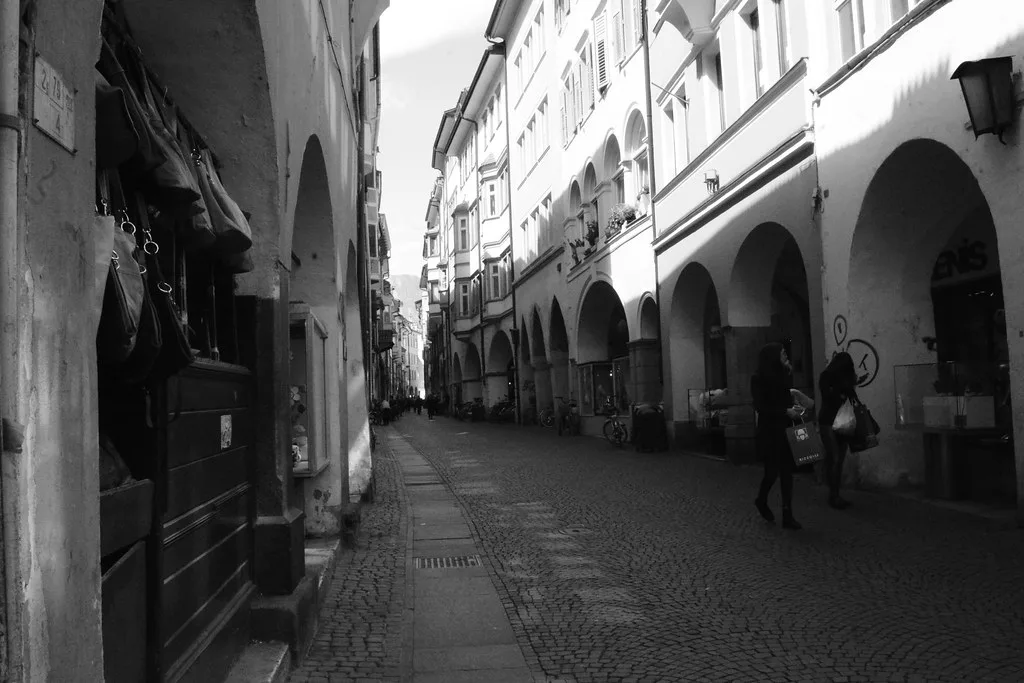
That geography means the core is largely reachable on foot, and the practical question is not distance but texture. Someone who wants to step out of a doorway into arcades and coffee bars will feel at home in the centre, while a traveller who prefers wider pavements and fewer crowds will gravitate across the Talvera. A personal city guide by a resident captures the same split, describing cobbled streets and pastel buildings in the old town before crossing the river into a streetscape the author calls monumental, hotter and louder.
Centro Storico and Portici: The Walking-First Base
The old town is the obvious first stay, and for a short trip it is hard to beat. Arcaded streets, markets and pastel facades put the day within a few steps of the door, and the city's own tourism pages build their visitor offer around porticoes, museums and castles. If your Bolzano is a two-night stop between trains, the centre removes most transport decisions from your morning.
The trade-off is being in the thick of visitor traffic. The same walkable core that makes the centre convenient also means noise, busier pavements and the sense of staying inside the postcard rather than beside it. Light sleepers should ask about room position rather than assume, and anyone sensitive to summer crowds may prefer to sleep a short walk away and visit the arcades by day.
Gries and the Far Side of the Talvera
Crossing the Talvera changes the mood more than the map suggests. Gries has a broader streetscape that reads differently from the medieval tangle of the centre, and the resident guide notes that the architecture shifts once you are over the river, with streets that feel hotter and louder in high summer. Treat that as one visitor's descriptive impression rather than an architectural verdict.
For planning purposes, Gries works as a calmer-feeling counterpart to the centre: still urban, still walkable into the old town, but removed from the immediate tourist flow. It suits travellers who want to sleep outside the busiest lanes while keeping the centre within a stroll, and the river promenade gives a natural route between the two banks.
Rencio and the Mountain Edge
Rencio makes the strongest case for anyone who wants nature within easy reach of a city bed. The Renon cable car rises from this side of town, and the same resident guide describes a cable car ride up to a plateau with panoramic loop trails, lunch stops and mountain gardens. If your ideal day is a morning walk above the city followed by an afternoon in the arcades, this is the district that cuts out the commute.
The reverse trade-off applies to evenings. Rencio is a quieter residential edge rather than a dining quarter, so dinners and people-watching usually mean heading back toward the centre. Book here if the mountains are the point of the trip and the city is the supporting act, not the other way around.
Station Side and Modern Bolzano
The area around the station and the newer city is the pragmatic choice. Arrivals by train step out into a walkable grid, and the centre is close enough that logistics never dominate the day. It is the base to pick for a late arrival, an early departure toward the Brenner corridor, or a trip where the hotel matters less than the ease of moving.
Accommodation portals group Bolzano's stock by practical categories rather than by district, sorting options by family suitability, pools, luxury amenities and proximity to the airport. Read those filters for what they are, and use them to shortlist candidates before checking the exact street on a map.
Budget Character Without Nightly Rates
The centre is not automatically the most expensive place to sleep, and the outskirts are not a budget guarantee. What varies more reliably is character: old-town addresses tend to charge for location and atmosphere, Gries and the station side often trade a few minutes of walking for calmer surroundings, and Rencio reflects views and cable car access as much as room size.
The honest method is to compare like with like on the booking platform of your choice, checking the same dates across districts and filtering by what you actually need. The city's tourism site also publishes information offices and practical visitor services, which is the right place to confirm local details before you commit.
Walkability and Everyday Rhythm
A day of wandering in Bolzano covers more ground than first-timers expect, because the core is flat and compact. Markets, bakeries and the porticoes form a natural loop, and the resident guide maps a version that includes organic produce stands, an old household-goods shop, local food stores for gifts and a family bakery worth a detour.
For a half-day outside the streets, the Oswald Promenade is a gentle loop through vineyards that returns you to the old town, and the same guide cautions that it gets very hot in June, July and August and suggests spring or autumn instead. That is a concrete reason to plan exposed walks for the shoulder seasons and to save summer for shaded arcades or the cooler plateau. You can read more about it in our hidden gems in Bolzano guide.
Matching the District to Your Trip
Families usually do best near the centre or the station side, where short walks and easy returns to the room matter more than a view. Couples often lean toward the old town for evening atmosphere or toward the mountain edge for early trails. Solo travellers who want company and convenience will find the porticoes easiest, while those who want a quieter base will prefer crossing the Talvera.
Whichever you choose, plan around the city's four-season identity rather than a single highlight. The tourism site frames Bolzano as a year-round destination with events, wine and cycling in every season, so a repeat visit in a different month can justify a different district.
Arrival Notes Worth Verifying
Most visitors arrive by train, and the central station is walkable to the old town, which is a strong argument against renting a car for a city stay. Drivers use the Brenner motorway, and the resident guide advises that once you are in town a car is only useful for mountain day trips, not for getting between districts.
Bolzano has a small airport served by a local airline whose flights the same guide describes as seasonal and booked directly rather than through big comparison sites. Schedules and fares change constantly, so confirm them with the airline before building a trip around a flight.
Mistakes First-Timers Make
The most common error is treating Bolzano as a quick stop between Verona and the Dolomites. The city rewards a full day of wandering, and staying overnight in the old town turns a station pause into an evening among the arcades. A second mistake is assuming a car is needed: the centre is walkable and the station is central, so a rental only earns its keep for out-of-town mountain days.
A third is underestimating summer heat on exposed routes. The promenade and plateau walks are at their best outside the hottest weeks, and a plan that puts sun-exposed walking at midday in July will feel very different from the same route in October.
A Simple Decision Framework
For a first visit of two or three nights, choose the Centro Storico: it maximises what you can see on foot and removes transport from the equation. For a nature-focused stay, base near the mountain edge and use the cable car as your daily commute upward. For a longer, calmer trip or a late arrival, the station side and Gries offer practical alternatives with a different feel. For wider planning, see Bolzano Attractions: Visitor Guides to 13 Sights.
Plan Your Visit
Pick the district that matches your days rather than the hotel brand: arcades for a short first trip, the river's far bank for calm, the mountain edge for trails, and the station side for logistics. Verify current details on the city's official visitor pages and with your accommodation before booking, since practical information changes with the season.
Whichever base you choose, leave room for the slow version of Bolzano: a market morning, an afternoon under the porticoes and a walk that ends with a view. The city rewards that pace more than a checklist. For related planning, see Gries Quarter Guide, Bolzano: Abbey, Wine Streets & Old Town Contrast.
Frequently Asked Questions
Where is the best place to stay in Bolzano for a first visit?
For most first-timers the Centro Storico is the simplest choice, because the arcades, markets and main sights sit within walking distance and the station is close by. If you want a quieter feel, Gries across the Talvera keeps you near the centre with calmer surroundings, while the mountain edge suits travellers who prioritise the Renon cable car and plateau walks.
Is the old town or Gries better for a short stay?
The old town wins for a short stay, since limited time is best spent on foot among the porticoes rather than crossing the river. Gries makes more sense on a longer trip, when a calmer base and a riverside walk into the centre become a pleasure rather than a detour.
Do you need a car to explore Bolzano's neighbourhoods?
No. The centre is compact and walkable, the station is central, and districts like Gries are reachable on foot or by city transport, with the Renon cable car serving the plateau above. A car is mainly useful for day trips into the surrounding mountains, not for moving between neighbourhoods.
Is Bolzano more Italian or German?
Bolzano is genuinely bilingual, with Italian and German both present in street signs, menus and daily life. The city's tourism site describes an authentic cultural mix where past and future, nature and urban life coexist, which is a more useful way to think about it than assigning one national identity.
Why can Bolzano feel expensive?
Bolzano sits in a prosperous alpine region with strong wine and tourism sectors, and central addresses charge for location and atmosphere. Comparing the same dates across districts, rather than assuming the centre is always priciest, is the practical way to judge whether a given option is good value.
Which base suits a nature-focused visit?
The mountain edge of the city, where the Renon cable car begins, suits travellers whose priorities are plateau trails and views; evening plans will usually mean heading back toward the centre. For a mixed city-and-mountains trip, the old town keeps the arcades on your doorstep and the cable car within reach.
Sources
Continue exploring
More guides you'll find useful





