Città Bassa Bergamo Guide: Lower Town Streets and Sights
Plan a walk through Città Bassa, Bergamo's modern lower town: Porta Nuova, the Sentierone, Piazza Dante, the historic borghi and the funicular to Città Alta.
On this page
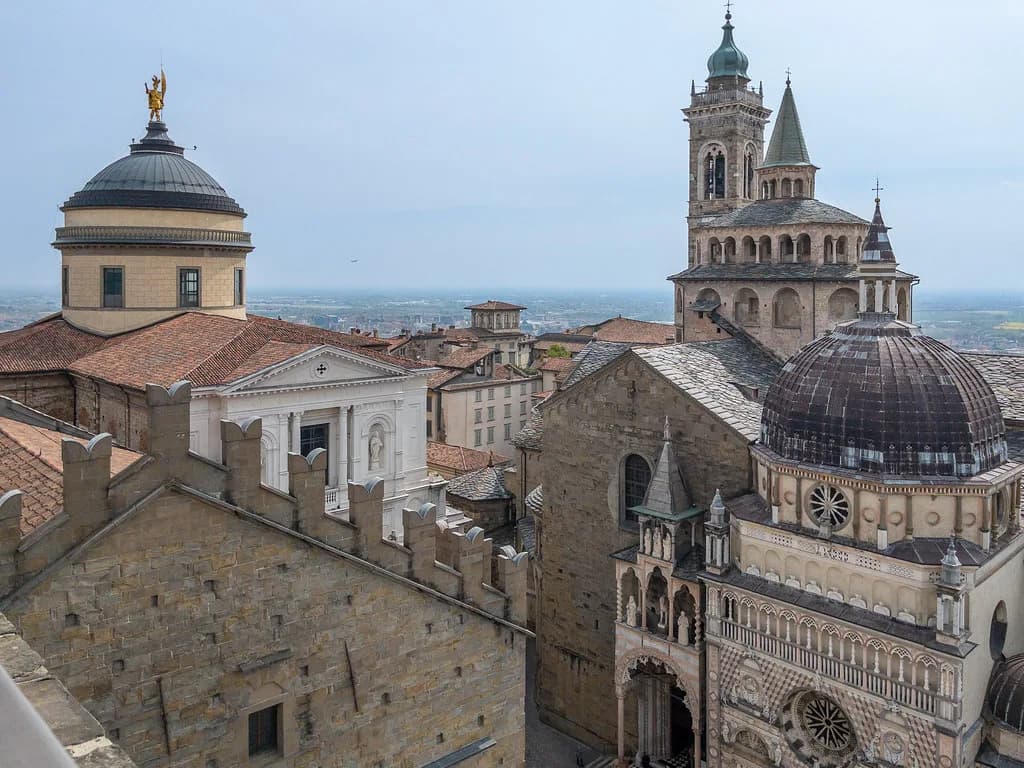
Bergamo is really two cities stacked on one map. Città Alta is the walled medieval heart on the hills, while Città Bassa is the modern, flat town that developed between the 19th and 20th centuries, built around wide avenues, arcaded squares and Art Nouveau facades.
Most visitors treat the lower town as a corridor between the train station and the funicular, which is a mistake. Its central point is Porta Nuova, the everyday fulcrum of Bergamo life, and the streets around it hold the Donizetti Theater, the Accademia Carrara, a cluster of historic borghi and one of the best shopping grids in Lombardy.
This guide treats Città Bassa as a destination in its own right, then shows how to fold it into a day that also climbs to the upper town. Treat every walking time here as a suggestion rather than an official figure, and confirm site hours and access on official sources before you set out.
Orientation: How the Lower Town Wraps Around the Upper Town
Città Bassa spreads around the hills of Città Alta, so the two halves are physically interlocked rather than side by side. The lower town's flat grid of tree-lined avenues and broad squares contrasts sharply with the upper town's cobbled alleys, Venetian Walls and medieval monuments, which is exactly why the pair works so well on foot.
Think of Porta Nuova as your anchor. It is the lower town's true centre and the point where the station axis, the Sentierone promenade and the shopping streets all converge, making it the simplest place to start, pause or change direction.
Beyond the centre, five historic borghi branch outward from the upper town like fingers of a hand, each with its own character. Treat them as optional extensions: Borgo Pignolo sits closest to the art museums, while Borgo Santa Caterina and Borgo Palazzo stretch further out toward the valleys and the plains.
A Suggested Half Day, Not an Official Route
A comfortable suggestion is to give Città Bassa a relaxed half day of walking, without counting stops, and to reserve the rest of the day for Città Alta. That split lets you see the lower town's squares and churches properly while still reaching the hilltop before energy runs out; the lower town is flat and easy to cross, but the upper town rewards slow wandering.
A sensible order runs from the station down Viale Papa Giovanni XXIII to Porta Nuova, west along the Sentierone and Piazza Dante, then into Borgo Pignolo for the art museums, finishing at the funicular. If time is short, cut the borghi first and keep the central spine, which holds the densest concentration of sights.
Since this timing is a personal planning suggestion rather than a published itinerary, use it as a frame and adjust to what is actually open. The city publishes its event calendar and civic notices separately, so check current listings before locking in a day built around a specific venue.
The Central Spine: Viale Papa Giovanni XXIII and the Sentierone
Viale Papa Giovanni XXIII is the main street of lower Bergamo and the central axis linking the train station to Porta Nuova, lined with shops, cafes and restaurants. Arriving by train, you effectively step off the platform and onto the promenade route, which makes the lower town the natural first chapter of any Bergamo visit.
The Sentierone is the elegant pedestrian boulevard at the heart of the city's promenade, framed by historic stores, cafes and restaurants. On Sunday mornings Bergamaschi stroll here, stopping for a cappuccino and a pastry under the arcades before browsing shop windows, so it is a good place to absorb local rhythm rather than rush through.
The surrounding blocks form the Piacentinian Centre, an architectural complex designed in the early 20th century by the Roman architect Marcello Piacentini. Knowing the name helps you read what you are seeing: this is planned, monumental modern Bergamo, not accreted medieval fabric, and the geometry is the point.
Piazza Dante and the Torre dei Caduti
Piazza Dante was recently renovated and now functions as one of the centres of city life and nightlife, its balanced geometries overlooked by the Prosecutor's Office and the Chamber of Commerce buildings. In the middle stands the Triton Fountain by Gian Battista Caniana, a good orientation point if you are meeting someone in the lower town.
Beneath the square lies the former Albergo Diurno, which began as an air-raid shelter and later became a popular meeting place before being recovered as a cultural and recreational hub. It is an unusual layer of 20th-century history hidden directly under a busy public square, and worth knowing about even if you only pass over it.
Next door, the adjacent square named for Vittorio Veneto is dominated by the Torre dei Caduti, a monument to the memory of the First World War. Inside, the staircase to the viewing terrace tells the story of the Piacentinian Centre, and the view from the top takes in the lower town laid out beneath you.
Culture Stops in and near the Centre
The Donizetti Theater is the city's historic 19th-century opera house and a cultural landmark of the lower town, named for the composer born in Bergamo. Even if you are not attending a performance, its presence explains why the surrounding streets feel like a civic centre rather than a shopping district.
The Church of Ss. Bartholomew and Stephen holds an altarpiece by Lorenzo Lotto, an important artistic testimony that rewards a short detour. Churches in Italy are typically free to enter but may restrict access during services, so treat any visit as a quiet, respectful stop rather than a ticketed attraction.
The Cloister of Santa Marta is a hidden 14th-century jewel with works by Giacomo Manzù, tucked into the fabric of the lower town. Because small cloisters and church interiors often keep limited or seasonal opening, check locally or with the tourism office before building a walk around one.
Art beyond the Centre: Accademia Carrara and GAMeC
Two prominent art museums sit in Borgo Pignolo: the Accademia Carrara and GAMeC, holding collections that run from Renaissance masterpieces to contemporary art. Pairing them in one visit lets you move from gold-ground panels to current practice within a short walk, which is rare in a city of Bergamo's size.
These are ticketed museums, and each has its own admission arrangements, so do not assume one ticket covers both. Prices, opening days and any combined offers change, so confirm them on each museum's official page before you travel rather than relying on older listings.
Borgo Pignolo itself is the noble village of the lower town, with ancient buildings, fine crafts and art galleries. That makes the museum quarter a natural extension of the walk rather than a separate excursion, and it is where the lower town's slower, more crafted side shows through.
The Historic Borghi: Six Characters, One City
Borgo Pignolo is the aristocratic quarter, San Tomaso links the centre to the Seriana and Brembana valleys, and Borgo Santa Caterina, also known as the Borgo d'Oro, has been nominated as one of Italy's most beautiful villages. Each borgo has a distinct personality, so pick two rather than trying to tick off all of them.
Borgo San Leonardo, clustered around Piazza Pontida, is the city's cult spot and the natural place for an evening aperitivo. Borgo Sant'Alessandro unfolds below the gate of the same name and leads straight into the heart of the shopping district, while Borgo Palazzo splits around Piazza Sant'Anna into a traditional half and a more multiethnic one.
For a compact walk, follow Borgo Sant'Alessandro downhill from its gate into the shopping streets, then loop back through Piazza Pontida as the city shifts into its evening mood. That route keeps you close to the centre while still showing how varied the lower town's neighbourhoods are.
Shopping: The Fashion Quadrilateral and Beyond
Between Via Sant'Alessandro, Via Borfuro, Via Sant'Orsola and Via XX Settembre lies what is known as the Bergamasque fashion quadrilateral. Here you find both big international chains and more sophisticated independent stores, which makes it the most efficient area to browse if fashion is your goal.
Shopping also spreads along Via Tiraboschi, Via Tasso and Via Pignolo, continuing as far as Via Borgo Santa Caterina and Via San Tomaso. Choose your streets by purpose: the quadrilateral for fashion, the wider network for historic shops and artisan workshops where handmade goods are still sold.
Bergamo's shopping identity leans heavily on family-run historic stores and craft workshops tied to the area by birth or vocation. If you want something beyond high-street labels, look for these older shopfronts around the borghi rather than in the newer central arcades.
Connecting to Città Alta by Funicular
A historic funicular railway quickly connects the two parts of the city while offering an atmospheric panoramic ride on the way up. It is the easiest way to move between the flat lower town and the hilltop, and the ascent itself is part of the experience rather than just transport.
Fares, operating hours and frequency change and are not fixed in general guidebooks, so check the current details on the operator's or city's official pages on the day. Arriving at the lower station outside busy periods improves your chances of a window view without changing your route.
The funicular also makes a neat full-day structure possible: walk the lower town in the morning, ride up for the upper town's medieval streets, then descend on foot through the walls if you prefer to earn the views. Plan the uphill leg early, since the upper town rewards time more than the lower town does.
Practical Planning: Verify Before You Go
Opening hours, ticket prices and temporary closures for museums and churches change with the season, and no static guide can keep pace. Note the two or three places you care most about, then confirm their current access on official sources a few days before arrival, including whether interiors are ticketed separately from grounds.
The city runs a busy calendar of exhibitions, concerts and civic events, so it is worth checking the municipal events listings alongside the tourism board's pages. That also tells you whether a street or square you planned to cross is hosting something on your dates.
As a general orientation, the tourism board's main site bundles sights, experiences and transport guidance in one place. Use it to confirm details rather than as a fixed schedule, and remember that seasonal experiences are listed with specific validity periods that may already have passed.
Plan Your Visit to Città Bassa
Città Bassa deserves more than the ten minutes most travellers give it on the way to the funicular. Start at the station, follow Viale Papa Giovanni XXIII to Porta Nuova, take in Piazza Dante and the Sentierone, add one museum and one borgo, and you have a proper day in the lower town.
The most practical advice is to verify rather than assume. Hours, fares and access shift with the season, and a five-minute check on official sources before you go will save you a wasted crossing of town.
Frequently Asked Questions
What is the difference between Città Bassa and Città Alta in Bergamo?
Città Alta is the historic hilltop heart, surrounded by the Venetian Walls and filled with medieval alleys and monuments such as Piazza Vecchia. Città Bassa is the flat, modern town developed between the 19th and 20th centuries, with tree-lined avenues, wide squares, Art Nouveau architecture and a strong commercial and cultural life.
How long should I allow for walking Città Bassa?
A relaxed half day is a sensible suggestion for the lower town, leaving the rest of the day for the upper town. That is a planning recommendation rather than an official figure, so adjust it to how many museums you want to enter and whether you plan to explore the outer borghi.
What are the main things to see in Bergamo's Lower Town?
Priorities include Porta Nuova and the Sentierone, Piazza Dante with the Torre dei Caduti, the Donizetti Theater, the Church of Ss. Bartholomew and Stephen with its Lorenzo Lotto altarpiece, the Cloister of Santa Marta, and the Accademia Carrara and GAMeC in Borgo Pignolo.
Which streets are best for shopping in Città Bassa?
The fashion quadrilateral of Via XX Settembre, Via Sant'Alessandro, Via Borfuro and Via Sant'Orsola concentrates international chains and independent boutiques. For historic stores and artisan workshops, extend your walk to Via Tiraboschi, Via Tasso and Via Pignolo, which reach toward the borghi.
How do you get from Città Bassa to Città Alta?
A historic funicular railway connects the lower and upper towns, and the ride itself offers panoramic views. Fares, operating hours and frequency change, so confirm current details with the operator or the city's official tourism pages rather than relying on older guidebooks.
Is the Lower Town worth visiting if you only have one day in Bergamo?
Yes, if you use it well. Walk the central spine from the station to Porta Nuova, see Piazza Dante and the Sentierone, then add either the Borgo Pignolo museums or a wander through one of the historic borghi before taking the funicular uphill for the rest of the day.
Sources
Continue exploring
More guides you'll find useful