
Self-Guided Walking Route in Assisi: A Step-by-Step Loop
Walk Assisi on your own with a logical stop-by-stop order, sourced visiting details, dress-code notes and honest advice on stairs and pace.
On this page
Assisi rewards walkers who plan an order rather than a schedule. The historic centre is compact and largely pedestrian, and the Franciscan sites stack along a rough axis that lets you start in the Roman square and finish outside the walls. This route gives you that sequence, plus the sourced details that actually change a visit: dress rules, which interiors are ticketed, and when the basilica behaves differently.
Two honest caveats shape everything below. No source gives a reliable loop distance, gradient or stair count for the centre, so plan by time and energy rather than kilometres. And no source guarantees quiet hours, so treat any advice about beating crowds as a preference, not a promise.
Why Assisi Suits a Self-Guided Walk
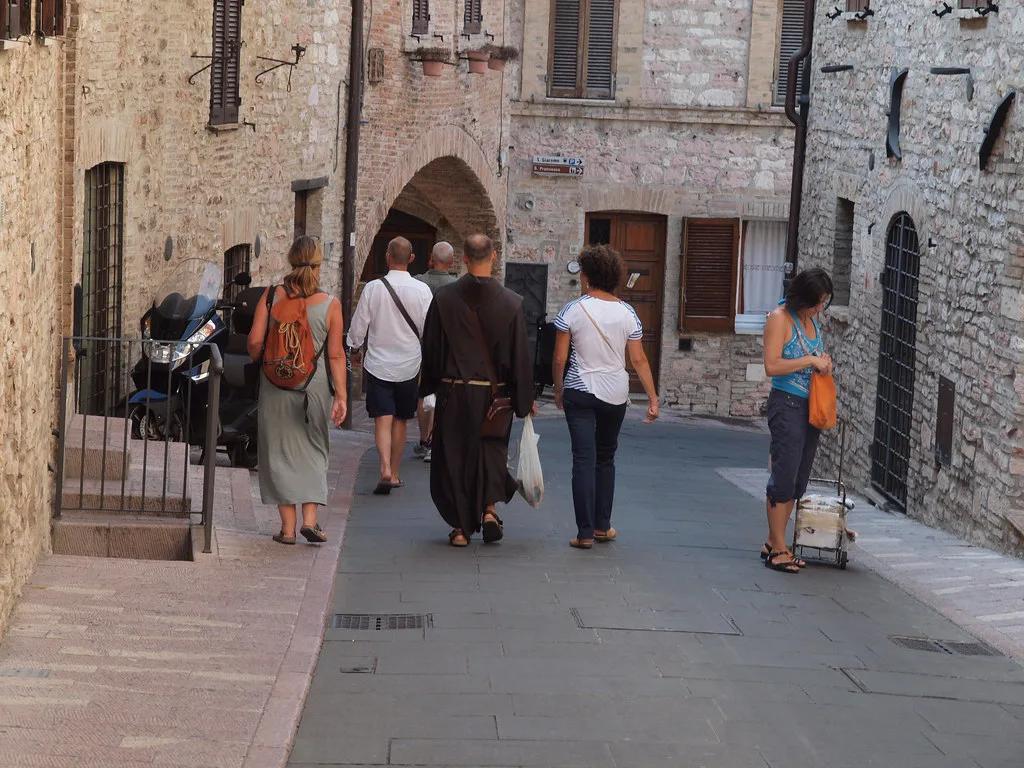
Assisi sits on the western slope of Mount Subasio, and its core is a knot of lanes and small squares where one major sight flows into the next. That density is the argument for walking without a guide: you can pause where something interests you and skip what does not. If you want orientation beyond the famous churches, our guide to the hidden gems in Assisi covers the quieter corners worth weaving in.
The official visitor site treats the town as a UNESCO site with Franciscan places and a nature park of over seven thousand hectares, which explains why a short urban walk can easily expand into a half day outdoors. Our Assisi Attractions hub collects visitor guides to individual sights if you want to go deeper on one stop before you arrive.
Before You Start: Dress, Feast Days and Reaching the Centre
Churches in Assisi enforce a dress code, and tour operators state it plainly: no shorts or sleeveless tops, and knees and shoulders covered for men and women too. Entry can be refused if you do not comply, so a light layer and trousers or a long skirt remove the risk on a warm day.
The feast period around 4 October needs checking before you build a walk around the basilica. Assisi Online lists a 2026 national celebration of St Francis running from late September to 4 October with liturgical events at the basilica and the Porziuncola, and tour operators report that guided tours inside the Basilica of St Francis are forbidden on Sundays, major Catholic holidays including 3 and 4 October, and national holidays, with the basilica closed on 4 October itself. Confirm details with the official tourist office before you rely on them.
Assisi's train station sits down in Santa Maria degli Angeli, roughly three kilometres from the historic centre, and buses connect the two. If you arrive by car, expect the centre to be a restricted traffic zone and park on the edge before walking in; check current bus times and parking arrangements with the tourist office rather than relying on old blog posts.
Leg 1 — Piazza del Comune and the Temple of Minerva
Start at Piazza del Comune, which sits directly above the ancient Roman forum and remains the social heart of the town. The square's showpiece is the Temple of Minerva, built in the second half of the first century BC and later converted into the church of Santa Maria sopra Minerva. Its columns are the clearest reminder that Assisi was a Roman town called Asisium long before Francis.
Stand in the middle of the square and look down rather than up. Everything under your feet is archaeology, and the civic palaces around you, including the Palazzo dei Priori and the Palazzo del Capitano del Popolo, are medieval additions layered onto Roman foundations. This is the right place to decide whether the underground visit appeals before you commit.
Leg 2 — Roman Forum and Archaeological Collection
The Roman Forum is entered from Via Portica, through the crypt of the former church of San Niccolò, and the visit follows a glass walkway above original flooring past a tribunal, a small temple to Castor and Pollux, and rows of tabernae that once served as shops. The official visitor site prices a full ticket at seven euros, a reduced ticket at five euros for students, school groups, visitors aged nine to eighteen, over-65s and groups over twenty, with free entry for residents and children up to eight.
That ticket applies only to the Roman Forum and its collection. A combined ticket, priced at fourteen euros full and eleven euros reduced, also covers the Rocca Maggiore, the Pinacoteca Comunale and the Civic Tower with a multilingual audioguide, which is worth the upgrade only if you intend to climb to the fortress later in the day.
Seasonal hours are published by the city: shorter winter opening from November to February with Tuesday closures, longer daily hours in spring, early summer and autumn, and the longest daily hours in July and August, closing 25 December and with the ticket office shutting half an hour before the site. The underground rooms stay noticeably cooler than the street, so carry a layer even in summer.
Leg 3 — San Rufino
Walk up to the Cathedral of San Rufino, which holds the title of Assisi's cathedral and stands in the oldest part of the city. Its façade is one of the finest examples of Umbrian Romanesque architecture, and Francis is said to have preached in the square in front of it. Inside, a very old baptismal font is traditionally linked to Francis, Clare and even Frederick II.
The cathedral is a working church that publishes no reliable public opening hours, so confirm current access on the day rather than planning around a remembered timetable. The crypt is part of the Diocesan Museum itinerary, which means the underground level is a separate, ticketed experience from simply walking into the nave.
Leg 4 — Santa Chiara
From San Rufino, drop through the lanes to the Basilica di Santa Chiara, a Gothic building in white and pink stone from Monte Subasio that has held Clare's remains since 1260. It is also home to the San Damiano cross, the crucifix that tradition says spoke to Francis and set his conversion in motion. The pink stone catches the late light, which makes this a natural pause rather than a rushed stop.
Entry to the basilica is free and it is not a ticketed site, so nothing here competes with the Roman Forum ticket in your pocket. Keep the visit short if you are pacing yourself, because the largest interior still lies downhill at San Francesco.
Leg 5 — Basilica di San Francesco
The Basilica of San Francesco is a two-level complex: a lower church that invites silence and holds the tomb of the saint, and an upper church whose frescoed cycle narrates his life in a bright, soaring Gothic nave. The practical sequence is to begin upstairs in the light and work down into the quieter lower church and crypt, which keeps the visit building rather than dissolving into a blur.
General entry to the basilica is free, but guided tours inside are suspended on Sundays, major Catholic holidays including 3 and 4 October, and national holidays, and the basilica is closed on 4 October. On those days a guide explains the church from outside and visitors enter on their own, so plan your timing accordingly.
The dress code applies here most visibly, photography rules vary by area and are posted, and voices stay low because this is a living church rather than a museum. If you want the fresco cycles unpacked, a certified guide adds real value, but the walk itself needs none. Our guide to the Basilica of San Francesco goes deeper into the art and the crypt.
The basilica anchors a UNESCO listing that also takes in other Franciscan sites and the landscape around them. Approach it from Via San Francesco and the arcaded lower square, which have welcomed pilgrims since the thirteenth century.
Leg 6 — Optional Climb to Rocca Maggiore
If your legs and your ticket allow, climb past the cathedral to the Rocca Maggiore, the medieval fortress above the town. It was first built in the twelfth century, destroyed in a revolt, and rebuilt in the fourteenth century by Cardinal Albornoz, and the walk up is along steep streets rather than steps or paths. The reward is an open view across the Umbrian valley that no church interior can match.
This is the leg to cut if you are short of time. The combined Roman Forum ticket already includes the fortress and the Civic Tower, so if you bought it you have a reason to go; if not, weigh a single fortress ticket against the remaining light. Check current admission at the ticket office rather than assuming.
Leg 7 — San Damiano and the Descent Out of the Walls
Leave the last gate and walk down to San Damiano, the small church and convent outside the walls where Clare began her community and where Francis is said to have heard the crucifix speak. The path out of the centre is a genuine descent, which means a climb back, so budget energy accordingly.
From San Damiano you can return uphill through the olive groves and lanes or loop back through the Bosco di San Francesco, a wooded alternative to the paved road. Either way, this is the natural end of the walk rather than the middle, because everything else is now behind and above you.
Practical Decisions: Pacing, Pauses and What to Skip
For half a day, do Piazza del Comune, the Roman Forum if it is open, San Rufino, Santa Chiara and the basilica, and leave the fortress and San Damiano for a longer visit. For a full day, add both and treat the Roman Forum's underground cool as a midday pause before the climb to the Rocca. Pause where you find shade and a view, because there is no official waypoint list.
Remember that only the Roman Forum, the museums and the fortress carry tickets; the basilica and Santa Chiara do not. That distinction decides how you budget the day as much as distance does, since a single combined ticket can absorb an afternoon.
What This Route Does Not Tell You
No source documents a total loop distance, gradient percentages, elevation gain or a stair count for any leg of this walk. Anyone quoting exact figures for the historic centre is estimating, so plan by hours and energy instead. Walking shoes with grip help on wet stone and the underground route, and the streets themselves are uneven.
Equally, do not count on the town being quiet at a particular hour. Early mornings and late afternoons are pleasanter by common sense, but no source supports a guaranteed crowd-free window. Check seasonal opening for the Roman Forum and any feast-day adjustments to the basilica before you set out.
Beyond the Loop: Linking to the Way of St Francis
If the walk leaves you wanting a longer pilgrimage, Assisi is a major waypoint on the Way of St Francis, which runs from La Verna to Rome as a loose network of Franciscan landmarks rather than a single path Francis walked end to end. Walking the full route takes at least three weeks, and most people allow around four to linger.
A guided package from La Verna to Assisi covers eleven nights and ten days with half board, luggage transport, a pilgrim credential and GPX maps, priced from 1,275 euros per person in a double room. Published itineraries describe demanding stages and long asphalt sections, so treat the distance honestly. Pilgrims who walk at least 100 kilometres can collect a testimonium at the Statio Peregrinorum beside the basilica.
Plan Your Visit
A self-guided walk in Assisi works best as a single ordered line: Roman square, underground forum, cathedral, Clare, basilica, and then the descent to San Damiano if you have the time and the legs. Decide in advance which ticketed interiors matter, because they set the pace as much as any distance would.
Before you go, confirm current basilica arrangements and Roman Forum hours with the official tourist office, check the feast period around early October, and pack covered shoulders and knees. Then walk it slowly, because the town is short on metres and long on layers.
Frequently Asked Questions
Do you need a guide to walk Assisi?
No. The historic centre is compact and walkable on your own, and you can move between the main sights without booking anything. A guide adds context inside the Basilica of St Francis, where the frescoed cycles reward explanation, but it is not required for the walk itself.
Is the Basilica of St Francis free to enter?
General entry to the Basilica of St Francis is free, separate from the ticketed Roman Forum and museums. Guided tours inside are restricted on Sundays, major Catholic holidays including 3 and 4 October, and national holidays, and the basilica is closed on 4 October, so check before you plan around it.
How long does a self-guided walk of Assisi take?
No source documents a loop distance or a reliable walking time for the centre, so the honest answer is that it depends on how many interiors you enter. Half a day covers the square, the cathedral, Santa Chiara and the basilica; a full day adds the Roman Forum, the Rocca Maggiore and San Damiano.
What should you wear for the churches in Assisi?
Cover your knees and shoulders and avoid shorts and sleeveless tops, for men and women alike. Tour operators say entry can be refused if you do not comply. Comfortable shoes with grip help on uneven stone, and a light layer suits the cool underground forum.
Can you walk from Assisi station to the historic centre?
The station sits in Santa Maria degli Angeli, roughly three kilometres below the centre, and buses run up the hill. Walking is possible along the brick path, but it adds a climb. Check current bus times locally rather than relying on an old timetable.
Where does a self-guided Assisi walk start?
Piazza del Comune is the logical start because it puts the Roman forum, the Temple of Minerva and the main lanes within a few steps. From there the route works downhill through San Rufino, Santa Chiara and the basilica towards San Damiano, so you end below the walls rather than climbing back repeatedly.
Sources
- Assisi Online Guida turistica, Hotel, ristoranti e mappa di Assisi, Umbria
- The Way of St Francis pilgrimage route in Italy (2026)
- Assisi Walking Tour by Local Guide with St. Francis Basilica
- The Way of St Francis from La Verna to Assisi - Francesco's Ways
- Walking Tour Assisi: San Rufino, Santa Chiara and San Francesco - Secret Umbria
- Roman Forum and Archeological Collection - Visit Assisi
- Official tourist information site for Assisi - Visit Assisi
- Assisi: a complete guide through the birthplace of San Francesco
- Rocca Maggiore: An Unforgettable View of Assisi - Adventurous Kate
- Assisi Cathedral (San Rufino) - Exploring Umbria
- Assisi, City Highlights and Basilica of St. Francis tour in Assisi | Pelago
- Assisi travel guide: attractions & things to do in Assisi Italy - ItalyGuides.it
Continue exploring
More guides you'll find useful





