
Bolzano Old Town Guide: Streets, Squares and a Walking Order
A practical guide to Bolzano's old town quarter, from the porticoes and Piazza Walther to the museums worth your time, with a suggested walking order.
On this page
Bolzano's historic centre is small enough to cross on foot in an afternoon, yet layered enough to fill a day if you know how to read it. The tourism office presents the city as a place where Tyrolean and Mediterranean traditions sit side by side under the arcades, with the Dolomites rising at the edge of town. This guide treats the old town as a district with blocks and trade-offs rather than a checklist, so you can decide where to spend time and where to keep moving.
Start with one concrete orientation point: the South Tyrol Museum of Archaeology, home to the Copper Age mummy known as Ötzi, sits in the heart of the medieval centre. If you plan to see it, that single booking shapes the rest of your day, because museum time is the main variable in an old-town walk. Everything else here can be arranged around it.
Where the Historic Centre Sits and Why It Anchors a Visit
The old town occupies the flat heart of Bolzano, wrapped around Piazza Walther and threaded by Via dei Portici, the long arcaded street that most visitors treat as the city's spine. The tourism office frames Bolzano as a compact city where porticoes, museums and castles sit within easy reach of each other, and where cable cars lift you from the streets to mountain viewpoints within minutes. Treat that compactness as your planning advantage: you rarely need transport inside the quarter.
One useful framing detail comes from a long-form city guide: Bolzano is described as the capital of South Tyrol and a gateway city at the foot of the Dolomites. That gateway role matters practically, because it explains why the centre feels more alpine than a typical Italian city, and why a walk here doubles as a warm-up for mountain days.
For a wider inventory of what the city holds beyond this quarter, the Bolzano Attractions hub collects guides to individual sights, which is worth skimming before you commit museum hours.
How to Read the Quarter Before You Walk
Bolzano's bilingual character is not decoration; it is a navigation tool. The tourism office describes an authentic cultural mix in which past and future, nature and urban life coexist, and street signs, menus and museum labels appear in both Italian and German. Reading both versions often clarifies a name you thought you misheard, and it prepares you for place names that shift between Bolzano and Bozen on the same block.
Practically, that means you should decide your priorities in advance rather than drift. The quarter rewards a loose plan: pick one ticketed interior, choose a square to sit in, and leave the arcades as connective tissue rather than a destination in themselves. A five-day city plan published by one travel site groups the archaeology museum and Piazza Walther together as a first-day pairing, which is a reasonable logic for anyone with limited time.
Via dei Portici: What a Portico Stroll Actually Delivers
Via dei Portici is the old town's defining street, a medieval arcade where shopfronts sit behind continuous covered walkways. The tourism office lists these porticoes among the city's signature experiences, alongside its museums and castles. In rain or strong sun, the covered route is simply the most comfortable way to move across the centre.
What the arcades offer is rhythm rather than spectacle: a sequence of shop windows, doorways and small courtyards that rewards slow walking instead of goal-oriented shopping. Set your expectations accordingly and you will enjoy it more; treat it as a place to cover ground while staying dry, and let Piazza Walther be the moment you step into open air.
If you want to push beyond the obvious stretch, the hidden gems guide covers overlooked corners of the city, including the Oswald Promenade, for readers who want a second layer after the centre.
Piazza Walther and the Cathedral Block: Your Orientation Point
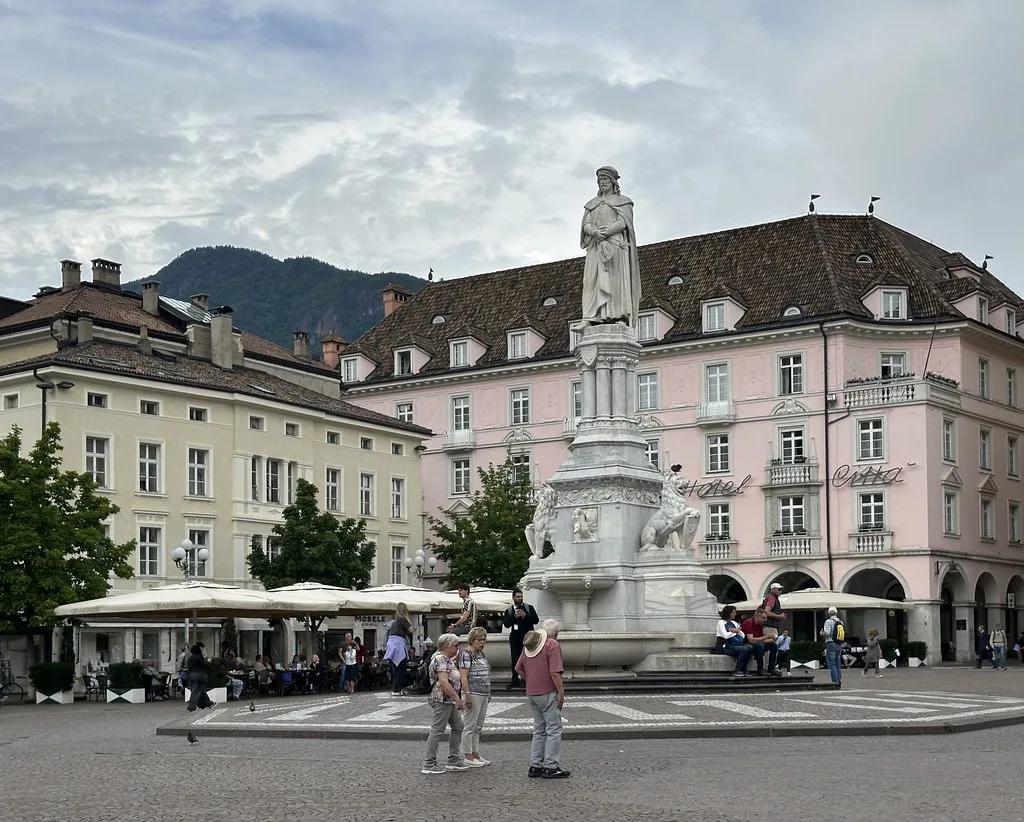
Piazza Walther functions as the city's open-air living room, and it is the easiest place to reset your bearings. A travel tip on the city recommends simply finding a seat at one of the cafes and restaurants surrounding the square, with a coffee, a glass of local wine or an aperitivo as the pretext, and notes that options are plentiful. That makes the piazza a good anchor for a mid-walk break rather than a sight to tick off.
The cathedral block around the square is where the old town's layers stack most visibly. One five-day itinerary threads the cathedral, the arcades of Via dei Portici, Mareccio Castle and the Museion into a single stroll, which usefully shows how tightly the historic and modern halves of the city are packed together.
Use the square as a compass: from here the arcades run one way, the riverbank another, and the station district lies beyond the centre. Decide your next block before you sit down, so the break does not dissolve your remaining daylight.
The Museum Question: Ötzi Versus the Mercantile Museum
The South Tyrol Museum of Archaeology is the old town's heavyweight, holding the glacier mummy found in the region in 1991 and studied in Bolzano since 1998. A city guide describes it as a must-not-miss stop right in the heart of the medieval centre. If you only visit one interior, this is the one most visitors choose, and it is also the one worth planning around.
The counterpoint is the Mercantile Museum, housed in the historic Chamber of Commerce building on Via dei Portici. One guide describes it as overshadowed by the Ötzi museum but rewarding, with historic rooms and rare documents covering the trade history that made the city wealthy, and often having the place to yourself. That framing is a claim from a single source rather than a guarantee, but it usefully identifies a quieter alternative for anyone who wants a shorter stop after the mummy.
Do not assume one ticket covers several sites in the quarter, and do not rely on old opening times. Check the official city tourism pages or each museum's own site for current hours and admission before you build a day around one.
Half-Day Extensions: Castel Firmiano and the Renon Cable Car
The Messner Mountain Museum sits at Castel Firmiano on the edge of the city, in a castle documented back to the tenth century and taken over by mountaineer Reinhold Messner. A city guide notes that regular buses serve the castle, and frames the museum as a tribute to the human encounter with mountains over history. Budget a half day if you go, since the journey out and back eats into old-town time.
The Renon cable car is the other obvious extension, lifting you high above the city for mountain views and continuing options such as a cog railway. One itinerary describes reaching high plateaus from the centre, with hiking trails and earth pyramids above, and pairs it with a walk through the old town on the same day. That pairing works because the cable car is close enough to the centre to treat as an afternoon rather than an expedition.
Choose one extension, not both, unless you have a spare day. Castel Firmiano suits museum-goers and anyone interested in mountaineering history; the cable car suits walkers who want altitude and views without committing to a long hike.
Neighbourhood Edges: Gries, the Riverbank and Museion
Where the historic centre ends, the city keeps going in directions worth an hour each. One itinerary describes Gries-San Quirino as a more residential and upscale district west of the Talvera river, known for parks, grand villas and religious sites, and places the modern Museion across the Talvera from the arcades. Crossing the river gives you a genuine change of texture without leaving the city.
The same itinerary treats Oltrisarco-Aslago, south of the station, as a less touristy area with markets and a mix of old and new architecture, and notes that St. Magdalena, with its vineyards, sits nearby. These are ordinary city districts rather than attractions, and that is precisely their value after a morning among the porticoes.
For more ideas on overlooked corners across the city, the hidden gems guide is the natural next read.
A Suggested Walking Order for One Day
Start at Piazza Walther in the morning, when you are freshest and the square works best as an orientation point. Walk the length of Via dei Portici once without stopping, noting shopfronts and courtyards you want to revisit, then return to the archaeology museum for your booked slot if you have one. This order front-loads orientation and puts the most demanding interior before lunch.
After lunch, take the Mercantile Museum on Via dei Portici if you want a shorter, less crowded second stop, or skip interiors entirely and cross the Talvera to Museion for a modern contrast. Finish with a drink back in the square, then decide whether the evening belongs to the arcades or the riverbank.
This sequence is a suggestion, not an official route, and it assumes a single day. If you have two, add either Castel Firmiano or the Renon cable car as a half-day block rather than trying to squeeze one into an already full old-town day. The trade-off is straightforward: every museum hour is an hour not spent walking.
Where the Crowds Thin Out, Honestly Labelled
Bolzano's centre is genuinely compact, so expecting empty lanes in the core is unrealistic. What can be said with support is comparative: the Mercantile Museum is described by one guide as often having the place to yourself, which makes it a reasonable choice when the archaeology museum feels busy.
Beyond that, calm is something you judge rather than something a guide can promise. Side lanes off the arcades, the riverbank paths and the neighbourhood edges described above are all plausible places to find breathing room, but conditions shift with season, weather and events. Watch where delivery carts and school groups go, and follow that instinct rather than a fixed list.
One further city fact worth knowing: Bolzano is described as the largest city in South Tyrol and part of historical Tyrol, which helps explain why its institutions and place names carry two traditions at once.
Getting Your Bearings: Information Points and the Bolzano Bozen Card
The tourism office runs two information desks in the city, one at Piazza del Grano and another at Via Alto Adige, and publishes their opening days on its own site. Check those before you travel rather than assuming a weekend service, and use the desks for current leaflets on events and transport.
The Bolzano Bozen Card appears on the same official site alongside arrival and mobility information. Whether it pays off depends entirely on how many paid interiors, cable cars and buses you plan to use, so read the current inclusions and compare them with your own list before buying. Treat it as a calculation, not a default purchase.
Practical Rhythms: Clothing, Language and Food
Layered clothing is the practical rule for any day that combines the old town with a cable car, because conditions shift with altitude. One itinerary notes that even in summer mountain weather can change rapidly and that a light jacket is useful, especially heading up on the lift.
On language, a few words of Italian go a long way, and German works equally well in much of the centre; the same source suggests even basic courtesies earn goodwill. For food, the local specialities it lists include speck, spinach and ricotta ravioli, dumplings and Lagrein wine, all of which appear across price points in the centre.
Budget figures circulating online, such as per-day food and sightseeing estimates, are third-party calculations with dates attached and change with season. Set your own cap before you arrive and treat published numbers as rough context rather than current prices.
Plan Your Old Town Day
Bolzano's old town works best when you treat it as a district with a spine, a square and a handful of interiors, then decide deliberately what to pay for. Walk the porticoes, use Piazza Walther as your compass, pick between the archaeology museum and the quieter Mercantile Museum, and leave room for one extension beyond the centre.
Confirm current hours and admission on official pages before you go, since none of those details hold still between seasons. With that settled, the quarter rewards exactly what it asks for: a comfortable pair of shoes and a loose plan. For related planning, see Bolzano Self-Guided Walk: Piazza Walther to Castel Roncolo.
Frequently Asked Questions
Is Bolzano's old town worth visiting?
Yes, particularly if you want a compact historic centre with a distinctive alpine-Italian character. The arcaded Via dei Portici, the cathedral square and the archaeology museum sit within a small area, and the cable car and Castel Firmiano extend the day without long transfers. It is a city centre to walk, not to drive between sights.
How long does it take to walk the old town of Bolzano?
The core itself is small and can be crossed quickly at a steady pace, but a meaningful visit takes most of a day once you add a museum and a sit-down break in Piazza Walther. No official duration is published, so treat any figure as a planning estimate and adjust for how long you linger.
What is the main street in Bolzano's historic centre?
Via dei Portici is the street most visitors use as the old town's spine, with its continuous medieval arcades. Piazza Walther functions as the main open square and orientation point. The tourism office highlights the porticoes alongside the city's museums and castles as signature experiences.
Do you need tickets for Bolzano's old town sights?
Walking the streets, squares and porticoes is free, while interiors such as the South Tyrol Museum of Archaeology and the Mercantile Museum require admission. Do not assume one ticket covers several sites, and check current prices and hours with each museum before you go.
Where can you escape the crowds in Bolzano?
The Mercantile Museum is described by one guide as often having the place to yourself, making it a useful alternative when the Ötzi museum is busy. Beyond that, no lane can be guaranteed quiet. Riverbank paths, side streets off the arcades and residential districts such as Gries or Oltrisarco-Aslago are reasonable places to look for breathing room.
Should you visit the Ötzi museum or the Mercantile Museum?
Choose the South Tyrol Museum of Archaeology if you want the city's headline exhibit, the glacier mummy found in the region in 1991. Choose the Mercantile Museum on Via dei Portici if you prefer a shorter, less crowded stop about the trade history that shaped the city. If time allows, the two complement each other rather than duplicate.
Is the Renon cable car close to the old town?
Yes, it is accessible from the centre and is commonly paired with an old-town walk on the same day. One itinerary describes it as reaching high plateaus from the city centre. Check current operating times and ticket options before relying on it, especially outside the main season.
Sources
Continue exploring
More guides you'll find useful





