
Collegio del Cambio Perugino Frescoes: Visitor Guide
A short, focused guide to Perugia's Collegio del Cambio: Perugino's 1496-1500 frescoes, the moneychangers' hall and what to confirm before visiting.
On this page
The Collegio del Cambio occupies the new wing of the Palazzo dei Priori on Corso Pietro Vannucci, Perugia's main pedestrian street, so it sits on the route most visitors already walk. Inside, the Sala dell'Udienza preserves a fresco cycle painted by Pietro Vannucci, known as Perugino, between 1496 and 1500 at the height of his career, according to the museum service that describes the building. Treat it as a deliberate stop at the start of a morning rather than something to squeeze between shops.
The hall is not a neutral picture gallery. Its decoration was designed as a coherent programme by a named humanist, and knowing how that programme is arranged lets you read the walls instead of drifting past them. As a suggestion rather than an official figure, allow around half an hour inside the room, plus time to look at the entrance woodwork before you go in.
What the Collegio del Cambio Actually Was
The Collegio del Cambio was the headquarters of the Guild of Merchants and Money Changers, the body that handled exchange and finance in Perugia, and it was built in the mid-fifteenth century in the new wing of the Palazzo dei Priori. The room that draws visitors today, the Sala dell'Udienza, was the guild's audience hall: a working chamber for a working institution rather than a chapel or a private gallery.
That civic function explains the confidence of the decoration and its content. A guild that lent, exchanged and regulated money wanted a hall that spoke about justice, prudence and good government, and it commissioned the most celebrated painter it could. Keep this in mind as you look at the figures: the virtuous ancients on the side walls are not filler but an argument about how a merchant should behave.
Perugino's Cycle and Why the Dates Matter
Perugino completed the frescoes between 1496 and 1500, at the height of his fame, according to the museum page dedicated to the building. Those years place the work after his Roman commissions and before the generation of Raphael, his most famous pupil, overshadowed him. Standing in the hall, you are looking at a painter working at his peak for a demanding local patron.
The date range is also a warning against trusting older descriptions found online. Text written years ago may describe the room's condition, access or entrance arrangements differently from today, so use the dates as a fixed fact and treat everything else as something to confirm. A former guild hall that now functions as a museum has almost certainly changed its visitor arrangements since the frescoes were last cleaned or the ticket system reorganised.
The guild's decision to commission a full decorative scheme rather than a single altarpiece says something about ambition. This is a room conceived as a complete environment, with painted walls, a painted vault and fitted woodwork designed to be seen together. That wholeness is why the hall repays slow looking more than a quick photograph of the end wall.
Reading Maturanzio's Programme
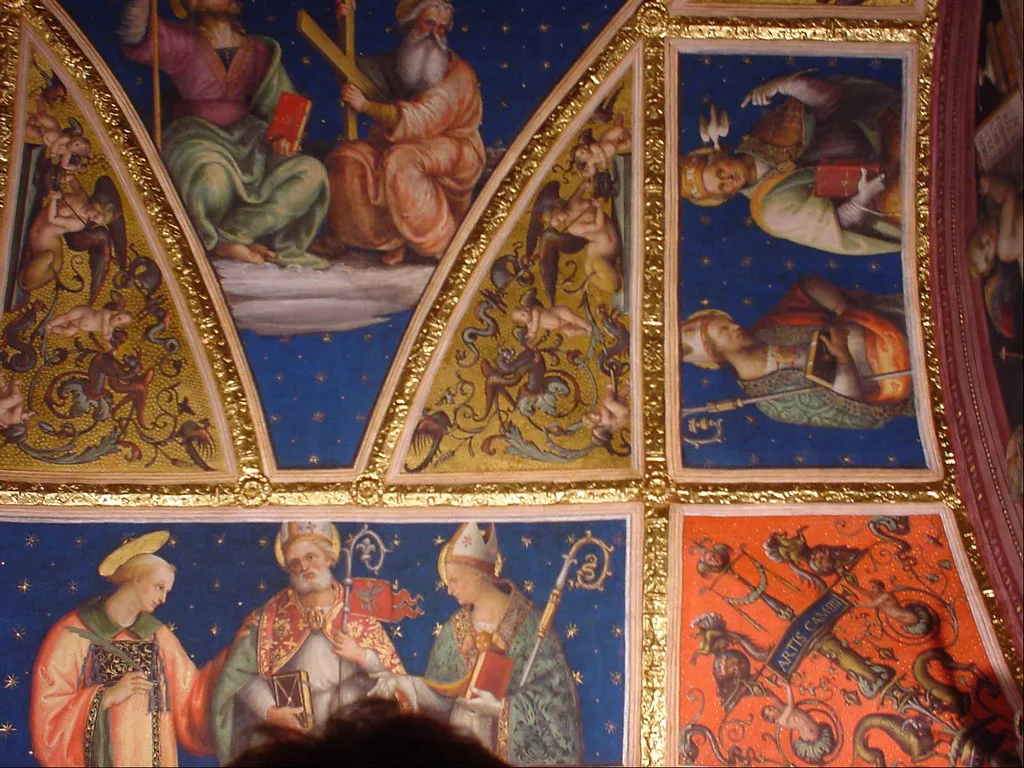
The iconographic scheme was devised by Francesco Maturanzio, a Perugian humanist, and draws on classical texts, notably Cicero's De officiis and Valerio Massimo's collection of memorable deeds and sayings. The vault was inspired by a fifteenth-century astrological text by Johannes Angelus, and the lunette painting of the prophets and sibyls takes its cue from the writings of the Christian author Lactantius. This is a deliberately layered programme, matching pagan and Christian authority rather than choosing between them.
For a visitor, the practical consequence is simple: the figures on the walls are not a random assembly of saints and heroes. They were chosen to make a case about virtue, prophecy and the legitimacy of the guild's role in the city. Reading the captions or a short guide before you start looking lets you recognise the logic rather than admire a general glow of Renaissance colour.
The Three-Part Wall Narrative, in Order
The museum describes the painted decoration as three connected themes, and following them in sequence is the easiest way to make sense of the room. Begin with the lunette, where the prophets and sibyls announce the coming of the Redeemer, drawing on Old Testament figures whose prophecies were read as foreshadowing. That is the frame for everything below and around it, so give it a few minutes before moving on.
Next, look at the end wall, where the programme develops and completes the opening theme with the Nativity and the Transfiguration of Christ. Then turn to the side walls, which carry a procession of virtuous characters from antiquity, eight from the Latin world and four from Greece. Standing in the middle of the hall and rotating slowly is a better way to absorb this than working wall by wall from one corner.
The side-wall figures are where the hall's civic purpose becomes most legible. Figures such as Socrates, Numa Pompilius and Trajan were models of judgement and good rule, and placing them around a moneychangers' audience hall was an argument about how the guild saw itself. That is the payoff for reading the room in order: the classical figures stop being a decorative frieze and become the moral point of the scheme.
Woodwork, the Entrance, and the Self-Portrait
The room is not only painted surfaces. Its Renaissance wooden furnishings survive alongside the frescoes, and the entrance carries a finely crafted wooden work dated to 1505, according to descriptions of the building. Allow time to look at the joinery at eye level rather than walking straight through it on the way to the paintings.
Among the painted figures, the museum lists a self-portrait of Perugino, alongside figures such as Pericles, Cato the Younger, and Prudence and Justice with Fabius Maximus. A self-portrait placed inside a civic commission is a statement of authorship as much as a likeness: the painter signs his work by inserting himself into the company of the virtuous. Look for it deliberately, because in a room this dense it is easy to miss.
Practical Planning and What to Verify
Opening hours, admission arrangements and any closures change and should be checked directly before you travel, because listings go out of date. Use the city's official pages and the museum's own contact details for the current position, and confirm whether timed entry or advance booking applies on the day you plan to visit. Do not rely on a review from an earlier year for the opening schedule.
Treat any combined-ticket arrangement as something to confirm at the desk rather than assume. Older visitor reviews mention a single ticket covering the Collegio del Cambio and the Collegio della Mercanzia, but that describes a past arrangement, not a guarantee, and you should not plan around it. Ask what the ticket covers and what each part of the complex includes before you pay.
The sensible approach is to arrive knowing you may need to adjust. If the hall is closed for maintenance or a private function, the National Gallery of Umbria in the same palace holds a major collection of Umbrian art, including works by Perugino, and makes a strong substitute. Check the gallery's own published information for its hours and ticket terms on the day, since these also change.
Pairing It With Nearby Sights
Because the Collegio del Cambio sits inside the Palazzo dei Priori on Corso Vannucci, it slots naturally into a walking route rather than requiring a trip of its own. The Collegio della Mercanzia is metres away, and the cathedral, the Fontana Maggiore and the National Gallery are all within a few minutes on foot. Build the hall into the middle of that circuit instead of treating it as an isolated museum stop.
If you want to push beyond the main squares, our hidden gems in Perugia guide covers quieter corners and viewpoints that fill the rest of a morning or afternoon. These are useful for slowing the pace after a dense fresco room, when a walk and a view do more for you than another labelled painting.
For a firmer sense of how the individual sights compare and which deserve your limited hours, the Perugia Attractions hub sets the major stops side by side. Read it before you finalise the order of your day, particularly if you are choosing between a short fresco visit and a longer gallery session.
How Long to Allow and How to Sequence the Visit
As a suggestion rather than an official figure, think in terms of roughly half an hour inside the Sala dell'Udienza, plus whatever time you spend reading the entrance material. That is enough to work through the lunette, the end wall and the side walls once, with a return look at the self-portrait. If you are a specialist or sketching, book longer and accept that the room rewards it.
A practical sequence for a single morning is to start at the Palazzo dei Priori before the surrounding streets fill, see the Collegio del Cambio while your attention is fresh, then move to the gallery or the cathedral. Put the walking and the viewpoints afterwards, when standing and looking closely has lost its appeal. That ordering also gives you a natural fallback if the hall turns out to be closed.
The trade-off is real: a short visit to a single painted room, or a longer, broader session in the National Gallery. Choose the hall if you want one coherent programme explained by its own walls, and the gallery if you want range across centuries and artists. The two work best as complements rather than competitors, but only if you have the hours to give both.
Plan Your Visit
The Collegio del Cambio is a compact, central stop that rewards an hour of preparation far more than an hour of wandering. Learn the three-part narrative, look for Maturanzio's sources behind it, and give the woodwork and the self-portrait their own moments. Then let the rest of Perugia, from the fountain on the square to the quieter corners above the Corso, carry the day.
Confirm the current hours, ticket scope and any closures with the official city and museum sources before you set out, and keep a nearby alternative in mind. Arriving informed is the difference between walking through a painted room and actually reading it.
Frequently Asked Questions
What frescoes did Perugino paint in the Collegio del Cambio?
Perugino decorated the Sala dell'Udienza between 1496 and 1500. The programme, devised by the humanist Francesco Maturanzio, places prophets and sibyls in the lunette, the Nativity and Transfiguration on the end wall, and virtuous figures from Greek and Latin antiquity on the side walls, with a self-portrait of the painter among the figures.
How long does a visit to the Collegio del Cambio take?
Around half an hour inside the hall is a reasonable suggestion, though it is not an official figure. Add time for the entrance and for reading any explanatory panels. If you plan to study the iconographic programme closely or sketch, allow longer and accept that the room rewards slow looking.
Is the Collegio del Cambio ticket combined with the Collegio della Mercanzia?
Older visitor reviews describe a single ticket covering both, but that reflects a past arrangement rather than a guarantee. Confirm the current ticket scope at the desk or through the museum's own information before you pay, and do not plan your day around an assumed combination.
Sources
Continue exploring
More guides you'll find useful





