
San Giovanni Evangelista Parma: Correggio Dome Guide
See Correggio's early dome in San Giovanni Evangelista in Parma, plus Parmigianino frescoes. Learn how the free church fits a Correggio-themed day.
On this page
San Giovanni Evangelista stands immediately behind Parma Cathedral, close enough that many visitors cross the end of its piazza without realizing a second church is there. It holds the other Correggio dome, painted in the early 1520s, a few years before he began the Assumption in the cathedral itself. A suggested allowance of about forty minutes covers the church and its dome, and entry to the church is free.
That makes the church the natural first stop for anyone building a day around Correggio. Cloisters and the monastery pharmacy sit behind it but are managed separately, so treat them as a second, optional layer rather than part of the same visit. Further visitor details appear in San Giovanni Evangelista, Parma: Correggio's Other Dome.
Where San Giovanni Evangelista Sits in Parma
The church occupies the block directly behind the cathedral, in the heart of the city's historic centre around Piazza Duomo. Because it is not on the piazza itself, the simplest approach is to walk through or past the cathedral square and continue behind it rather than treating the church as a separate expedition. From there, the baptistery and cathedral are a short walk away, which makes the three buildings a natural single morning.
Its bell tower is visible from the surrounding streets, so look back as you approach: the tower gives you a bearing point that makes the church easy to find even when the facade blends into the surrounding buildings. The facade itself is Baroque in appearance, though the complex's origins reach much further back. Further visitor details appear in Literary itinerary in Parma and surrounding areas | Visit Emilia.
If you are mapping a wider circuit of the centre, this church pairs well with the city's other quiet corners, which are gathered in this guide to hidden gems in Parma. Set aside the cathedral and baptistery as separate stops, since entry rules differ between them and the free church. The baptistery, for instance, is a monument built between 1196 and 1216 with pink Verona marble, and it does not share an entry arrangement with San Giovanni.
Correggio's Vision of St John on Patmos: What to Look For
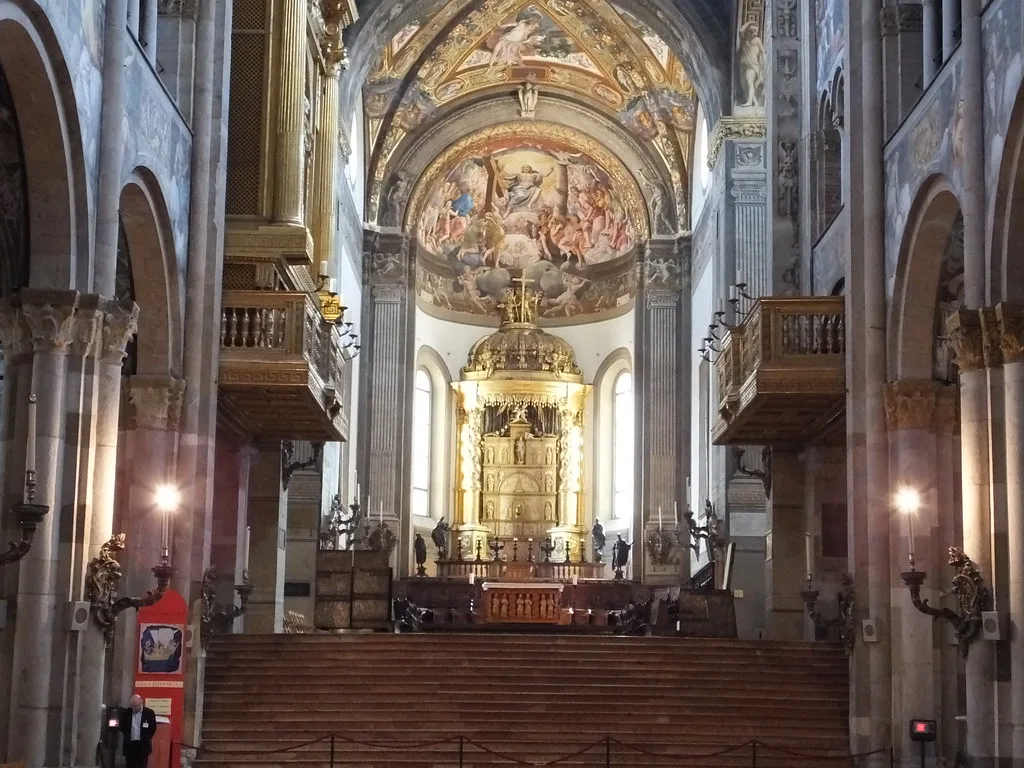
The dome fresco shows the Vision of St John on Patmos, with Christ descending through cloud toward the apostles. Everything is foreshortened from below and the architecture appears to open upward, the technique that would define Correggio's ceiling painting. Stand near the centre of the nave rather than at the entrance, so the perspective reads as intended.
This is the smaller and quieter of Parma's two Correggio domes, and the source material is explicit that it is where he worked out the method before applying it at a much larger scale in the cathedral. Give yourself time to look upward without moving, then walk a few steps and look again: the figure group shifts as your viewing point changes.
The nave also carries a continuous frieze painted by Correggio, an element that is easy to walk straight past on the way to the dome. Look along the central nave walls at eye level before you tilt your head upward. If you are following the city's literary associations, this church also appears on Visit Emilia's literary itinerary through Parma, where it is noted for the dome's cycle of frescoes and the play of perspective in the Vision of Saint John.
Telling the Two Domes Apart
The cathedral's dome holds the Assumption, painted from 1526 to 1530, and it does the same thing as San Giovanni's dome at roughly four times the scale and with far more figures. Visitors who see the cathedral first often find the earlier dome underwhelming; seen in the other order, it reads as the rehearsal. Make the sequence decision deliberately rather than by accident of which door you reach first.
One practical consequence: if your time in Parma is limited to a single morning, choose San Giovanni first, then cross to the cathedral. The cathedral is free to enter as well, so the ordering costs nothing but a few minutes of walking. That is also why the two are best treated as one continuous look at how Correggio's ideas developed, rather than as two separate attractions to tick off.
Parmigianino in the Left-Aisle Chapels
The chapels of the left aisle carry frescoes by Parmigianino, painted when he was still in his late teens. Parma produced two painters of European importance within a single generation, and both have work in this one church, which is more than its modest exterior suggests. Slow down here instead of treating the aisle as a corridor to the dome.
The Visit Emilia account of the church describes the interior as an emotional journey and singles out the dome cycle alongside the nave frieze, which is a useful reminder that the Parmigianino chapels sit within a broader decorative scheme rather than as isolated panels. Read the aisle as a sequence: chapels first, nave frieze next, dome last.
Details Easy to Miss
A St John in the lunette at the end of the nave, also by Correggio, is often missed by people who come only for the dome. Walk the full length of the nave before leaving and look at the end wall. The same applies to the frieze along the nave: both reward a second pass after your eyes have adjusted to the dim interior.
If you are interested in the building's place in Parma's wider story, the surrounding streets hold the city's other literary and artistic markers, and this Parma Attractions hub lists the sights worth pairing with this one. Just outside the church, the walk back toward the cathedral and baptistery also passes the older layers of the city, which rewards looking up at facades rather than only at the pavement.
Free Entry to the Church: What It Covers
Entry to the church itself is free, and that includes the dome, the nave frescoes, the Parmigianino chapels and the lunette. It does not extend to the monastery's cloisters or the historic pharmacy, which are managed separately. Do not assume one ticket covers the whole complex, because it does not.
The cloisters and the Spezieria may charge for entry or keep restricted hours, so ask inside the church rather than assuming access. If you want to see the pharmacy, plan it as a separate request at the start of your visit, not as an afterthought on the way out. Current access arrangements are best confirmed with the diocese before you travel, since no published schedule appears in the sources used here.
The Cloisters and the Spezieria di San Giovanni
Behind the church, the Benedictine monastery has three cloisters, and at the end of one of them sits the Spezieria di San Giovanni, the monastery's own pharmacy. It operated for centuries and survives with its fitted shelving, majolica jars and mortars still in place. It is described as one of the oldest surviving pharmacy interiors in the country, which makes it a genuinely unusual thing to find at the end of a cloister.
Access to the cloisters and the pharmacy is managed separately from the church and hours vary, so the sensible move is to ask at the church rather than build a plan around a published time. If the cloisters are open, allow longer than the suggested forty minutes for the church alone. If they are closed, the church visit still stands on its own and takes very little of your day.
Building a Correggio-Themed Day
Start at San Giovanni Evangelista, look at the dome and the lunette, then walk the short distance to the cathedral and look up at the Assumption. The earlier dome makes sense of the later one: you see the same idea pushed further, with more figures and a far larger surface. Doing it the other way round tends to make the smaller dome feel like a lesser version rather than the starting point.
After the cathedral, the baptistery completes the group, and its interior is a different experience again: an octagon begun in 1196, by Benedetto Antelami, rather than a painted dome. Beyond Piazza Duomo, Parma's Correggio and Parmigianino holdings extend to other churches and collections, so decide in advance whether you are doing a dome-focused morning or a broader art day. The city's attractions are catalogued with practical notes in the Parma Attractions hub.
Suggested Timing and How to Combine the Morning
Allow about forty minutes for the church and its dome, and longer if the cloisters and pharmacy are open. That figure is a suggested allowance for planning, not an official time limit, so adjust it to how long you spend under the dome. The cathedral nearby needs roughly an hour by the same kind of reckoning.
A comfortable sequence is San Giovanni, then the cathedral, then the baptistery, keeping the three within a single unhurried morning. Because the church sits directly behind the cathedral, there is no travel time to budget between them beyond a short walk. If the baptistery interior is on your list, check its separate ticketing before you set out, since it does not share entry with the free church. Further visitor details appear in San Giovanni Evangelista, Parma: Correggio's Other Dome.
Before You Go: Checking Current Access
No reliable published schedule for the church, cloisters or pharmacy appears in the sources used here, and access arrangements can change. Confirm current opening times and whether the cloisters and Spezieria are receiving visitors by asking locally or checking the diocesan website before you travel. Treat any third-party listing as a prompt to verify rather than a guarantee.
One caution for anyone researching Parma online: the visitparma.it domain currently displays a for-sale notice rather than tourist information, so it is not a usable planning source. Use official diocesan and regional tourism channels instead. That also avoids outdated pages that still surface in search results.
Plan Your Visit
San Giovanni Evangelista rewards a deliberate order more than a long visit. See Correggio's early dome here, then walk the few steps to the cathedral so the Assumption reads as the same idea at full scale. The church costs nothing to enter, and the entire stop fits easily into a morning already centred on Piazza Duomo.
Check cloister and pharmacy access on the day rather than assuming it, and leave the baptistery's separate ticket for when you are actually there. If you want more of the city's quieter corners alongside the headline sights, the hidden gems guide is a useful companion.
Frequently Asked Questions
How is San Giovanni Evangelista's dome different from the cathedral's?
It is earlier and smaller. Correggio painted the Vision of St John on Patmos here in the early 1520s, a few years before starting the Assumption in the cathedral, and the church's dome is where he worked out the upward-opening, strongly foreshortened approach. The cathedral dome then applies the same idea at a much larger scale with many more figures. Seeing this one first makes the cathedral easier to read.
Is there work by Parmigianino in San Giovanni Evangelista?
Yes. The chapels of the left aisle carry frescoes by Parmigianino painted when he was in his late teens. Together with Correggio's dome, nave frieze and lunette, that gives the church work by two major Parma painters in a single modest interior, which is why it deserves more than a glance on the way to the cathedral.
Is the church free to enter?
The church itself is free, including the dome and the frescoes in the nave and chapels. The cloisters and the historic Spezieria di San Giovanni are managed separately and may charge for entry or keep restricted hours, so ask inside the church if you want to see them rather than assuming they are included.
What is the Spezieria di San Giovanni?
It is the Benedictine monastery's own pharmacy, preserved with its fitted shelving, majolica jars and mortars in place after centuries of use. It is described as one of the oldest surviving pharmacy interiors in Italy and sits at the end of one of the monastery's three cloisters. Access is separate from the church and hours vary, so confirm on site.
How long do you need at San Giovanni Evangelista?
A suggested allowance is around forty minutes for the church and dome, longer if the cloisters and pharmacy are open. That is a planning figure rather than an official limit. If you also want the cathedral and baptistery, treat the three as one unhurried morning rather than separate outings.
Should I see this dome before or after Parma Cathedral?
See San Giovanni Evangelista first. The smaller dome is the earlier experiment, and the cathedral's Assumption then reads as the same idea pushed to its limit. Reversing the order tends to make the smaller dome feel like a lesser version rather than the place where Correggio's method began. The two buildings are directly adjacent, so the order costs you nothing.
Sources
Continue exploring
More guides you'll find useful





