
Pozzo di San Patrizio: A Visitor Guide to Orvieto's Double-Helix Well
Visiting Orvieto's Pozzo di San Patrizio: why Clement VII built it, how Sangallo's double-helix ramps work, the 248 steps each way, and the stair-only access.
On this page
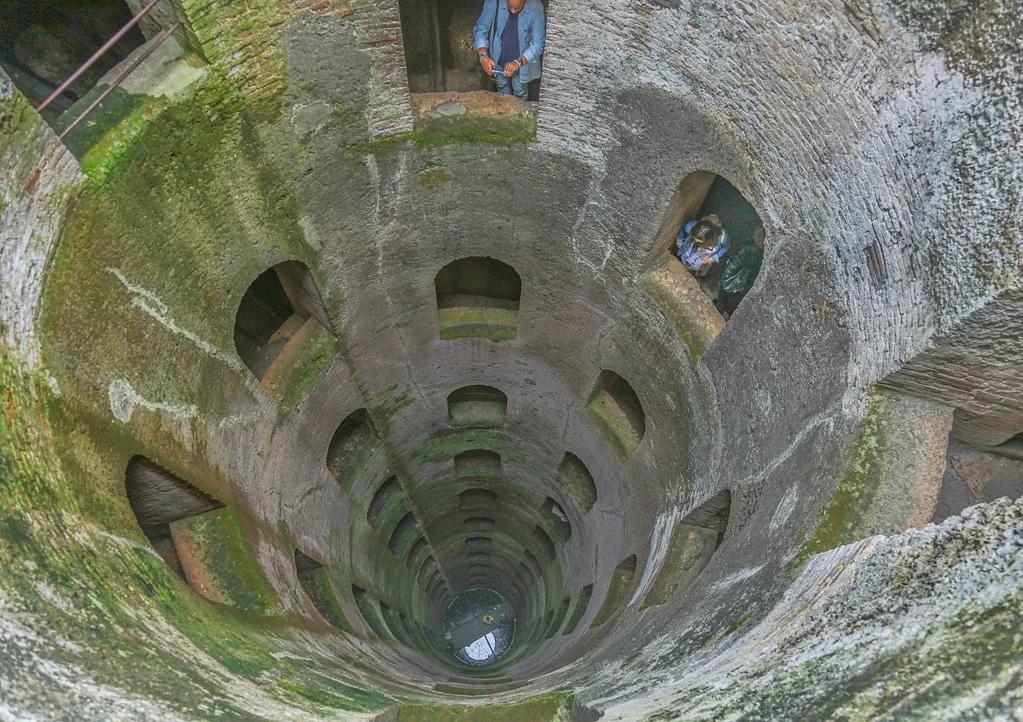
Pozzo di San Patrizio sits at Piazza Cahen, beside the exit of Orvieto's rack railway and the large visitor car park, so it is often the first or last stop of a day in town. Under a low brick drum the shaft drops into the volcanic tuff that holds the city aloft, and two separate helical ramps wind around it. This guide covers why the well was built, how the double helix works, and the practical demands of the descent, including the stair-only access that makes the round trip unsuitable for some visitors. Related guide: Orvieto Attractions: Visitor Guides to 7 Sights.
Why Pope Clement VII Ordered a Well at Orvieto
The well belongs to the aftermath of the 1527 Sack of Rome. Pope Clement VII fled the city and took refuge in Orvieto, and from there he acted to give the town a water supply that could survive a siege. A besieging army would target a town's water lines first, so the project was designed to make Orvieto self-sufficient rather than dependent on vulnerable supply routes outside the walls.
Sangallo had already been in Orvieto in 1525, sent to study how water could be brought into the town, so the commission built on earlier reconnaissance. The scheme was commemorated on a medal made by Benvenuto Cellini, coined with the inscription Ut bibat populus, meaning that the people may drink. The city's official site is the sensible place to check current municipal visitor information before a trip.
Antonio da Sangallo the Younger and the Double-Helix Design
The commission went to the Florentine architect Antonio da Sangallo the Younger, known as il Giovane to distinguish him from his uncle. His solution was a pair of separate spiral ramps wrapped around the central void, one for going down and one for coming up, so that walkers and animals moving in opposite directions never had to pass one another. The arrangement is the reason the well feels more like a working machine than a decorated monument.
Giorgio Vasari, writing in the sixteenth century, praised the well as ingenious in its invention and wonderful in its beauty. That judgement points to how the design joined use to elegance: the function came first, and the beauty follows from solving the problem well. The work took about ten years and was finished in 1537, by which time Pope Paul III was on the throne.
How the Two Spiral Flights Keep Traffic Apart
Descending, you follow one helical ramp; ascending, you take the other, which opens at the surface on the opposite side of the entrance. Because the flights are independent, there is no need to turn around or squeeze past anyone coming the other way. The steps were made low and wide on purpose so that mules carrying water containers could manage them, which is why the descent reads as a continuous gentle spiral rather than a steep, cramped staircase.
The interior is lit by openings set along the walls, so daylight follows you down and fades gradually as you near the water. That natural lighting came out of the design rather than being added later, and it shapes the feel of the descent: bright near the top, increasingly shadowed toward the bottom. The two helices never meet, and that is exactly the point.
The Numbers That Shape the Visit
The well is about 62 metres deep and around 13 metres wide. It is lined with 72 windows, and each of the two spiral flights has 248 steps. Those figures are the ones to hold in mind before committing, because 248 steps down means 248 steps back up, even on the other ramp. At the base a small bridge, originally made of wood and iron, served to draw the water.
Because the well stands right by the car park and the rack railway exit, it fits naturally into the start or end of a day rather than requiring a separate detour. Route notes for the site describe walking loops that begin and end at the well, from a short 2.34 km circuit to a longer 4.99 km route that also takes in the Torre del Moro. Those are suggestions for walkers, not fixed itineraries.
What You See and Feel on the Way Down
The descent is a slow spiral, and the openings in the wall offer repeated glimpses across the shaft and down to the water. Near the base the light thins and the space turns cooler and more enclosed, so a layer to put on at the bottom helps even on a warm day. The bridge at water level is the natural turning point; from there you climb the second helix back to the surface.
Why an Orvieto Well Carries an Irish Saint's Name
The name has nothing to do with the original project. In the second half of the eighteenth century, friars of the Servants of Mary began calling the well after Saint Patrick, drawing a parallel with Saint Patrick's Purgatory in Ireland, a legendary site tied to visions of the afterlife. The comparison stuck because the route down into darkness toward water, followed by a climb back toward light, reads easily as a symbolic journey.
What the Stairs Demand of Visitors
There is no lift and no shortcut: access is by the double-helix staircase alone, with 248 steps in each direction and continuous climbing on the return. Route information for the site states that the experience is not suitable for wheelchairs or for visitors with significant mobility impairments, because of that unbroken stair work. Anyone with heart or lung conditions, knee trouble or a dislike of enclosed spaces should weigh the round trip honestly before buying a ticket.
Practical advice for the site concentrates on the sheer amount of up-and-down walking rather than any single steep section. Good shoes matter more than fitness, since the steps are low but numerous and the surface is historic masonry. If stairs are a problem, the surrounding gardens and the exterior of the entrance building can still be enjoyed without descending at all.
A Suggested Time Budget for the Visit
As an editorial suggestion, not an official figure, allow roughly 30 to 60 minutes for the descent, a pause at the bridge and the climb back out. The stair count rather than the depth sets the pace, and most of the time goes on the return ascent, especially if you stop to look back down the shaft. Budget longer if you plan to photograph the interior, where the changing light slows everything down.
Where the Well Fits Into a Wider Orvieto Walk
Pozzo di San Patrizio stands on the eastern edge of the historic centre. From Piazza Cahen it is an easy walk into the lanes toward the Duomo di Orvieto, so the well works well as a first stop after arriving or a last one before leaving. Treating it as part of a loop rather than a there-and-back errand keeps the day varied.
Orvieto has other underground spaces beyond this well, and they are separate sites with their own arrangements rather than one shared ticket. Deciding which underground visits matter most to you is worthwhile, because each involves stairs and time. The Orvieto Attractions hub sets out the principal sights so you can sequence them realistically.
Checks to Make Before You Go
Ticket prices, opening hours, closure days and booking arrangements change, and the material available for this guide does not establish current figures. Check the Comune di Orvieto and the monument's own channels shortly before you go rather than relying on older write-ups. If a combined ticket with other city museums is offered, confirm exactly which sites it covers, since Orvieto's attractions are run separately.
If anyone in your group has doubts about the stairs, ask at the ticket desk about the stair-only route before paying, and decide there. That way an unsuitable purchase is avoided and the rest of the day can be spent on the surrounding gardens and lanes instead.
Plan Your Visit
Pozzo di San Patrizio rewards visitors who arrive knowing what the descent involves: two separate spiral ramps, 248 steps each way, no lift, and a cool, dim chamber at the bottom. It is a Renaissance engineering solution first and a story about an Irish saint second, and understanding that order makes the walk down more interesting. Confirm current hours and ticket arrangements with official sources before setting out, then give the well a proper hour of your Orvieto day. For related planning, see Orvieto Classico Wine Guide: The Bottle and the Cantina.
Frequently Asked Questions
How many steps are there in Pozzo di San Patrizio?
Each of the two spiral flights has 248 steps, so a full descent and return means 496 steps in total. The steps are low and wide because they were built for mules carrying water containers, but the round trip is still a sustained climb.
Is Pozzo di San Patrizio wheelchair accessible?
No. Access is by the double-helix staircase only, with continuous stairs in both directions, and route information for the site states that it is not suitable for wheelchairs or for visitors with significant mobility impairments. There is no lift, so anyone with mobility limits should enjoy the exterior and gardens instead.
How long does a visit to Pozzo di San Patrizio take?
As a suggestion rather than official guidance, allow around 30 to 60 minutes for the descent, a pause at the bottom bridge, and the climb back up. The 248-step ascent takes most of that time, and photography slows it further given the changing light inside.
Why is it called Saint Patrick's Well?
The name dates from the second half of the eighteenth century, when friars of the Servants of Mary linked the well to Saint Patrick's Purgatory in Ireland, a legendary site associated with visions of the afterlife. The descent into darkness toward water and the climb back toward light made the comparison natural.
Who built Pozzo di San Patrizio and why?
Pope Clement VII commissioned it after taking refuge in Orvieto following the 1527 Sack of Rome, to give the town a water supply that could survive a siege. The design was by the Florentine architect Antonio da Sangallo the Younger, and the work was completed in 1537, under Pope Paul III.
What is at the bottom of the well?
At the base of the shaft there is a small bridge where water was drawn, originally made of wood and iron. The two spiral flights end on opposite sides, so you return to the surface by the other ramp without ever retracing your route.
Sources
Continue exploring
More guides you'll find useful





