
Piazza Grande Modena: What to See at the UNESCO Square
Piazza Grande is Modena's UNESCO-listed civic heart. See the cobbled paving, the enclosing Palazzo Comunale and cathedral, plus the San Geminiano feast.
On this page
Piazza Grande has been Modena's gathering place for centuries, and since 1997 it has held UNESCO World Heritage status as part of a single ensemble with the cathedral and the Ghirlandina bell tower. That scope shapes how you visit: the square is not a detached monument but an open-air room framed by the Palazzo Comunale and the cathedral.
This guide treats the piazza as a landmark in its own right rather than a forecourt on the way to the Duomo. It covers what you see on the stones, why the listing groups the square with the religious buildings, which recurring traditions are worth planning around, and how to choose between a short pause and a longer walk. Interior arrangements are left to the cathedral to confirm.
Where Piazza Grande Sits in Modena
The square occupies the core of Modena's historic centre, near the Via Emilia axis that has organised the city since Roman times. Published walking itineraries of the centre's piazzas open at Piazza Grande precisely because the cathedral and the tower that share its UNESCO status radiate from it.
Its name overpromises: beside the vast squares of other Italian cities it is modest in size, gathered tightly around the Duomo and the Ghirlandina rather than spreading wide. That compactness is part of its character, since the buildings press in on the sides and keep attention on the architecture.
You usually arrive through a portico or a narrow lane rather than seeing the square coming. If you are starting from the station or a car park, treat the piazza as a fixed reference point and route yourself around it rather than trying to pass through on the way elsewhere.
What You Actually See on the Stones
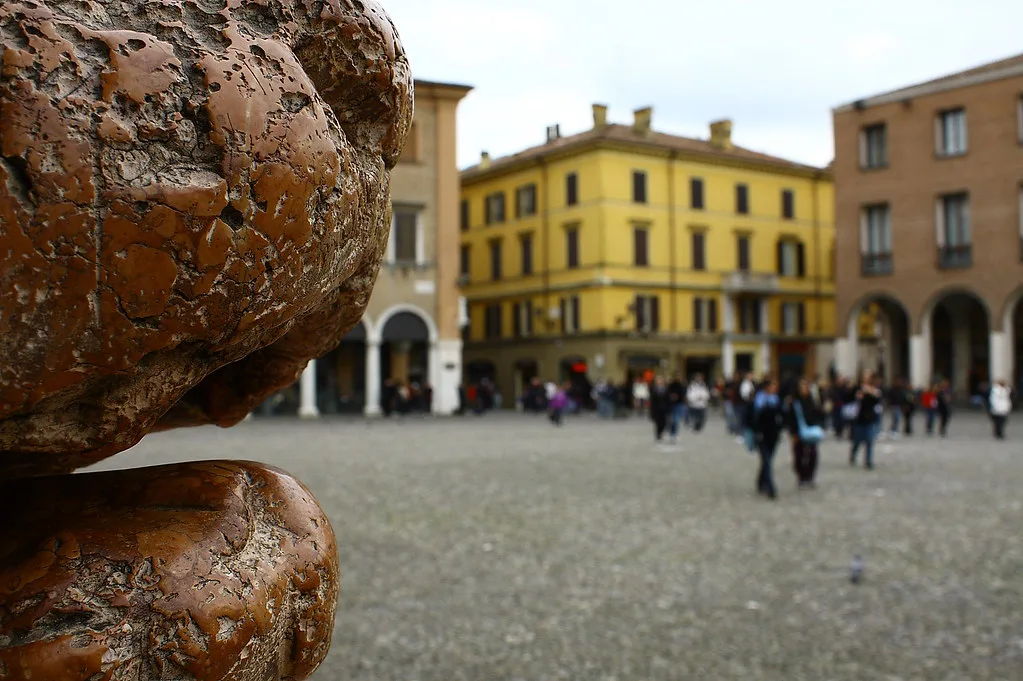
Underfoot the surface is river cobblestone, a detail that shapes the look of the square and gives the paving a pebble texture rather than the flat stone of many Italian piazzas. Look at it rather than past it: the small rounded stones are part of what makes the space feel old and used.
The Palazzo Comunale closes the square on the north and east, with the cathedral forming the other dominant edge of the enclosure. The effect is a space enclosed by civic and religious authority at once, which is why it reads as the city's living room rather than a monument to one family.
The cathedral is the Romanesque masterpiece that anchors everything else, begun in 1099 and completed with its bell tower in 1319. On the facade, Wiligelmo's sculptural cycle decorates the main portals, giving you something substantial to study before you consider going inside.
The Ghirlandina is attached to the Duomo and rises 86 metres, visible from outside the city in every direction, which makes it useful as an orientation landmark when exploring the wider centre. Its top is decorated with two marble railings resembling wreaths, the ghirlande that give the tower its name.
Why the Square Is Listed With the Cathedral and Tower
UNESCO recognises the ensemble of the Cathedral, Torre Civica and Piazza Grande as one World Heritage Site, inscribed in 1997. The listing does not praise the square in isolation; it credits the whole complex as a supreme example of early Romanesque art and as testimony to the faith of its builders and the power of the Canossa dynasty that commissioned the work.
Understanding that scope changes how you look around. The paving, the enclosing palace and the cathedral facade are not separate sights to tick off but parts of a single urban and architectural statement, so a slow circuit of the square is closer to the point than a checklist of individual features.
The civic side matters too. Modena's municipal authority maintains the official city portal where services, notices and events are published, and it is the sensible place to check before a visit for anything affecting the centre, such as public works or civic programming.
The Light Question: When to Walk the Square
A published piazza walk notes that at sunset the light turns the marble of the cathedral and the Ghirlandina into a palette of pastels, altering the atmosphere entirely. That is a concrete planning cue: if you can arrange your day so the square is your last stop, you see it in its most flattering light rather than at flat midday.
The trade-off is that late afternoon light comes with more people and less time before interiors close, so pair an evening circuit with a daytime return if you also want to see the cathedral interior. The square itself is open public space, and the sources give no specific crowd-free window, so treat any claim about quiet hours with caution.
Traditions Worth Planning Around
Two recurring civic traditions are documented well enough to build a visit around, and both fall outside high summer. On 31 January, the feast of Modena's patron saint Geminianus, the square fills with cheerful stalls, and during Carnival, on Fat Thursday, usually in mid-February, crowds gather beneath the balcony of the Palazzo Comunale to hear the rant of Sandrone, the traditional masked character, and his family the Pavironicas.
These are fixed liturgical and carnival dates rather than a published events calendar, and the municipality's official pages carry the civic programme for anything beyond them. Check the city's own notices before travelling if a specific spectacle is the reason for your trip, rather than assuming the square will be animated.
Outside those moments the piazza is primarily a place to stand and look, and the sources do not describe current weekly market trading on it. If a market is part of your plan, verify it through the tourist office or the comune rather than working from older assumptions.
Extending the Walk: Square to Square
Immediately beside the Ghirlandina is Piazza Torre, also known as Piazzetta delle Rivendugliole after the small greengrocers once concentrated there, where periodic art and craft markets are held in the shadow of the tower. Continuing along the Via Emilia toward Bologna brings you to Piazza Mazzini, created after the dismantling of the Jewish ghetto, of which the 1873 synagogue survives as the seat of the Jewish community.
From there the same itinerary suggests Piazza Roma, reached down Via Farini and useful for a rest on its modern benches beside the fountains, then Piazza San Domenico with its Begarelli terracotta group, and onward toward Largo Porta Sant'Agostino and the Palazzo dei Musei. The route returns through smaller spaces such as Piazza San Giacomo and its Fountain of the Nymph before circling back toward Piazza Grande.
Use the sequence as a menu rather than a forced march: the full circuit rewards a half-day if you stop inside churches, while the stretch from Piazza Grande to Piazza Roma makes a sensible short orientation walk if you are pressed for time. Distances within the centre are short and walkable, and the itinerary is published as a flexible self-guided route.
What Is Free and What Needs Checking
The square is public space, and nothing in the sources suggests a charge for standing on it, so wandering the paving and studying the facades costs nothing. The cathedral is an active place of worship as well as a monument, and its visitor arrangements, including any restriction on tourist entry during services, are not documented in the material behind this guide.
For the Duomo interior and the Ghirlandina climb, the honest position is that admission arrangements and booking requirements are not asserted here because they are not sourced. Check the cathedral's own channels and the city's tourist information before counting on either. The tower involves around 200 steps to the Stanza dei Torresani, the fifth floor, from where a 360-degree view opens over Modena, which is useful context when deciding whether the climb fits your day.
Common Mistakes to Avoid
Treating the square as a five-minute photo stop is the most common misjudgement, because the façade sculptures, the civic palace and the tower reward a slower lap. The second is arriving without checking the cathedral's current visitor arrangements and finding the interior unavailable at the moment you had set aside.
A third is confusing tradition dates with general opening: 31 January and Fat Thursday are the moments the square is animated, and they say nothing about when buildings open or when the city is busy overall. Keep the two questions separate and verify each with the relevant body.
Finally, resist the temptation to read the whole city through this one space. Modena rewards wandering beyond the UNESCO core, and the smaller corners and quieter lanes are where the centre becomes legible, so build in time for the hidden gems in Modena once you have done the square justice.
How the Square Fits a Modena Itinerary
Position Piazza Grande as the fixed centre of your day and let everything else orbit it. Start with a daylight lap to read the facade and the enclosure, return toward dusk when the marble softens, and use the surrounding piazzas to extend the walk if the light and your energy allow.
Before travelling, confirm the cathedral's current visiting arrangements and any civic events through official channels, since the square's own schedule is not published here. Then broaden out with the Modena Attractions hub to place the Duomo, the tower and the city's museums in a coherent sequence.
Frequently Asked Questions
What can you see in Piazza Grande in Modena?
You see a river-cobblestone square enclosed by the Palazzo Comunale and the cathedral, with the Ghirlandina bell tower rising beside it. The facade of the Duomo carries a notable Romanesque sculptural cycle, and the square is part of a UNESCO World Heritage Site inscribed in 1997 together with the cathedral and the Torre Civica.
Is Piazza Grande free to visit?
The piazza is public open space, so walking through it and looking at the surrounding architecture costs nothing. Whether any interior or tower climb carries a charge is a separate question and is not stated here; check with the cathedral and the city's tourist information before planning on visiting interiors.
Why is Piazza Grande a UNESCO site?
It is inscribed as part of the ensemble of the Cathedral, Torre Civica and Piazza Grande, recognised in 1997 as a supreme example of early Romanesque art. The listing credits the whole complex as testimony to the faith of its builders and to the power of the dynasty that commissioned it, so the square is understood as one component of a single statement.
What happens in Piazza Grande on 31 January?
On 31 January the city marks its patron saint, Geminianus, and the square fills with cheerful stalls. On Fat Thursday during Carnival, usually in mid-February, crowds gather beneath the balcony of the Palazzo Comunale for the traditional rant of Sandrone and the Pavironicas.
How long should you spend at Piazza Grande?
Our editorial advice is twenty to thirty minutes for the square itself and the facades, with another hour or more if you go inside the cathedral. If you also walk the surrounding piazzas, plan a half-day so you can move without rushing. These are suggestions rather than official estimates.
When is the best time to see Piazza Grande?
Late afternoon into sunset is the strongest time according to published guides, which describe the marble of the cathedral and the Ghirlandina turning to pastel tones as the light changes. If you also want to see interiors, pair that visit with a daylight return rather than relying on the evening alone.
Sources
Continue exploring
More guides you'll find useful





