
Visiting Modena Cathedral: Free Entry, Paid Routes and What to See
Plan a visit to Modena Cathedral, the UNESCO Romanesque duomo: what entry is free, what the small paid route adds, and which sculptures to seek out.
On this page
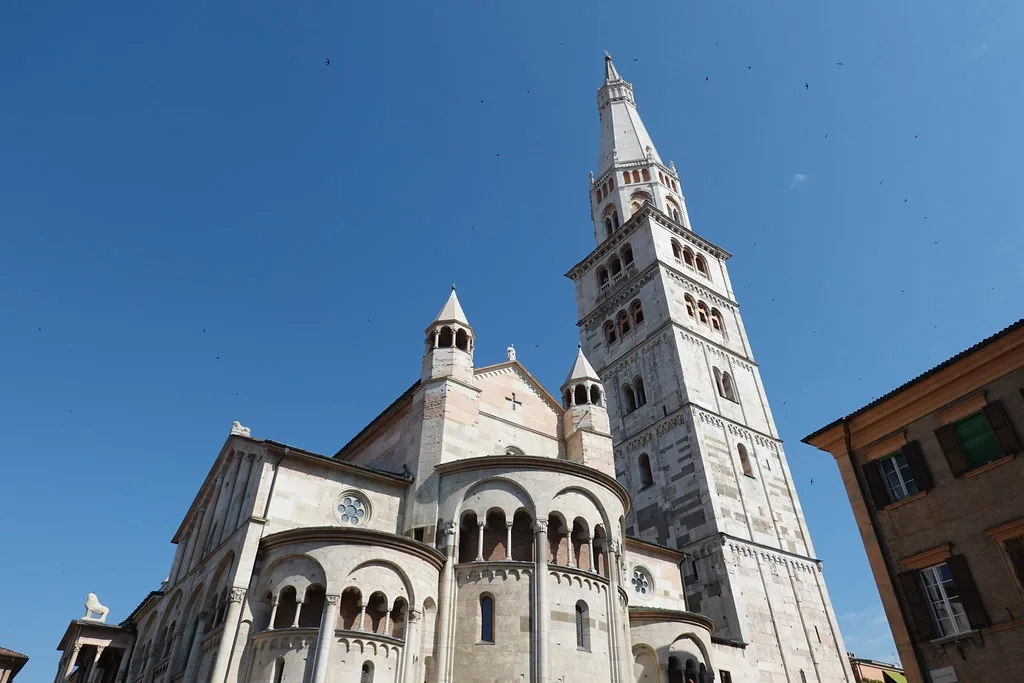
Modena Cathedral sits on Corso Duomo, between Piazza Grande and the Ghirlandina bell tower in the compact centre of Modena. The tourist office states that the cathedral, the tower and the square have been a UNESCO World Heritage Site since 1997, which is why the building reads as part of one ensemble rather than an isolated church. The nave is free to walk into, so the main decision is not whether to go but how much of the paid and contextual material to add.
Allow roughly 30 to 45 minutes for the free interior and a quick look at the façade, or about 90 minutes if you plan to read the portals, walk the perimeter and take the raised presbytery route. Those durations are editorial suggestions, not anything the cathedral publishes, so treat them as a planning baseline. For most travellers the exterior sculpture is the part that rewards slowing down, and it costs nothing.
Where the Duomo Sits in Modena
The cathedral faces Piazza Grande on one side and backs onto the Ghirlandina, so you can see the civic square, the church and the tower in a single short walk. The address given by the city's tourist office is Corso Duomo, 41121 Modena, which places you directly in the historic core rather than on the edge of town. Because everything is on foot, the Duomo works well as the anchor of a half-day in the centre.
If you want to extend the walk beyond the obvious monuments, the surrounding lanes reward a slow loop after your cathedral visit. Our guide to hidden gems in Modena covers the quieter corners of the centre that fit naturally around Piazza Grande.
The 30-Second History
The foundation stone was laid on 9 June 1099, and the building was consecrated by Pope Lucius III on 12 July 1184. The architect was Lanfranco, whose three-aisled basilica with a raised presbytery over the crypt became a reference point for Romanesque architecture across the Po Valley. Knowing these two dates helps you place the building: it is an eleventh-century project finished in the twelfth.
Sculpture came from Wiligelmo and his workshop, whose reliefs on the façade carry the Genesis stories in a direct, narrative style. Later masters from Campione, working from the late twelfth into the fourteenth century, added the rose window, the Porta Regia and the false transept. The result is a layered building where you can read different centuries in a few steps.
Free Versus Paid: What the Ticket Covers
Entry to the cathedral is free. The paid element is the upper presbytery, which gives an elevated view over the central nave and the counter-façade with its rose window, plus the sacristy. The tourist office publishes the entrance ticket at 3 euros per person and lists the route as closed to the public on Mondays, so do not save this for a Monday visit. Those published figures are not dated, so confirm them before you travel.
The crypt is not described as a separately ticketed area in the published information; the paid route covers the presbytery and sacristy only. Ticket reciprocity exists with the Cathedral Museums: showing a presbytery-route ticket entitles you to a reduced museum admission, and showing a museum ticket makes the presbytery route free. That is a reciprocal discount arrangement, not a single combined ticket for the whole complex, so budget accordingly.
Before travelling, verify the current fee and the days the paid route operates, because published figures and times can change between seasons. The cathedral's own site is the best starting point for anything time-sensitive, and the tourist office page is where the visiting rules are set out.
Practical Entry Rules
The tourist office publishes visiting hours of Tuesday to Sunday from 7:00 to 19:00, with shorter Monday hours split between morning and late afternoon. Visits are not permitted during celebrations, so a service can interrupt your sightseeing even inside the published window. Treat these hours as what has been published rather than as confirmed for any particular date, and check again close to your trip.
Groups are admitted free but must book a time slot in advance, and the tourist office publishes the visit regulations alongside the booking form. If you are travelling with a coach party, school group or guided tour, sort the slot before you arrive rather than turning up and hoping. Individual travellers do not face that requirement in the published information.
The Exterior Walk
Start on the Piazza Grande side at the Porta dei Principi, whose reliefs tell the story of San Geminiano, the city's patron saint. Then walk around to the northern side near the Ghirlandina to find the Porta della Pescheria, where two carved telamons appear to sag under their load and the door frames depict the months of the year as agricultural labour. Most hurried visitors see only the main façade, so this short loop adds a lot for very little time.
Look up at the roof line for the metopes, the carved projections showing imaginary and monstrous beings. The archivolts of the Porta della Pescheria carry the adventures of King Arthur, an unusual subject for an Italian cathedral portal and an easy detail to point out to children. Bring binoculars or use a phone zoom if you want to study the upper carvings properly.
One thing to know before you admire the stonework: the sculptures you see on the building are largely reproductions, with the originals moved to the Epigraphic Museum for conservation. That does not diminish the visit, but it explains why the carvings look so crisp after nine centuries of weather. Plan a museum stop if seeing the originals matters to you.
Reading the Sculpture
Wiligelmo's Genesis reliefs on the façade cover Adam and Eve, Cain and Abel, and Noah's Ark, carved with a narrative force that still reads clearly across the square. The tourist office notes that investigation during restoration work that began in 2006 found that stone salvaged from the Roman city of Mutina was reused in the building's cladding. Give yourself a few minutes in front of one panel rather than scanning all of them.
The interior carvings, including the capitals and the pulpit, are also worth close attention, but the exterior reliefs are where the building tells its most accessible stories. If you are travelling with people who tire of church interiors quickly, the outdoor sculpture walk is the strongest short stretch you can spend here.
Inside the Cathedral
The nave is broad and relatively uncluttered, with Enrico da Campione's pulpit dated 1322 and a crypt below the raised presbytery. The crypt holds the sepulchre of San Geminiano, the patron saint the cathedral was built to honour, which makes it the devotional heart of the building rather than a museum set piece. Keep your voice down and step aside when worshippers pass.
Other works gather through the side chapels: Guido Mazzoni's polychrome terracotta Adoration of the Shepherds from around 1480 to 1485, the inlaid wooden choir by the Lendinara brothers from 1465, and Dosso Dossi's Saint Sebastian panel from 1518 to 1522. Rather than trying to see everything, pick two or three pieces and look at them properly.
How Long to Allow
A short visit of about half an hour covers the nave, a look at the façade and a pause at the Porta dei Principi. A sculpture-focused visit of roughly 90 minutes adds the Porta della Pescheria, the metopes and the paid presbytery route. Neither figure is official, so adjust for your own pace and for how much time you want in the paid area.
If you are building a broader day in the city, our Modena Attractions hub lists other sights to slot around the cathedral. Pairing the Duomo with the Ghirlandina and Piazza Grande is the most efficient option, since all three are minutes apart.
Quiet Timing and Crowds
The cathedral is a free, working city-centre church, so it draws worshippers, school groups and tourists throughout the day. Rather than hunting for a guaranteed quiet hour, plan around services: visits are not allowed during celebrations, and the published timetable is the best guide to when the building is in liturgical use. Early mornings tend to feel calmer in many Italian churches, but no source confirms that for Modena, so treat it as a habit rather than a rule.
If you mainly want the exterior sculpture, the square and portals can be viewed without a ticket and are less affected by interior services. That makes the outdoor route a sensible fallback when the doors are busy or closed for Mass.
Access and Constraints
The tourist office notes that the paid presbytery area is not accessible to visitors with motor disabilities, which is a significant constraint if you were planning around the elevated view. The free nave is the easier part of the visit. Check current access arrangements directly with the tourist office before travelling if this affects your plans, and do not rely on older visitor reports.
Pairing the Duomo with Piazza Grande and the Museums
Because Piazza Grande, the Ghirlandina and the cathedral form one UNESCO ensemble, the natural visit is a loop rather than a single stop. The city's World Heritage office explains how the three monuments relate, which helps you see the square as part of the church's setting rather than a separate sight.
The Cathedral Museums are the place to see original sculpture moved off the building, and the reciprocal arrangement with the presbytery route can reduce the combined cost. Opening hours and full museum admission are not covered by the sources cited here, so check the official pages before you go. Add the museums if you want the originals; skip them if your time in the city is short.
Plan Your Visit
Modena Cathedral rewards a slightly slower approach than its free entry suggests: walk the exterior first, read one Genesis panel properly, then decide whether the paid presbytery and sacristy route is worth it for you. Check the published hours and fees on the official pages before you travel, since those details can change.
For the rest of your time in the city, use the Modena Attractions guides to build a day around the cathedral and the hidden gems guide for the quieter streets nearby. Both are within a short walk of Corso Duomo. For related planning, see Modena Viewpoints: Ghirlandina Tower vs Cathedral Views.
Frequently Asked Questions
Is Modena Cathedral free to enter?
Yes. The tourist office states that admission to the cathedral is free. A small paid route covers the upper presbytery and sacristy. Check the official tourist office page for the current fee, since the published figure may be out of date.
What does the paid presbytery and sacristy route include?
It gives access to the raised presbytery, with an elevated view over the nave and the rose window on the counter-façade, plus the sacristy. The tourist office notes that this paid area is not accessible to visitors with motor disabilities.
Who is buried in Modena Cathedral?
The crypt houses the sepulchre of San Geminiano, the patron saint of Modena, to whom the cathedral was dedicated. The tourist office describes the building as conceived as his house of worship, which is why the crypt sits at the devotional centre of the church.
Are the sculptures on the façade originals?
Most of the sculpture visible on the building consists of reproductions. The tourist office states the originals were moved to the Epigraphic Museum for conservation. If seeing the original carvings matters to you, plan a museum stop as well as the exterior walk.
How long should I spend at Modena Cathedral?
A short visit of about half an hour covers the nave and main façade. A sculpture-focused visit of roughly 90 minutes adds the Porta della Pescheria, the metopes and the paid presbytery route. These are planning suggestions, not official visit times.
Do groups need to book a time slot?
Yes. The tourist office states that groups are admitted free but must book a time slot in advance, and the visit regulations are published alongside the booking form. Individual visitors do not face that requirement in the published information.
Is a visit to Modena Cathedral worth it?
For anyone interested in Romanesque architecture or medieval sculpture, it is easy to justify. The cathedral is part of a UNESCO site with Piazza Grande and the Ghirlandina, entry to the nave is free, and the exterior portals reward close looking even on a short city stop.
When is the quietest time to visit?
No official source identifies specific quiet hours. Visits are not allowed during celebrations, so check the published timetable and avoid service times. Early mornings are often calmer in Italian churches, but treat that as a general habit rather than a confirmed rule for Modena.
Sources
Continue exploring
More guides you'll find useful





