
Castello Estense Visitor Guide: Towers, Frescoes and What Your Ticket Covers
Plan a visit to Ferrara's moated Castello Estense: what the Castle Museum includes, the Torre dei Leoni climb, time to allow and garden access caveats.
On this page
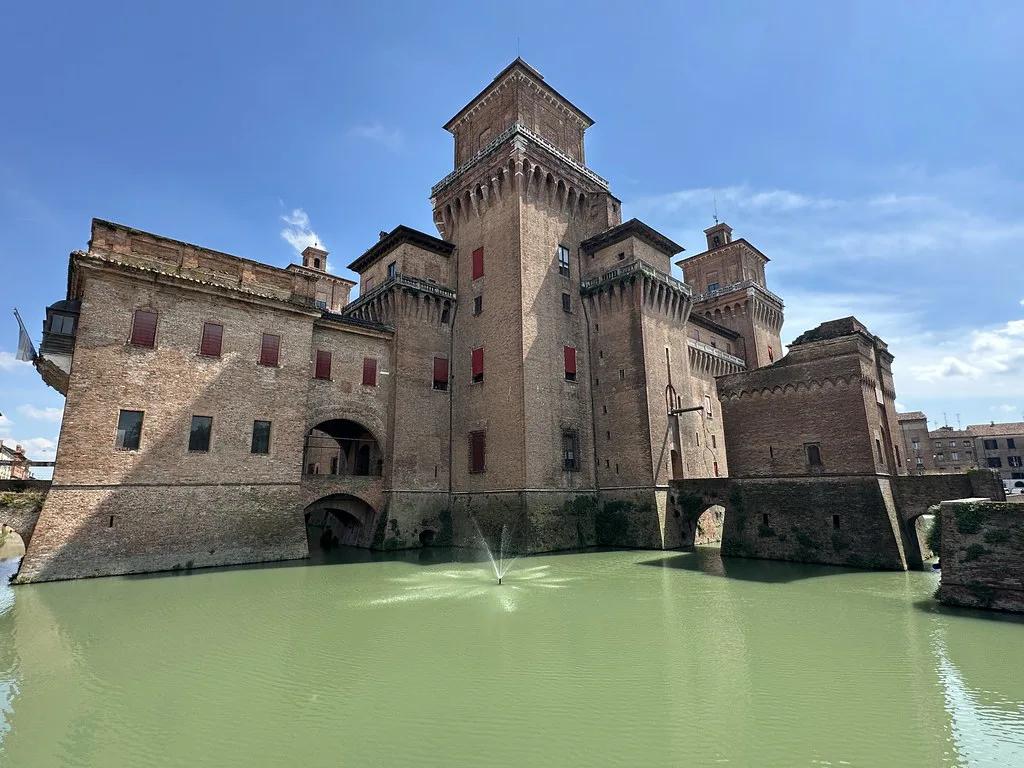
The Castello Estense sits in the middle of Ferrara, a ring of red brick and pale balustrades rising straight out of a water-filled moat. It began as a fortress and later became the residence of the Este family, so a visit moves between defence and display rather than staying in one register. Treat it as two experiences — the museum route through the interior and the tower climb above it — and planning gets simpler.
This guide covers what the Castle Museum contains, why the Torre dei Leoni carries its own supplement, how the moat actually works for visitors and where the sources stop short on the Orange Garden. It also sets out hours and ticket tiers as a regional castles page publishes them, with the caveat that such details carry a validity window. A useful starting point for the wider city is the collection of Ferrara Attractions guides.
Why the Este Family Built a Castle in the Middle of Ferrara
Construction began in 1385 under Marquis Nicolò II d'Este, to a design by Bartolino da Novara, after a popular uprising convinced the family it needed a refuge it controlled. The site absorbed the existing Torre dei Leoni, part of the medieval walls, and three further towers were raised around a central courtyard, all enclosed by a moat.
By the end of the 15th century the building had shifted from stronghold to court residence. Turrets, marble balconies, a Renaissance courtyard and frescoed apartments were added, and those interiors are the rooms visitors now walk through. When the duchy passed to the Papal States in 1598 the Este left Ferrara, and the castle later served as the seat of Cardinal Legates.
The Province of Ferrara, which bought the castle after Italian unification, remains its owner and carried out major restoration work. That institutional history explains why the castle reads as a museum today rather than a furnished palace: the Este patrimony was dispersed after 1598, and what remains is architecture, fresco cycles and the story of how the building was used.
The Castle Museum: Dungeons, Frescoed Apartments and Storerooms
The museum layout was designed by architect Gae Aulenti and runs as a narrative route, from the dungeons at moat level up to the frescoed halls of the ducal apartments. Below the courtyard, large barrel-vaulted rooms with original terracotta flooring once served as storerooms and as access to the wharf, where people left the castle by small boat. Those water-level spaces are part of the visit, not a separate attraction.
The dungeons occupy the basement of the Torre dei Leoni, at the level of the moat, and held high-ranking prisoners who needed special surveillance; the rooms connect and are now used for ceremonies and events. Upstairs, the apartments are largely without furniture, which shifts attention upward to the ceilings. Mirrors placed in some rooms let you study the frescoes without craning your neck, and some cycles still show the effects of the 2012 earthquake and subsequent restoration. Further visitor details appear in The mirrors of Castello Estense in Ferrara | Velvet Escape.
Torre dei Leoni: The Climb and the Supplement
The Torre dei Leoni is the oldest of the four towers, and its top is the only point in the castle that gives a panoramic view over Ferrara and the surrounding territory. Reaching it means climbing 120 steps in sequence, so it is a physical commitment rather than a lift ride. The tower is not simply another room on the museum route.
On the regional castles page, the tower is listed with a supplement on top of the standard admission rather than being folded into one all-inclusive ticket. That page also records a last ticket for the Torre dei Leoni at 16:30 and a last ascent at 17:15, with the ticket office closing at 17:15 — cut-offs that matter if the tower is the reason you came.
Before you build a day around the climb, check the official castle website for the current position, because tower access can be suspended independently of the rest of the museum. Confirming the day's situation at the ticket desk costs a minute and avoids arriving for a view you cannot reach.
The Moat, the Imbarcaderi and What You Can Actually Enter
The moat is a visual feature that surrounds the castle; visitors do not cross it, walk on it or enter it. What you can do is stand at the water-level rooms and understand how the castle related to water in use: the wharf below the courtyard was where boats, including larger bucentaur-type vessels, pulled in. That relationship is legible from inside the lower route, not from the water itself.
Ugo and Parisina: The Story That Dominates the Dungeons
The castle's most repeated tale concerns Ugo, an illegitimate son of Niccolò III d'Este, and his young stepmother Parisina Malatesta. According to the account, the two fell in love during a pilgrimage to Loreto, were discovered on their return to Ferrara, imprisoned in the castle dungeons and later executed. The story travelled widely and inspired Byron's poem Parisina.
It is worth separating two things in the dungeon rooms: what the building can show you and what the story asserts. The vaulted spaces and their position at moat level are documented fabric; the narrative of the lovers comes down through literary retelling, which is why guides linger on it. Listening for that distinction makes the lower route more interesting, not less.
Courtyard and Orange Garden: What Is Documented and What Is Not
The courtyard of honour and an eight-arched loggia were part of the castle's 15th- and 16th-century transformation from fortress to residence. A garden attributed to Girolamo da Carpi, built in the 1550s for the women of the court and known as the Orange Garden, is also described in accounts of the castle's Renaissance layer.
What the available sources do not settle is access: there is no confirmation that the Orange Garden is free, separately ticketed or always open, and the same caution applies to the courtyard as an independent stop. Ask at the ticket office whether either is open on the day of your visit rather than assuming they form part of the paid route or that they are open to all.
Opening Days, Hours and Ticket Tiers
The regional castles page lists free visits from 30 April 2025 to 31 January 2027, open 10:00 to 18:00 on Monday and Wednesday through Sunday, with Tuesday closed. Within that same listing the ticket office closes at 17:15, and it states that the ticket office shuts 45 minutes before closing. That is the clearest published picture, and it comes with an end date attached.
The same page sets out tiers rather than a single price: a full ticket, a reduced ticket for visitors such as over-65s, university students and groups of at least 15, and reduced rates for younger teenagers in a specific age band. It also lists free admission categories and a family arrangement in which one child enters free per paying adult. Because these figures sit inside a dated validity window, treat them as a reference point and confirm at the castle ticket office.
The official castle website carries its own contact details for the ticket office at Largo Castello 1, and that is the channel to use for a specific date rather than relying on a secondary listing. A quick call or message resolves whether a booking is advisable and whether any part of the route is closed for works.
How Long to Allow and How to Sequence Your Day
As a working estimate rather than an official figure, allow around two hours for the museum route at an unhurried pace, and add 30 to 45 minutes if you intend to climb the Torre dei Leoni. The tower's fixed ascent cut-off means the climb is better placed early in a visit than at the end, particularly on a short winter afternoon.
Outside the castle, Ferrara rewards walking: the Cathedral of San Giorgio stands a short distance away, and the Palazzo dei Diamanti is reachable on foot in the historic centre. The city's UNESCO-listed centre and its quieter lanes are covered in the hidden gems in Ferrara guide, which works well as an afternoon complement to a castle morning.
If you are combining several museums, the regional page notes that the castle accepts the MyFe cumulative museum card, which is offered in multi-day versions. That is a decision worth making before you buy individual admissions, since it changes how many sights you can reasonably fit into a stay.
Practical Planning: Booking, Closures and Day-of-Week Traps
The castle is closed on Tuesdays according to the published schedule, which makes Tuesday the day to schedule the cathedral, the Palazzo dei Diamanti or a walk along the Po instead. The listing also records some exceptional openings and December closures, and it notes that the tower may be closed on those dates; check the current notice rather than planning from a page whose window has expired.
Reservations via the city's museum booking page are described as strongly recommended to avoid crowding, so booking ahead is the low-effort option even when it is not compulsory. Do not treat that as a guarantee either way for a given date: the booking page is the place that answers whether a slot exists when you want one.
The castle appears on the Ferrara Attractions hub alongside the city's other sights, which helps if you are choosing between a castle-led day and one built around churches and galleries. The Ferrara page collects the guides in one place so you can compare before committing your time.
Plan Your Visit
Castello Estense rewards a little preparation because its two halves work differently: the museum route is a self-paced walk through dungeons, storerooms and frescoed apartments, while the tower is a timed, step-heavy add-on with its own supplement and cut-offs. Decide which of those you actually want before you arrive, and budget time for both if the answer is both.
Confirm hours, prices and any closures on the official castle website close to your date, since the most detailed public listing carries a validity window. Then build the rest of the day around Ferrara itself — the cathedral, the palaces and the quieter streets beyond the moat.
Frequently Asked Questions
Is the moat at Castello Estense walkable or enterable?
No. The moat surrounds the castle and functions as a visual feature; visitors do not cross it or walk on it. What you can do is see how the castle connected to water from the lower-level rooms, where storerooms and a wharf once gave onto the moat. Access arrangements can change with works, so confirm at the ticket office.
How many steps is the Torre dei Leoni climb?
The climb to the top of the Torre dei Leoni runs to 120 steps, according to the regional castles listing, and ends at the only vantage point that gives a panorama over Ferrara and its territory. Because the tower is the oldest of the four, the route up is historic fabric rather than a modern stairwell. Allow extra time and check whether the tower is open on your date.
Does the castle ticket include the tower?
Treat the tower as an add-on rather than an included extra. The published listing shows a supplement for the Torre dei Leoni on top of standard admission, along with separate last-ticket and last-ascent times for the tower. Exact figures sit inside a dated validity window, so confirm the current position at the ticket office before paying.
How long should I spend at Castello Estense?
A reasonable working estimate is about two hours for the Castle Museum route, plus another 30 to 45 minutes if you climb the Torre dei Leoni. That is a suggested allowance rather than an official duration. Group visits and anyone reading every panel should add time, and the tower cut-off means climbers should go up early rather than last.
Is the castle closed any day of the week?
The published regional listing shows Tuesday as the weekly closing day, with opening on Monday and Wednesday through Sunday. It also records some exceptional openings and December closures, and notes that the tower can be closed on certain dates. Hours and closures are best confirmed on the official castle website shortly before you travel.
Is the Orange Garden separately ticketed?
There is no confirmed position either way. The garden is described in accounts of the castle's Renaissance layer, attributed to Girolamo da Carpi and built for the women of the court, but the sources do not establish whether it is free, separately ticketed or always open. Ask at the ticket office on the day rather than assuming access.
Is the Ugo and Parisina story true and where did it happen?
The story of Ugo and Parisina is attached to the castle's dungeons, where the pair were reportedly imprisoned before their execution. It comes down to us through literary retelling, including Byron's poem, so the building's rooms are documented while the romantic narrative is a later tradition. Guides tell it in the lower rooms at moat level.
Sources
Continue exploring
More guides you'll find useful





