
Bolzano Cathedral Visitor Guide: What to See at the Duomo
Plan a visit to Bolzano Cathedral: what to see in the Gothic nave, the openwork bell tower and surviving frescoes, plus how long to allow nearby.
On this page
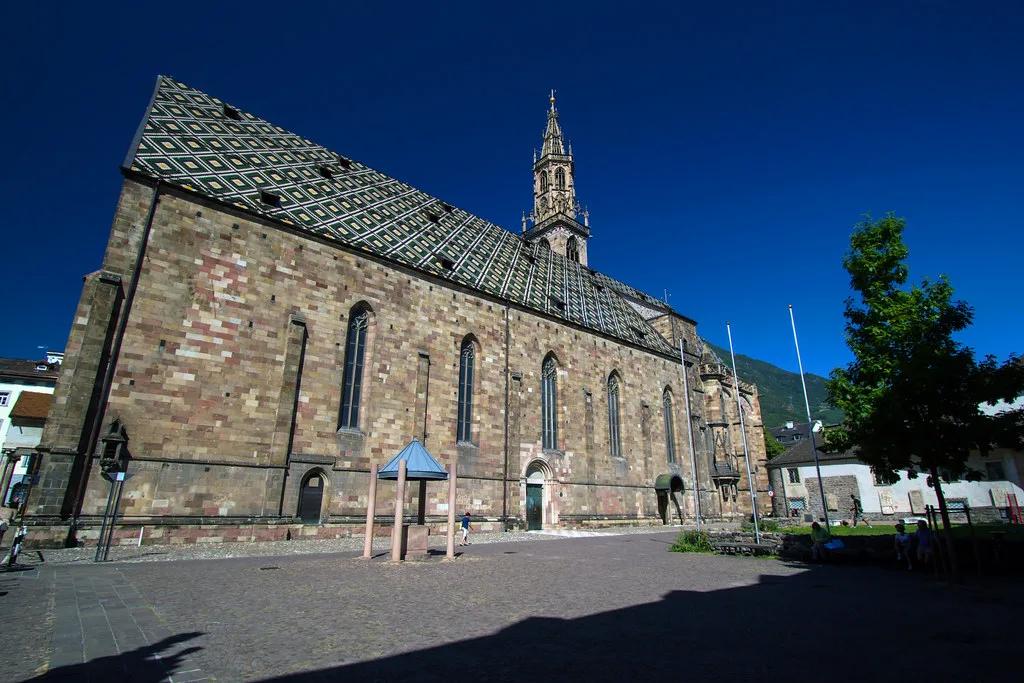
Bolzano Cathedral, the Duomo di Bolzano or Bozner Dom, is the first landmark most visitors see after stepping out of the station into Piazza Walther. Its openwork spire rises above the square, and the Gothic nave opens straight off the city's busiest pedestrian space. One source places the bell tower at 65 metres and calls its spire a late Gothic masterpiece, a detail worth looking up for as soon as you arrive. The church has been the bishop's church and co-cathedral of the Diocese of Bolzano-Brixen since 1964, so it is a working place of worship rather than a monument kept behind glass.
It works best as an anchor: a fixed point you return to between the arcades, the fruit market and the museums nearby. The building is easy to cross in a few minutes, so it can carry a short pause or open onto a slower half-day through the old town.
Where the Duomo Sits in the Old Town
Piazza Walther, named for the medieval poet Walther von der Vogelweide, is the square where the cathedral faces daily city life. The square opens onto Via dei Portici, the arcaded main street that runs roughly 300 metres under tall houses with oriel windows and shops. A sensible route starts at the church doors, continues through the arcades and ends at the fruit market on Piazza delle Erbe, all within a short walk.
From the station, the square is reached on foot through the pedestrian centre. The city's tourism board frames Bolzano as the gateway to the Dolomites and presents its streets, museums and cable cars as one continuous experience, which is a useful way to organise a stay. Put the cathedral at the centre and treat everything else as a ring around it.
How to Read the Building: Romanesque Roots to Gothic Rebuilding
The cathedral's mixed character comes from a long building history. A Romanesque basilica on the site was completed in 1222, built under Lombard master builders who had previously worked on the cathedral of Trento. About a century later that building was judged outdated, and a Gothic replacement began under architects from Swabia, the brothers Schiche.
The stone repays close attention: reddish Bolzano sandstone and yellowish stone from the Unterland were used for the Gothic work, and the difference is subtle but visible across the facade. The Romanesque apses gave way to a new choir, and windows and portals were redesigned in the new style. Traces of the older church survive in the vestibule, the presbytery and the south portal, which is why a slow circuit of the exterior is worth the time.
The interior's painted scheme is uneven because of the war. The cathedral was heavily damaged by Allied bombing in the 1940s, and much of its fresco decoration and a large part of the old stained glass were lost. Reconstruction after 1945 also brought to light remains of the early Christian church beneath the floor. What you see inside is therefore a rebuilt interior with surviving fragments, not an untouched medieval ensemble.
Look Up: The Bell Tower and the Roof
The bell tower is the detail to seek out first. The 65-metre tower was completed in 1517, and the Swabian master builder Hans Lutz von Schussenried placed his openwork spire on the Romanesque base; one account calls that spire a masterpiece of late Gothic craftsmanship. Notice how the delicate stonework thins as it rises, and how different it looks against morning and late-afternoon light.
The second detail sits overhead: the roof is laid with coloured glazed tiles in a diamond pattern, which gives the building its distinctive silhouette from across the square. Photographers should step to the far side of Piazza Walther for roof and tower together, then return close to the facade for the portal carvings.
Tower access is not something the sources consulted describe, and no verified schedule for climbing appears in them. Readers hoping to go up should ask the diocese directly rather than assume access is available. The exterior view is the dependable highlight.
Inside the Nave: The Pulpit and the Surviving Frescoes
The interior is deliberately plain, and its centrepiece is the late Gothic sandstone pulpit associated with Hans Lutz, described as the highlight of the church and said to have been carved by hand by the same master. Look at the carved detail and the way the pulpit stands out against the simple nave around it.
In the vestibule there is a fresco of the Madonna with Child attributed to Michael Pacher, the great Tyrolean painter and carver of the late Gothic. Because much of the interior painting was lost in the bombing, this and the remaining fragments are what reward a patient look. Expect architecture and stonework rather than a dense pictorial cycle.
Where the Treasury Is Shown
The cathedral treasury is exhibited separately, in the diocesan museum, rather than inside the church. Treat it as its own stop rather than assuming a visit to the nave includes it. The sources reviewed here do not confirm a current price or a combined ticket, so check with the Diocese of Bolzano-Brixen or the museum before you go.
The diocese's history explains this arrangement. The cathedral chapter remains in Brixen, and the Bolzano church became a co-cathedral only in 1964 when the new diocese was created. Institutional collections and the church building are therefore administered in different places, and it is safest to plan them as two separate visits.
Practical Planning: Hours, Etiquette and the Square
The cathedral is an active place of worship, so services take priority over sightseeing. Visit outside Mass times where possible, keep voices low and dress respectfully. The sources consulted do not provide a verified current schedule, so confirm arrangements with the diocese before making the church the fixed point of a day.
Piazza Walther itself changes character with the seasons. A flower market traditionally fills the square around 1 May, and secondary accounts describe a Christmas market from late November into early January. These are traditions rather than fixed dates for any particular year, so verify before planning travel around them.
Hours at other Bolzano museums say nothing about the cathedral. The South Tyrol Museum of Archaeology, for instance, publishes its own schedule and ticket terms, and it is a separate operation. Check each site on its own rather than carrying city-wide assumptions from one to another.
How Long to Allow: An Editorial Suggestion
A practical suggestion, not an official figure, is to allow about 30 to 45 minutes inside for the nave, the pulpit and the vestibule fresco. Add around a quarter of an hour outside for the tower and the square. This estimate reflects the building's compact size and is offered as planning advice only.
If you add the diocesan treasury or a second church, half a day is a realistic block for the cathedral area alone. Pairing the Duomo with the Dominican church, whose Chapel of St. John holds fourteenth-century frescoes in the manner of Giotto, or with the old parish church of Gries, where Michael Pacher's carved altar survives in a side chapel, gives each building room to register.
For a fuller old-town day, combine the cathedral with the archaeology museum and a walk along the Talvera promenade. The museum publishes its own visiting information, and the riverside path offers a green contrast to the stone square. The cathedral remains the natural starting point.
Pairing the Cathedral with Other Bolzano Sights
The South Tyrol Museum of Archaeology is a few minutes away and holds Ötzi, the Copper Age mummy found in the Alps in 1991 and exhibited in Bolzano since 1998. The museum manages its own hours and time slots, and it is a paid museum entirely separate from the church.
For open views, the Renon cable car climbs from near the station to Oberbozen, and the narrow-gauge Renon railway continues across the plateau. On foot, the Lungotalvera promenade follows the river meadows out toward Runkelstein Castle, a gentle way to see the mountains that frame the square.
Among the hidden gems in Bolzano, the quieter churches and promenade paths around the old town are easy to pass over on a quick visit. Runkelstein Castle, with its late fourteenth-century secular frescoes painted for the Vintler brothers, offers a different kind of art from the cathedral's and rewards a longer walk or a bus ride.
Make the Duomo the Anchor of Your Day
Bolzano Cathedral works best as a fixed point you return to rather than a sight to tick off. Its late Gothic tower and glazed roof give the city a recognisable silhouette, and its restrained interior rewards a slow look at the pulpit and the vestibule fresco. Because the church is in active use, confirm current arrangements with the diocese before you go.
Around that anchor, layer the old town, the Dominican church and, if the treasury interests you, the diocesan collection as separate stops with their own terms. The pairings in this guide are suggestions rather than a fixed itinerary, and the city's museums and promenades can be chosen to fit your pace. For related planning, see Chiesa dei Francescani Bolzano: A Visitor Guide.
Frequently Asked Questions
Is Bolzano Cathedral free to visit?
The sources consulted here do not confirm a current entry price or state that entry is free. Treat the church and any treasury or diocesan museum as potentially separate, and check with the Diocese of Bolzano-Brixen before you go.
How long does it take to visit the Duomo di Bolzano?
An editorial suggestion is about 30 to 45 minutes inside for the nave, pulpit and vestibule, plus a quarter of an hour outside for the tower and square. This is not an official figure; add time if you plan to include the diocesan treasury or a nearby church.
What is the Duomo di Bolzano known for?
It is known for its openwork bell tower, its diamond-patterned glazed roof and its role as co-cathedral of the Diocese of Bolzano-Brixen. Inside, the late Gothic sandstone pulpit and the vestibule fresco attributed to Michael Pacher are the main artistic highlights.
Where is the cathedral treasury displayed?
The treasury is exhibited separately in the diocesan museum rather than inside the church. Treat it as its own stop and confirm current arrangements with the diocese.
What else should I see near Piazza Walther?
The arcades of Via dei Portici, the fruit market on Piazza delle Erbe and the Dominican church with its Giotto-school frescoes are all a short walk away. The South Tyrol Museum of Archaeology and the Talvera promenade can also be combined with a cathedral visit.
Sources
Continue exploring
More guides you'll find useful





